


A motion to impeach President William Lai (賴清德) would be put forward by the Legislative Yuan’s Procedure Committee tomorrow, with the legislature convening on Friday at the earliest to draft a timetable for the process, which would include many public hearings, Chinese Nationalist Party (KMT) caucus secretary-general Lo Chih-chiang (羅智強) said yesterday.
The KMT and Taiwan People’s Party (TPP) caucuses on Friday last week proposed impeaching Lai. The move came after Lai on Monday last week refused to promulgate a legislative amendment that would have allowed local governments to receive a larger share of government revenue, arguing the legislation would hurt the nation’s fiscal sustainability. Premier Cho Jung-tai (卓榮泰) had declined to countersign the legislation, which Lai cited as the reason for not publicly announcing the law, normally considered to be routine.
Lo said the priority is to ensure people nationwide are fully informed about the proposed impeachment, which would require more time for public hearings.
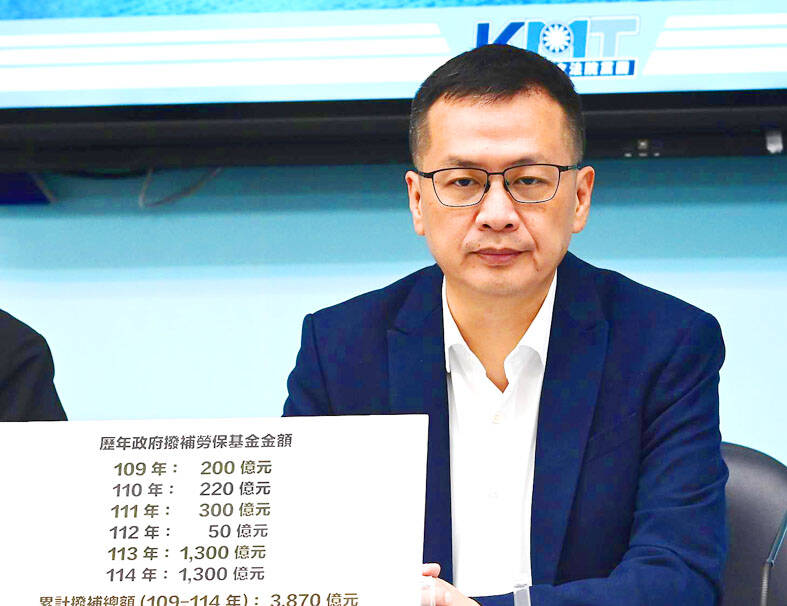
Photo: Taipei Times
The KMT and TPP are discussing the number of hearings and venues, which would possibly be held across the country as well as at the Legislative Yuan, he said.
Lo said this is a critical moment for the nation’s constitutional democracy.
The opposition wants to ensure thorough communication with the public through hearings and other events, so people can understand that an allegedly unconstitutional president is being impeached to defend democracy, Lo said.
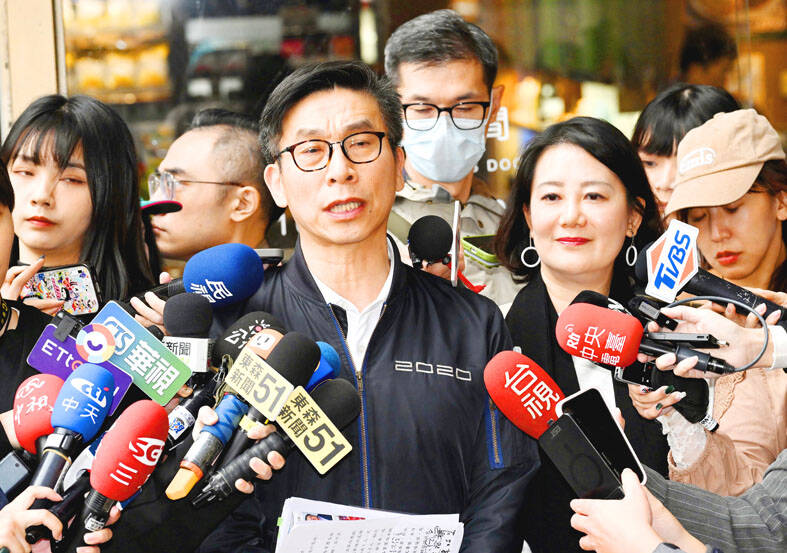
Photo: Lo Pei-de, Taipei Times
The Legislative Yuan plans to invite Lai to attend and provide an explanation in line with the Act Governing the Legislative Yuan’s Power (立法院職權行使法), TPP Chairman Huang Kuo-chang (黃國昌) said.
“This is not an invitation for you to give a national intelligence report, but a request for you to attend and explain in your capacity as the person being impeached,” Huang said, addressing Lai.
The provision allowing the Legislative Yuan to request the impeached person attend a hearing was passed when Lai was a legislator, not by the current legislature, Huang said.
“I do not know if Lai would claim the provision is unconstitutional and that the Legislative Yuan has no authority to invite him,” Huang said.
The opposition wants to show people that Taiwan’s hard-earned democracy and freedom have been trampled over by the Lai administration, he said.
The formal voting would only take place after public hearings in every corner of Taiwan, as they want to make sure people understand the reasons for the impeachment, he added.
This is the first time in Taiwan’s constitutional history that the Legislative Yuan has initiated an impeachment, so the procedure for Lai’s attendance still needs to be clarified, Democratic Progressive Party (DPP) Legislator Rosalia Wu (吳思瑤) said.
If the opposition wants Lai to appear before the Legislative Yuan, why not let him present a national intelligence report, which would benefit national development and he is willing to do, Wu said.
The motive for the opposition inviting Lai in this way might be to create a platform to insult, abuse and politically attack the president, she said.
DPP caucus chief executive Chung Chia-pin (鍾佳濱) said the opposition’s contradictory impeachment would make them a laughingstock, urging them to read the Constitution and recognize the Constitutional Court’s authority.
The KMT and TPP have acted with impunity since gaining the legislative majority last year, Chung said.
It is absurd that they previously advocated abolishing the Control Yuan, only to about-face and try to use it to impeach Cho, he said.
They pushed to impeach Lai while the Constitutional Court was still unable to function, and when that court ruled the amendment that paralyzed it unconstitutional, they said that ruling was invalid, he added.
Their demands are contradictory and confusing, Chung said.
The impeachment could only proceed if the opposition allows the Constitutional Court to operate and recognizes the court’s recent judgement, he said.
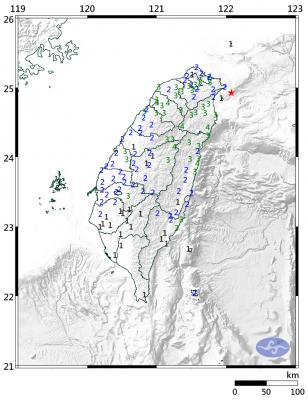
A magnitude 6.1 earthquake struck off the coast of Yilan County at 8:39pm tonight, the Central Weather Administration (CWA) said, with no immediate reports of damage or injuries. The epicenter was 38.7km east-northeast of Yilan County Hall at a focal depth of 98.3km, the CWA’s Seismological Center said. The quake’s maximum intensity, which gauges the actual physical effect of a seismic event, was a level 4 on Taiwan’s 7-tier intensity scale, the center said. That intensity level was recorded in Yilan County’s Nanao Township (南澳), Hsinchu County’s Guansi Township (關西), Nantou County’s Hehuanshan (合歡山) and Hualien County’s Yanliao (鹽寮). An intensity of 3 was
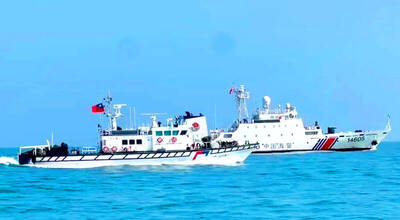
Instead of focusing solely on the threat of a full-scale military invasion, the US and its allies must prepare for a potential Chinese “quarantine” of Taiwan enforced through customs inspections, Stanford University Hoover fellow Eyck Freymann said in a Foreign Affairs article published on Wednesday. China could use various “gray zone” tactics in “reconfiguring the regional and ultimately the global economic order without a war,” said Freymann, who is also a nonresident research fellow at the US Naval War College. China might seize control of Taiwan’s links to the outside world by requiring all flights and ships entering or leaving Taiwan
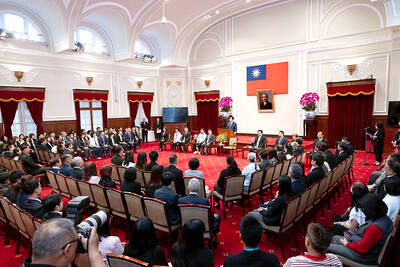
The next minimum wage hike is expected to exceed NT$30,000, President William Lai (賴清德) said yesterday during an award ceremony honoring “model workers,” including migrant workers, at the Presidential Office ahead of Workers’ Day today. Lai said he wished to thank the awardees on behalf of the nation and extend his most sincere respect for their hard work, on which Taiwan’s prosperity has been built. Lai specifically thanked 10 migrant workers selected for the award, saying that although they left their home countries to further their own goals, their efforts have benefited Taiwan as well. The nation’s industrial sector and small businesses lay
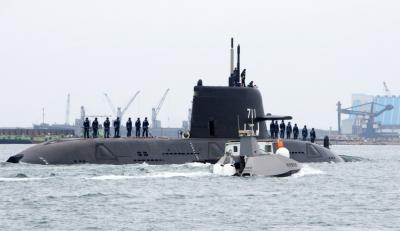
Taiwan's first indigenous defense submarine, the SS-711 Hai Kun (海鯤, or Narwhal), departed for its 13th sea trial at 7am today, marking its seventh submerged test, with delivery to the navy scheduled for July. The outing also marked its first sea deployment since President William Lai (賴清德) boarded the submarine for an inspection on March 19, drawing a crowd of military enthusiasts who gathered to show support. The submarine this morning departed port accompanied by CSBC Corp’s Endeavor Manta (奮進魔鬼魚號) uncrewed surface vessel and a navy M109 assault boat. Amid public interest in key milestones such as torpedo-launching operations and overnight submerged trials,


 RSS
RSS