


US President Donald Trump’s decision to impose a partial blockade on Venezuela is a dramatic escalation in US pressure on Venezuelan President Nicolas Maduro, but it risks undermining a top US policy goal: deterring a potential Chinese naval encirclement of Taiwan.
Trump on Tuesday last week ordered the “total and complete blockade” of all sanctioned oil tankers entering and leaving Venezuela, a move aimed at strangling the Maduro government’s main source of income. The action immediately raised questions under international law about whether it amounts to an act of war.
In the Indo-Pacific region, military planners have long feared that China might use a naval blockade to coerce democratically governed Taiwan to accept Beijing’s rule.
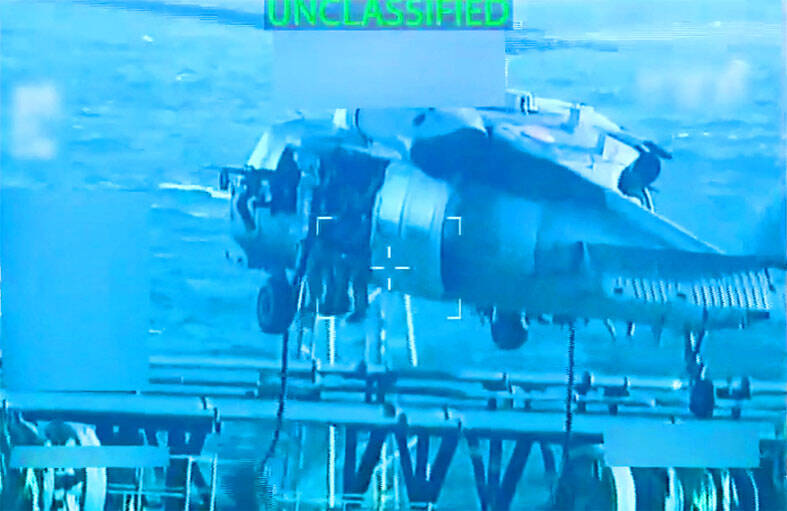
Photo: Reuters
Experts say Beijing could exploit a US blockade of Venezuela to undercut any American efforts to drum up international diplomatic opposition to such a move in the Taiwan Strait.
“If the US blockades to change political outcomes in Venezuela, China can justify coercive measures against Taiwan on so-called security grounds,” said Craig Singleton, a China expert at the think tank Foundation for Defense of Democracies in Washington.
“The legal contexts differ, but the propaganda opening is real,” he said, adding that precedent in international relations is set not only by law, but by narrative.
BLURRED TERMS
“When Washington blurs terms, it weakens its ability to call out coercion elsewhere,” he said.
The blockade is the latest step in a US military buildup that has included more than two dozen strikes on alleged drug boats to pressure Maduro and other senior Venezuelan officials, who the Trump administration says are linked to drug traffickers.
Maduro has said that the US action is aimed at overthrowing him and gaining control of the OPEC nation’s oil resources, which are the world’s largest crude reserves.
“President Trump is prepared to use every element of American power to stop drugs from flooding into our country and to bring those responsible to justice,” a White House official said in response to Reuters’ questions, without addressing the Taiwan issue.
China, the biggest buyer of Venezuelan crude, has sided with Venezuela, saying on Thursday that it “opposes all acts of unilateralism and bullying and supports countries in defending their sovereignty and national dignity.”
Beijing has repeatedly signaled that a de facto naval blockade could be a key element of a campaign to gain control of Taiwan.
China’s military has practiced blockade-style drills with increasing frequency in recent years around Taiwan, whose government rejects Beijing’s claims.
To an international audience, Chinese officials would probably portray such a move around Taiwan as a domestic quarantine or law enforcement matter.
Taiwanese officials have said a Chinese blockade of Taiwan would be an act of war and have far-reaching consequences for international trade.
Washington, which opposes unilateral changes to the “status quo” over Taiwan, would say that Chinese naval encirclement of Taiwan would amount to a blockade.
The Trump administration’s national security strategy released earlier this month called deterring conflict over Taiwan a priority due to its strategic location and economic importance.
CHINA’S GOAL
Isaac Kardon, a senior fellow at the Carnegie Endowment for International Peace who studies China’s maritime power, said Beijing would want to prevent the US from building a global coalition to oppose Chinese action toward Taiwan. International concern about a US blockade of Venezuela would be useful for China’s effort.
“Ultimately, the US is doing a lot of damage to the normative quality of the rules,” Kardon said. “That is a major blow to the credibility of international law to restrain other actors.”
Kardon said US action on Venezuelan tankers could open the door for China to take similar actions, such as interdicting Taiwan-bound vessels carrying vital natural gas supplies.
“Everything about it muddies the waters,” he said.
Protracted deployment to the Caribbean of US naval assets could undermine US military readiness and its ability to respond to a crisis in the Taiwan Strait, experts said.
Wartime blockades are permitted under international law, but only under strict conditions.
A full US blockade of Venezuela would likely be illegal without clear evidence that the US was in armed conflict with the country, said Milena Sterio, a maritime law expert at Cleveland State University.
“A US blockade would undermine our ability to criticize a Chinese blockade of Taiwan,” Sterio said. “The same rules of international law apply to all states and it would be inconsistent for the US to criticize others for doing what we are doing.”
Michael Hunzeker, a specialist on Taiwan’s military deterrence at George Mason University, said he was skeptical that Trump’s actions would hurt the effort that really matters: building US allied support for counter-blockade efforts in a crisis over Taiwan.
Any reference by allies to Venezuela in that context, Hunzeker said, would likely be rhetorical justification for a realpolitik decision to remain on the sidelines.
“I highly doubt that this episode will significantly reshape how they assess those interests,” he said.

Yangmingshan National Park authorities yesterday urged visitors to respect public spaces and obey the law after a couple was caught on a camera livestream having sex at the park’s Qingtiangang (擎天崗) earlier in the day. The Shilin Police Precinct in Taipei said it has identified a suspect and his vehicle registration number, and would summon him for questioning. The case would be handled in accordance with public indecency charges, it added. The couple entered the park at about 11pm on Thursday and began fooling around by 1am yesterday, the police said, adding that the two were unaware of the park’s all-day live
Fast food chain McDonald's is to raise prices by up to NT$5 on some products at its restaurants across Taiwan, starting on Wednesday next week, the company announced today. The prices of all extra value meals and sharing boxes are to increase by NT$5, while breakfast combos and creamy corn soup would go up by NT$3, the company said in a statement. The price of the main items of those meals, if ordered individually, would remain the same. Meanwhile, the price of a medium-sized lemon iced tea and hot cappuccino would rise by NT$3, extra dipping sauces for chicken nuggets would go up
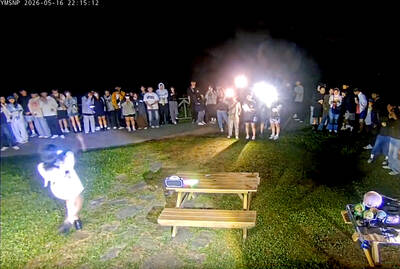
Yangmingshan National Park’s Qingtiangang (擎天崗) nature area has gone viral after a park livestream camera observed a couple in the throes of intimate congress, which was broadcast live on YouTube, drawing large late-night crowds and sparking a backlash over noise, bright lights and disruption to wildlife habitat. The area’s livestream footage appeared to show a couple engaging in sexual activity on a picnic table in the park on Friday last week, with the uncensored footage streamed publicly online. The footage quickly spread across social media, prompting a tide of visitors to travel to the site to “check in” and recreate the

Minister of Digital Affairs Lin Yi-ching (林宜敬) yesterday cited regulatory issues and national security concerns as an expert said that Taiwan is among the few Asian regions without Starlink. Lin made the remarks on Facebook after funP Innovation Group chief executive officer Nathan Chiu (邱繼弘) on Friday said Taiwan and four other countries in Asia — China, North Korea, Afghanistan and Syria — have no access to Starlink. Starlink has become available in 166 countries worldwide, including Ukraine, Malaysia, the Philippines and Vietnam, in the six years since it became commercial, he said. While China and North Korea block Starlink, Syria is not


 RSS
RSS