


Visits by multiple Chinese Nationalist Party (KMT) lawmakers to China’s Xiamen yesterday have sparked concern.
Lawmakers Lin Szu-ming (林思銘) and Weng Hsiao-ling (翁曉玲) were among those identified visiting.
In response to media queries, Lin said he was invited by the organizers to attend the Xiamen Taiwan Businessmen Association’s event in Xiamen.

Photo: Liu Hsin-de, Taipei Times
Their presence at the event is a gesture of respect for the association’s head, a businessman surnamed Han (韓), a friend from Hsinchu County, he said.
Weng yesterday confirmed that she is taking part in the event, but said she knows nothing about a delegation of KMT lawmakers or meeting any Chinese government officials there.
When told KMT Legislator Yeh Yuan-chih (葉元之) was seen boarding the same flight as her, Wen said she had no idea about her colleague’s plans.
Commenting on condition of anonymity, multiple Taiwanese businesspeople have said that the Chinese government is pressuring KMT lawmakers to stop Taiwan’s NT$1.25 trillion (US$39.6 billion) special defense budget and national security law amendments via go-betweens in the business community.
KMT Legislator Chen Yu-jen (陳玉珍), who initially invited fellow KMT lawmakers to the Xiamen event, ended up not making the visit herself.
Chen said the Xiamen Taiwanese Business Association has already been operating for 33 years and that it holds this particular event every year on Dec 20.
"It is completely normal for our colleagues to go and to show care for Taiwanese businesspeople,” she said.
When reached for comment, Democratic Progressive Party Legislator Rosalia Wu (吳思瑤) yesterday said the KMT lawmakers were “going to China again to receive instructions.”
Spikes in the frequency of KMT lawmakers’ contacts with China routinely coincide with the lead-up to votes on important bills concerning national security and cross-strait relations in the Legislative Yuan, she said.
The legislature is on the verge of voting on multiple high-profile bills, including arms purchases, National Security Act (國家安全法) amendments, nationality, and regulations on the government’s power to pull broadcasters off the air for untruthful reporting, Wu said.
The KMT delegation’s visit to China at this critical juncture is highly suspicious, especially as the legislature on Friday voted to extend the session to the end of January next year, she said.
She questioned whether the visits “meant to show submission to China, or to pave the way for a meeting between KMT Chairwoman Cheng Li-wun (鄭麗文) and Chinese President Xi Jinping (習近平).”
Additional reporting by Su Yun-yao and Liu Wan-ling
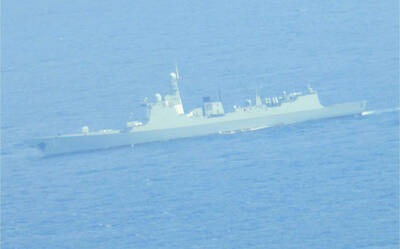
The military has spotted two Chinese warships operating in waters near Penghu County in the Taiwan Strait and sent its own naval and air forces to monitor the vessels, the Ministry of National Defense (MND) said. Beijing sends warships and warplanes into the waters and skies around Taiwan on an almost daily basis, drawing condemnation from Taipei. While the ministry offers daily updates on the locations of Chinese military aircraft, it only rarely gives details of where Chinese warships are operating, generally only when it detects aircraft carriers, as happened last week. A Chinese destroyer and a frigate entered waters to the southwest

The eastern extension of the Taipei MRT Red Line could begin operations as early as late June, the Taipei Department of Rapid Transit Systems said yesterday. Taipei Rapid Transit Corp said it is considering offering one month of free rides on the new section to mark its opening. Construction progress on the 1.4km extension, which is to run from the current terminal Xiangshan Station to a new eastern terminal, Guangci/Fengtian Temple Station, was 90.6 percent complete by the end of last month, the department said in a report to the Taipei City Council's Transportation Committee. While construction began in October 2016 with an
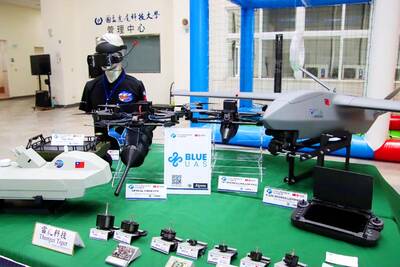
NON-RED SUPPLY: Boosting the nation’s drone industry is becoming increasingly urgent as China’s UAV dominance could become an issue in a crisis, an analyst said Taiwan’s drone exports to Europe grew 41.7-fold from 2024 to last year, with demand from Ukraine’s fight against Russian aggression the most likely driver of growth, a study showed. The Institute for Democracy, Society and Emerging Technology (DSET) in a statement on Wednesday said it found that many of Taiwan’s uncrewed aerial vehicle (UAV) sales were from Poland and the Czech Republic. These countries likely transferred the drones to Ukraine to aid it in its fight against the Russian invasion that started in 2022, it said. Despite the gains, Taiwan is not the dominant drone exporter to these markets, ranking second and fourth

Japanese Prime Minister Sanae Takaichi’s comment last year on Tokyo’s potential reaction to a Taiwan-China conflict has forced Beijing to rewrite its invasion plans, a retired Japanese general said. Takaichi told the Diet on Nov. 7 last year that a Chinese naval blockade or military attack on Taiwan could constitute a “survival-threatening situation” for Japan, potentially allowing Tokyo to exercise its right to collective self-defense. Former Japan Ground Self-Defense Force general Kiyofumi Ogawa said in a recent speech that the remark has been interpreted as meaning Japan could intervene in the early stages of a Taiwan Strait conflict, undermining China’s previous assumptions


 RSS
RSS