


The US Senate yesterday passed the National Defense Authorization Act (NDAA), which includes authorization of up to US$1 billion in funds for Taiwan-related security cooperation next year.
The legislation had already been approved by the US House of Representatives after the two chambers agreed on a compromise version of the massive bill, which covers more than US$900 billion in US national defense spending and related issues.
The bipartisan act reflects an “evolving security landscape and ensures the US remains prepared to deter adversaries like China and Russia while reinforcing vital partnerships with allies, including Taiwan,” US Senator John Curtis said in a statement yesterday.
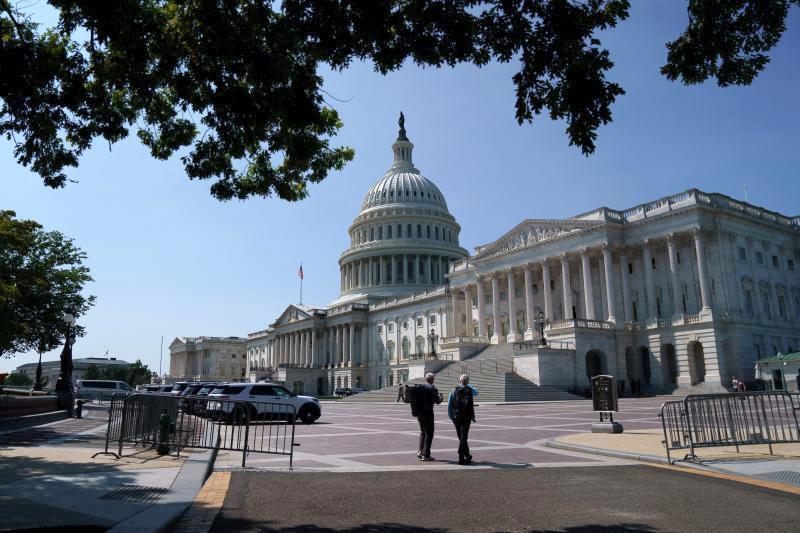
Photo: EPA-EFE
The NDAA authorizes up to US$1 billion in funding for the Taiwan Security Cooperation Initiative, which covers aspects such as medical equipment, supply capacity and "combat casualty-care capabilities."
It also authorizes US forces to continue training Taiwan and other partner countries to counter what the legislation describes as Chinese coercion and malign influence operations.
Under the NDAA, the Pentagon is required to “enable fielding of uncrewed and anti-uncrewed systems capabilities” with Taiwan by March 1 next year.
Systems covered by the act must comply with the Taiwan Relations Act and be usable by US and Taiwanese forces, it says.
Projected costs from next year through 2030 include deployments of US Coast Guard training teams to Taiwan to improve maritime security, law-enforcement capacity and deterrence, it says.
The NDAA also incorporates the Taiwan Non-Discrimination Act, which supports Taiwan's participation in the IMF.
Last week, the Chinese embassy in Washington denounced the legislation, saying that it unfairly targeted China as an aggressor.
“The bill has kept playing up the ‘China threat’ narrative, trumpeting for military support to Taiwan, abusing state power to go after Chinese economic development, limiting trade, economic and people-to-people exchanges between China and the US, undermining China’s sovereignty, security and development interests and disrupting efforts of the two sides in stabilizing bilateral relations,” the embassy said after the legislation passed the House.
“China strongly deplores and firmly opposes this,” it said.
Additional reporting by AP

NATIONAL SECURITY: Authorities are working to confirm the identities of the military personnel involved and investigating possible illegal conduct and regulatory violations Authorities are probing possible national security implications after Kinmen police and immigration officers on Sunday found a Chinese woman allegedly posing as a tourist while engaging in prostitution involving more than 10 military personnel. The woman, surnamed Chen (陳), has since been deported, authorities said, adding that investigators are still working to confirm the identities of those implicated, as the records only listed code names and aliases. The case stemmed from a report received by the Kinmen District Prosecutors’ Office on Friday last week from the Jinhu Precinct of the Kinmen County Police Bureau. On Sunday, police, along with the National Immigration

GLOBALGIVING: ‘ Caving to external pressure is not acceptable for an organization that has cultivated justice reform and human rights for 30 years,’ one NGO said A slew of non-government organizations (NGOs) have withdrawn from the GlobalGiving fundraising platform after it announced it would use “Chinese Taipei” instead of “Taiwan” from next month. The Taiwan Good Rice Association wrote on Facebook on Friday that it was informed on April 28 via a teleconference call of the change, which was made because the platform wanted to operate in China. Taiwan Good Rice is to terminate all cooperative relationships with GlobalGiving in response to the platform’s “unilateral and non-negotiable” decision to remove references to Taiwan, the NGO said. “Taiwan is in the official name of Taiwan Good Rice Association and the
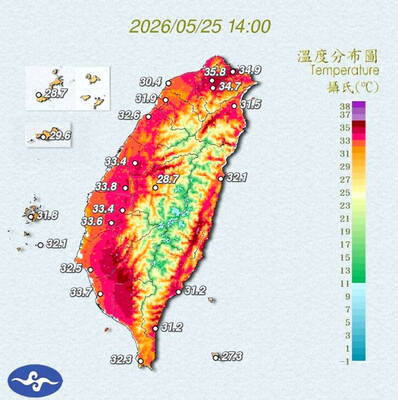
STAY COOL: The HPA recommended that people stay hydrated, use air-conditioning or fans while indoors, wear loose-fitting clothes and walk in the shade while outdoors Employers must implement measures such as installing cooling equipment, and providing drinking water and rest breaks for outdoor workers starting from Monday next week, the Taipei Department of Labor said on Sunday. Employers who fail to comply could face fines of NT$30,000 to NT$300,000 under the Occupational Safety and Health Act (職業安全衛生法), the department said. Businesses in Taipei employing fewer than 100 workers, as well as registered self-employed workers with labor insurance coverage, could receive on-site assessments and guidance from occupational safety consultants to help them apply for central government subsidies to implement or improve heat-protection measures, it said. Under the Ministry of

HEAVY WEATHER: Typhoon Jangmi is due to crash straight into the Ryukyus as airlines look to shift flights to larger aircraft or cancel flights to Okinawa entirely Taiwan’s international air carriers announced flight adjustments over the weekend as Typhoon Jangmi is forecast to hit the Ryukyu Islands today and tomorrow. The Central Weather Administration (CWA) upgraded Jangmi from a tropical storm to a typhoon at 8am yesterday, with the eye located 580km south of Naha city. It was moving north at 19kph. Today, China Airlines’ CI-120, CI-121, CI-122 and CI-123 flights between Taoyuan and Naha, Okinawa, have been canceled as well as CI-132 and CI-133 between Kaohsiung and Naha. EVA Air’s BR-112, BR-113, BR-186 and BR-185 flights between Taoyuan and Naha are also canceled. Low-cost carrier Tigerair Taiwan canceled IT-230,


 RSS
RSS