


China’s constant distortion of international documents would not make its narrative true even if it is “locked in 700 times or 7,000 times,” the Ministry of Foreign Affairs (MOFA) said yesterday.
Chinese Minister of Foreign Affairs Wang Yi (王毅) on Monday said during talks with German Minister of Foreign Affairs Johann Wadephul in Beijing that Taiwan’s status has been “locked in by seven layers of confirmation,” citing historical documents.
Supporting “Taiwan independence” is against China’s constitution and international law, and it interferes in China’s internal affairs, Wang said.
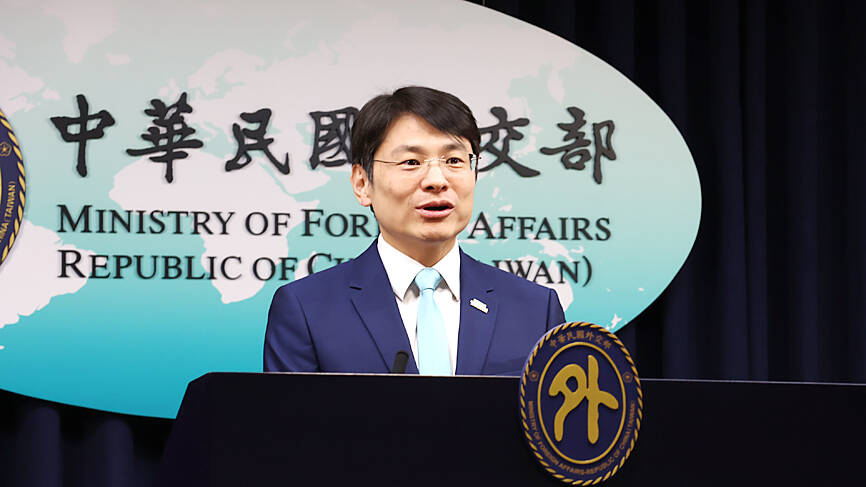
Photo: Huang Chin-hsuan, Taipei Times
Japanese Prime Minister Sanae Takaichi’s remark suggesting that Japan could take military action in self-defense if China were to attack “directly challenges the outcomes of the victory in World War II and the post-war international order, posing serious risks to peace in Asia and the world at large,” he added.
Reporters yesterday asked MOFA spokesman Hsiao Kuang-wei (蕭光偉) about Wang’s remarks.
The “locked in” claim by China is part of “its continuous distortion of international documents, but only mentioning the parts that are in its favor, while rejecting those that are against its stance,” Hsiao told a news conference in Taipei.
“If that is what ‘locked in’ means, then it could be locked in 700 times or 7,000 times, but it would never be true,” he said.
The Treaty of San Francisco, signed after World War II ended, is legally binding and has effectively replaced the Cairo Declaration and the Potsdam Declaration, Hsiao said, adding that the treaty did not hand over Taiwan to the People’s Republic of China (PRC).
The PRC has never ruled Taiwan, so Taiwan is in no way a part of the PRC, and this is a fact that is recognized by major democracies around the world, he added.
Taiwan began bottom-up political liberalization and democratization in the middle of the 1980s and conducted its first direct presidential election in 1996, confirming that Taiwan’s administration and legislature were elected by Taiwanese, he said.
“The Republic of China (ROC), Taiwan, government — elected through democratic procedures — has effective governance over Taiwan and is the only legal government that can represent Taiwan,” Hsiao said.
Taiwan has undergone three peaceful transfers of power through presidential elections in 2000, 2008 and 2016, consolidating its democratic system, bolstering its political identity, and reflecting the firm commitment of Taiwanese to freedom and democracy, he said.
UN Resolution 2758 also does not mention Taiwan, nor did it hand over Taiwan to the PRC or allow the PRC to represent Taiwan, he said.
“The historical facts clearly show that the ROC, Taiwan is a country with independent sovereignty, and that the ROC and the PRC are not subordinate to each other,” Hsiao said.
This is the objective “status quo” in the Taiwan Strait and a fact generally accepted by the international society,” he said.
Wadephul has frequently invoked the UN Charter this year to advocate against the use of force, particularly in the Taiwan Strait, Hsiao said.
The German minister has reiterated the importance of peace and stability in the Taiwan Strait, which demonstrates Berlin’s respect for international law and the rules-based international order, Hsiao added.
“China’s unilateral false claims and military threats are detrimental to the security and prosperity in the Taiwan Strait and the Indo-Pacific region,” he said.
Taiwan would continue to work with like-minded countries, including Germany, to protect the rules-based international order, and strive to maintain regional and global peace, security and prosperity, he said.
In related news, the MOFA urged South Korea to correct the title of Taiwan in its newly launched e-Arrival card system.
The online system, rolled out on Feb. 24, lists Taiwan as “China (Taiwan)” in menus for “place of departure” and “next destination,” but it has not been corrected, despite MOFA having repeatedly reached out to Seoul, asking it to fix the inappropriate name.
Department of East Asian and Pacific Affairs Deputy Director-General Richard Liu (劉昆豪) said that Taiwan and South Korea have years of close exchanges and Taiwan highly cherishes the decades-long bilateral friendship.
The ministry had officially asked the South Korean government to correct Taiwan’s name in the system, he said.
It has also noticed a significant trade imbalance between Taiwan and South Korea, and is comprehensively reviewing bilateral relations and feasible responsive measures, he said.
“MOFA believes that South Korea understands Taiwan’s request and stance, and hopes the South Korean government would, based on the friendship built from people-to-people exchanges, respond with reciprocal sincerity,” he said.

FUKUOKA SITUATION: Japanese media reported that the pathogen is expected to be identified by the summer, while the CDC downplayed the idea that it was hMPV A “mysterious cold-like illness” reported in Japan’s Fukuoka Prefecture does not seem to be a new disease, but Japanese authorities have been asked about the situation, the Centers for Disease Control (CDC) said yesterday. The Fukuoka Prefectural Medical Association on Wednesday told a news conference that a “mystery cold” that has become a hot topic on social media is “highly likely to be caused by some kind of viral infection,” Japan’s KBC News reported. “Many people are experiencing symptoms starting with a sore throat, followed by a runny nose, phlegm and a severe cough,” KBC News reported, citing association officials. Health authorities are

Nvidia Corp CEO Jensen Huang (黃仁勳) arrived in Taiwan yesterday ahead of upcoming AI and technology events, saying he plans to meet with clients and Taiwan Semiconductor Manufacturing Co Chairman C.C. Wei (魏哲家) during his visit. After landing at Taipei Songshan Airport, Huang posed for photos with fans and handed out Yakult drinks to reporters and supporters waiting at the scene, saying he has “a lot to do” during the trip. Asked about reports that Nvidia’s planned headquarters site in Taipei’s Beitou Shilin Technology Park could break ground on May 27, Huang said that if the company holds an event, he would

The Ministry of Finance this afternoon announced the winning numbers for the March-April uniform invoice lottery. The winning number for the NT$10 million (US$318,060) special prize is 19531471, and the winning number for the NT$2 million grand prize is 85941329. Three numbers were drawn for the NT$200,000 first prize: 07225810, 20231230 and 83518781. Those with receipts matching the last seven digits of any of the first-prize numbers will win the NT$40,000 second prize, while those matching the last six digits will win the NT$10,000 third prize. Those whose receipts match the last five digits of the first-prize numbers can claim the NT$4,000 fourth prize,
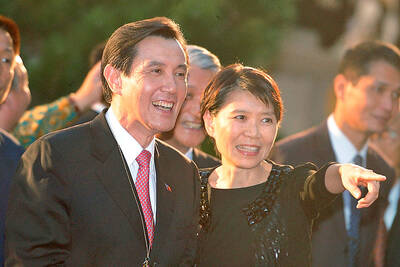
Former president Ma Ying-jeou (馬英九) yesterday expressed “shock and regret” over a statement issued by his wife without his consent, and rejected her assertion that his eldest sister, Ma Yi-nan (馬以南), would manage his medical care or act as his spokesperson amid an ongoing embezzlement probe into his foundation. Ma Ying-jeou in a statement said he was shocked by a statement by his wife, Chou Mei-ching (周美青), regarding his affairs. Ma Yi-nan “must not” be in charge of his healthcare and other personal affairs, nor can she be allowed to represent the Ma family, the former president said. He said he was also


 RSS
RSS