


Migrant workers yesterday marched in Taipei to call for abolishing work-year limits, which requires blue-collar migrant workers to leave Taiwan after working a cumulative total of 12 years in the country.
More than 100 marchers carried mock mortar bombs on their back to show that work-year limits are ticking down and could disrupt their lives in Taiwan once their 12 years are up.
The government in 2022 launched the Long-term Retention of Skilled Foreign Workers Program to allow blue-collar workers who have qualified as “intermediate skilled workers” to continue their jobs without being affected by the 12-year limit.
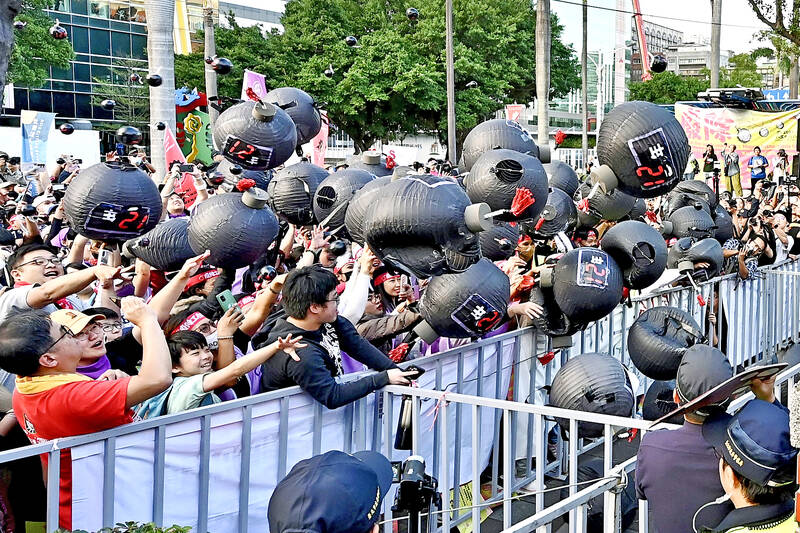
Photo: Tu Chien-jung, Taipei Times
Migrant workers who have engaged in “intermediate-level technical jobs” in Taiwan for at least five years and have a salary of up to twice the minimum wage or a Class B technician certificate can apply for permanent residency in Taiwan based on the Immigration Act (入出國及移民法).
However, the application for intermediate-level technical work permits must be filed by employers to the Ministry of Labor, meaning whether migrant workers can qualify as intermediate skilled workers is decided almost entirely by their employers.
Migrant workers consider the program “deceptive,” as they must tolerate more unfair treatment as a quid pro quo to elevate their work status, while it would be difficult for them to get a salary of twice the minimum wage from their employers to obtain permanent residency, Migrant Empowerment Network in Taiwan spokeswoman Wu Jing-ru (吳靜如) said.
Unlimited employment duration in Taiwan should not be a “favor” granted by employers to migrant workers, she said.
Blue-collar migrant workers contribute to society as much as white-collar workers and should have the right to work in Taiwan without discrimination until they choose to leave, she added.
The ministry has announced the Migrant Workforce Enhancement Plan, which would be implemented from next year, allowing employers to hire one additional migrant worker for every NT$2,000 in salary raise for a local worker.
Wu said the plan mischaracterized the problem as being between local and migrant workers.
Employers of migrant workers are already required to contribute to the national employment security fund — which is dedicated to offsetting the potential effects of an increased migrant workforce on locals’ employment conditions — but the new plan encourages employers to raise salaries only for individual local workers, she said.
Raising salaries of individuals would not improve the overall work conditions or salary levels, and could antagonize local workers against each other, Wu said.
Given that Taiwan has an urgent need for skilled workers in many industries, lifting the work-year limit for blue-collar workers would help retain talent, she said.
Taiwan had 42,752 intermediate-level migrant workers as of September, while 858,939 were blue-collar migrant workers, the Migrant Empowerment Network in Taiwan said, citing labor ministry data.
That means only 4.7 percent of migrant workers qualified as “intermediate skilled workers” over the past three-and-a-half years, it said.
Many blue-collar migrant workers mastering their jobs could not apply, likely because their employers preferred submissive, lower-paid new hires, the group said.
Others encountered obstacles from international employment agencies, because introducing migrant workers from overseas allows the agencies to make more profit, it said.

Yangmingshan National Park authorities yesterday urged visitors to respect public spaces and obey the law after a couple was caught on a camera livestream having sex at the park’s Qingtiangang (擎天崗) earlier in the day. The Shilin Police Precinct in Taipei said it has identified a suspect and his vehicle registration number, and would summon him for questioning. The case would be handled in accordance with public indecency charges, it added. The couple entered the park at about 11pm on Thursday and began fooling around by 1am yesterday, the police said, adding that the two were unaware of the park’s all-day live

Yangmingshan National Park’s Qingtiangang (擎天崗) nature area has gone viral after a park livestream camera observed a couple in the throes of intimate congress, which was broadcast live on YouTube, drawing large late-night crowds and sparking a backlash over noise, bright lights and disruption to wildlife habitat. The area’s livestream footage appeared to show a couple engaging in sexual activity on a picnic table in the park on Friday last week, with the uncensored footage streamed publicly online. The footage quickly spread across social media, prompting a tide of visitors to travel to the site to “check in” and recreate the

A former soldier and an active-duty army officer were yesterday indicted for allegedly selling classified military training materials to a Chinese intelligence operative for a total of NT$79,440. The Taipei District Prosecutors’ Office indicted Chen Tai-yin (陳泰尹) and Lee Chun-ta (李俊達) for contravening the National Security Act (國家安全法) and the Anti-Corruption Act (貪污治罪條例). Chen left the military in September 2013 after serving alongside then-staff sergeant Lee, now an army lieutenant, at the 21st Artillery Command of the army’s Sixth Corps from 2011 to 2013, according to the indictment. Chen met a Chinese intelligence operative identified as “Wang” (王) through a friend in November

Minister of Digital Affairs Lin Yi-ching (林宜敬) yesterday cited regulatory issues and national security concerns as an expert said that Taiwan is among the few Asian regions without Starlink. Lin made the remarks on Facebook after funP Innovation Group chief executive officer Nathan Chiu (邱繼弘) on Friday said Taiwan and four other countries in Asia — China, North Korea, Afghanistan and Syria — have no access to Starlink. Starlink has become available in 166 countries worldwide, including Ukraine, Malaysia, the Philippines and Vietnam, in the six years since it became commercial, he said. While China and North Korea block Starlink, Syria is not


 RSS
RSS