


The Taipei District Prosecutors’ Office today said it indicted three suspects in connection with an “internal breach” of Radio Taiwan International’s (RTI) Web site in September.
On Sept. 11, RTI reported an online attack in which the banner on its Web site was replaced with the People’s Republic of China flag.
Former RTI engineer Wu Cheng-hsun (吳政勳), former section chief Yue Chao-chu (岳昭莒) and a third man named Huang Fu-lin (黃富琳) were today indicted on charges including interfering with computer systems.

Photo: Tsai Wen-chu, Taipei Times
Prosecutors said they are seeking prison terms of three years for Wu, two-and-a-half years for Yue and a similarly severe sentence for Huang, as their actions were intended to provoke cross-strait tensions.
Following the incident, RTI convened a personnel review committee and decided to dismiss Wu, while Yue was disciplined with a major demerit for negligence in supervision and failing to stop the misconduct.
Yue has since voluntarily retired.
Wu began working at RTI in May as an engineer in the online media division and was responsible for Web site maintenance and information security audits, the indictment said.
Yue was head of the division and managed the Web site’s original source code, it said.
Huang had previously worked for RTI as a system maintenance contractor and knew both Wu and Yue, it added.
The investigation found that in June, Wu, Yue and Huang conspired to attack the RTI Web site, with Wu allegedly providing the site’s highest-level administrator account without authorization, enabling Huang to access the backend, delete logs of Wu’s activity and provide technical assistance.
The three also formed a Line group, prosecutors found.
Yue knew of Wu and Huang’s actions, but failed to report the matter or intervene, they said.
On Aug. 20, Wu interfered with the parameters of the RTI Web site, changed its Japanese main page so that it showed simplified Chinese or garbled characters, and interrupted the Web site's signal, prosecutors said.
On Sept. 11, 18, 19 and 20, he changed RTI's main site and replaced the Web site with the book cover of The 'Retaking the Mainland' by Taiwanese Government: The Concept of Chinese Unification by the ROC, and changed the banner to the People's Republic of China flag as well as the US flag.
On Sept. 24, prosecutors said that Wu used the Line group to send RTI’s original source code to Huang from inside the RTI office without authorization.
Prosecutors said they searched Wu and Yue’s residences on Sept. 26, with Wu showing no remorse and even logging onto the RTI system two days later to remove a URL.
Wu and Yueh claimed they acted as they suspected Chinese capital was interfering with the RTI Web site, prosecutors said.
Wu's actions damaged RTI's credibility and disrupted its operations, prosecutors said, while local media reported that Wu claimed he did so to "unveil loopholes" in the broadcaster's system.
However, the images that Wu put on the Web site raised tensions across the Taiwan Strait, posing danger far exceeding general criminal offenses, prosecutors said.
Wu's plan to attack the site on Oct. 10, Double Ten National Day, carries great symbolic meaning, they added.
RTI is a national radio broadcaster with Taiwan’s only international radio programming, which relies solely on government funding and is designated as key national infrastructure, they said.
Internal hacking at RTI could have a significant impact on national and public interests, as well as public confidence, they said.


UPGRADE: The Kang Ding-class frigate is replacing its Chaparall missiles with Tien Chien II and Hua Yang VLS, which would provide it with long-range, 360° air defense Taiwan plans to produce 1,200 to 1,376 Hai Chien II missiles (海劍二, Sea Sword II) — also known as TC-2N — to serve as the standard air defense system of the navy’s surface combatant fleet, a source said yesterday. Last week, the Hai Chien II, the naval version of the Tien Kung II missile (天劍二, Sky Sword II), completed a live-fire test in waters off the National Chungshan Institute of Science and Technology’s Jiupeng facility (九鵬) in Pingtung County’s Manjhou Township (滿州). The MIM72 Chaparral and other dated air defense missiles that currently arm Taiwanese ships have inadequate range to combat Chinese

REASONS FOR TRAVEL: An assistant professor said that proposed amendments to penalize drivers if they used drugs overseas would not deter people from traveling People who operate a motor vehicle under the influence of marijuana would have their driver’s license revoked, even if they used the substance while overseas, the Ministry of Transportation and Communications said yesterday, citing proposed amendments to the Road Traffic Management and Penalty Act (道路交通管理處罰條例). The amendments would also authorize the government to revoke the licenses of people determined to have used Category 1 or Category 2 narcotics, even if they were not operating a vehicle while under the influence of drugs, as well as ban them from taking the license test for three years, the ministry said. People aged 18 or
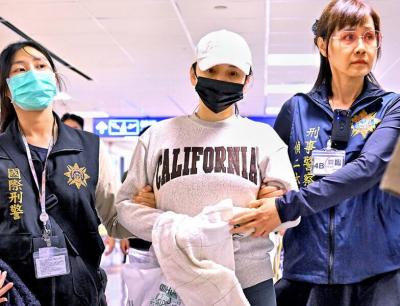
Johanne Liou (劉喬安), a Taiwanese woman who shot to unwanted fame during the Sunflower movement protests in 2014, returned to Taiwan last night after being deported from the US. She is to stand trial in Taiwan for charges involving embezzlement, fraud and drug crimes. The Criminal Investigation Bureau (CIB) said it took her into custody at Taiwan Taoyuan International Airport and would first question her before transferring her to the New Taipei District Prosecutors’ Office. She was arrested upon disembarking a flight from San Francisco that landed shortly before 7pm. Liou absconded to the US in 2019 after jumping bail
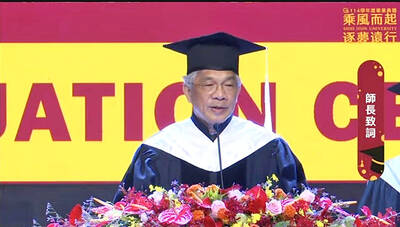
Shih Hsin University President Chen Ching-he (陳清河) yesterday issued a public apology for comments made in his commencement speech last week, stating that he has asked the school to suspend his duties and halt his wages for two months as a show of contrition. At the commencement ceremony on May 30, Chen said, “If you don’t manage your time well, or your own emotions, or your health, then I am telling every one of you — put a quick end to ‘you,’ because the world has no need for ‘you.’” The comments have sparked significant controversy online, and Chen through an open


 RSS
RSS