


The Ministry of Labor yesterday said it would bolster legal protections for sick leave, following the conclusion of a ministry investigation into the death of a flight attendant who worked while feeling unwell.
Crew interviews conducted during the ministry’s investigation showed that EVA Air “excessively used” its evaluation management system, causing staff to believe that applying for sick leave would lead to punitive treatment, Minister of Labor Hung Sun-han (洪申翰) told reporters.
The ministry would amend the Regulations of Leaves for Workers (勞工請假規則) to state that when a worker takes no more than 10 days of sick leave in a year, the employer may not take any unfavorable action, he said.
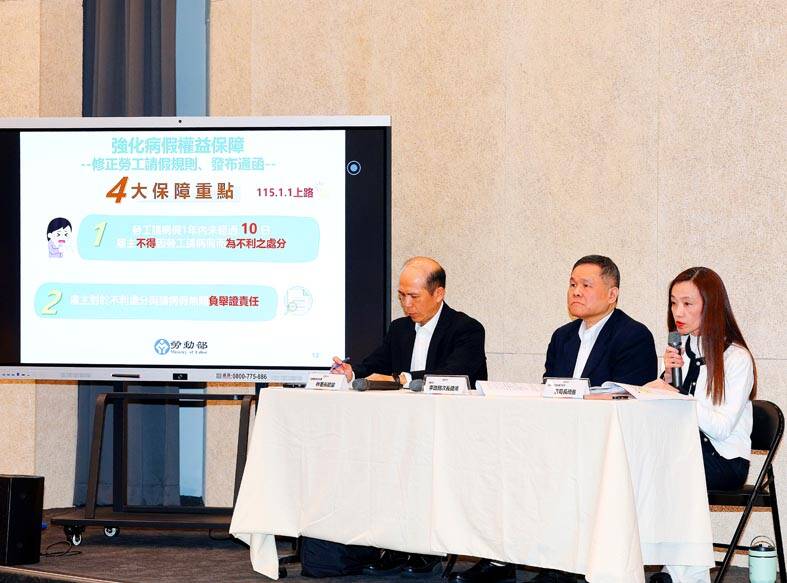
Photo: CNA
To protect workers’ right to request sick leave, the ministry said it first held an online survey and found that most workers request sick leave about 10 days per year.
The ministry on Monday last week held a meeting with representatives of labor groups, business associations and government agencies to discuss sick leave regulations.
“Labor representatives request 12 to 15 days of sick leave per year, while business groups say that sick leave should be three to seven days per year. We decided to change the rules governing leave of absence to allow 10 days of sick leave per year,” Department of Employment Welfare and Equal Employment Director-General Huang Chi-ya (黃琦雅) said.
First, employers may not impose any adverse action on workers who take fewer than 10 days of sick leave, Huang said.
If a worker demonstrates that they have suffered an adverse employment action, the burden of proof shifts to the employer, she said.
When conducting performance evaluations, employers must consider an employee’s abilities, attitude and actual work performance in a holistic manner, and may not rely solely on the number of days of sick leave taken, Huang said.
Attendance bonuses must be stipulated in work rules, collective agreements or employment contracts so that workers are clearly informed of the criteria, she said.
Any deductions must be reasonable and proportionate. If attendance bonuses are reduced due to sick leave, employers may not deny the entire bonus when the employee has taken only a few days of sick leave in a given month, to prevent workers from refraining from taking needed sick leave out of fear of being placed at a disadvantage, Huang added.
The amendment would authorize fines of between NT$20,000 and NT$1 million (US$639 and US$31,954) for employers who have violated the rules, the ministry said.
The changes are scheduled to take effect in January next year, the ministry said.
The announcement comes as the ministry completed its investigation into EVA Air over the death of a 34-year-old flight attendant surnamed Sun (孫) soon after returning from Milan, Italy, last month.
The investigation found that EVA flight attendants are reluctant to request sick leave, as their attendance records affect their work schedules, bonuses and performance reviews.
Sun reportedly felt unwell before the trip and had asked for assistance multiple times from coworkers and the cabin chief during the round-trip flight between Taipei and Milan.
The incident triggered a nationwide discussion of whether a worker’s performance should factor in the number of sick leave days requested, as local media reported that Sun did not dare request sick leave for fear that doing so would hurt her performance review.
Additional reporting by CNA

A magnitude 6.1 earthquake struck off the coast of Yilan County at 8:39pm tonight, the Central Weather Administration (CWA) said, with no immediate reports of damage or injuries. The epicenter was 38.7km east-northeast of Yilan County Hall at a focal depth of 98.3km, the CWA’s Seismological Center said. The quake’s maximum intensity, which gauges the actual physical effect of a seismic event, was a level 4 on Taiwan’s 7-tier intensity scale, the center said. That intensity level was recorded in Yilan County’s Nanao Township (南澳), Hsinchu County’s Guansi Township (關西), Nantou County’s Hehuanshan (合歡山) and Hualien County’s Yanliao (鹽寮). An intensity of 3 was
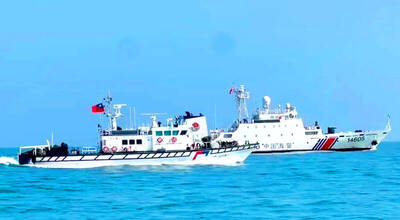
Instead of focusing solely on the threat of a full-scale military invasion, the US and its allies must prepare for a potential Chinese “quarantine” of Taiwan enforced through customs inspections, Stanford University Hoover fellow Eyck Freymann said in a Foreign Affairs article published on Wednesday. China could use various “gray zone” tactics in “reconfiguring the regional and ultimately the global economic order without a war,” said Freymann, who is also a nonresident research fellow at the US Naval War College. China might seize control of Taiwan’s links to the outside world by requiring all flights and ships entering or leaving Taiwan
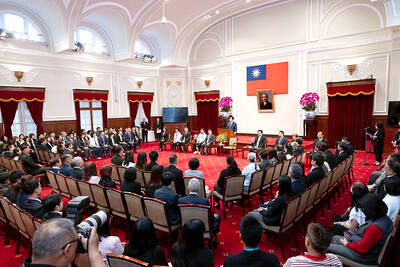
The next minimum wage hike is expected to exceed NT$30,000, President William Lai (賴清德) said yesterday during an award ceremony honoring “model workers,” including migrant workers, at the Presidential Office ahead of Workers’ Day today. Lai said he wished to thank the awardees on behalf of the nation and extend his most sincere respect for their hard work, on which Taiwan’s prosperity has been built. Lai specifically thanked 10 migrant workers selected for the award, saying that although they left their home countries to further their own goals, their efforts have benefited Taiwan as well. The nation’s industrial sector and small businesses lay
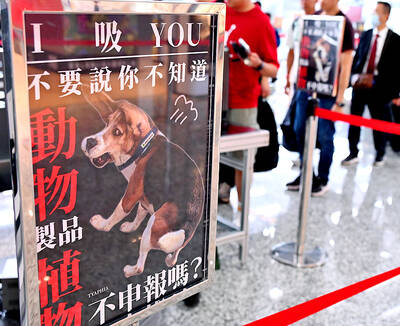
Quarantine awareness posters at Taiwan Taoyuan International Airport have gone viral for their use of wordplay. Issued by the airport branch of the Animal and Plant Health Inspection Agency, the posters feature sniffer dogs making a range of facial expressions, paired with advisory messages built around homophones. “We update the messages for holidays and campaign needs, periodically refreshing materials to attract people’s attention,” quarantine officials said. “The aim is to use the dogs’ appeal to draw focus to quarantine regulations.” A Japanese traveler visiting Taiwan has posted a photo on X of a poster showing a quarantine dog with a


 RSS
RSS