


The Czech Republic’s commitment to democracy and defense of Ukraine are deserving of admiration, Legislative Speaker You Si-kun (游錫堃) said yesterday while receiving a delegation led by Czech Senator Jiri Drahos in Taipei.
Drahos, who chairs the Czech Senate’s Committee on Education, Science, Culture, Human Rights and Petitions, and 12 other representatives arrived in Taiwan on Sunday for a six-day visit.
Addressing a reception for the delegation at the Grand Hotel yesterday afternoon, You opened by thanking the Czech s for welcoming him and other Taiwanese lawmakers when they visited the European nation in July.

Photo courtesy of the Legislative Yuan
He also praised the Czech Republic as a democratic leader in the region, whose peaceful 1989 Velvet Revolution instigated a wave of democratization across central and eastern Europe.
The late Czech president Vaclav Havel — the first to be elected democratically after the fall of communism in the nation — had the foresight to recognize that the totalitarian nature of communism is unsustainable, You said.
Yet over the past few years, democracy has been losing ground, he said, pointing to Chinese and Russian expansionism, and military rule in Afghanistan and Myanmar.
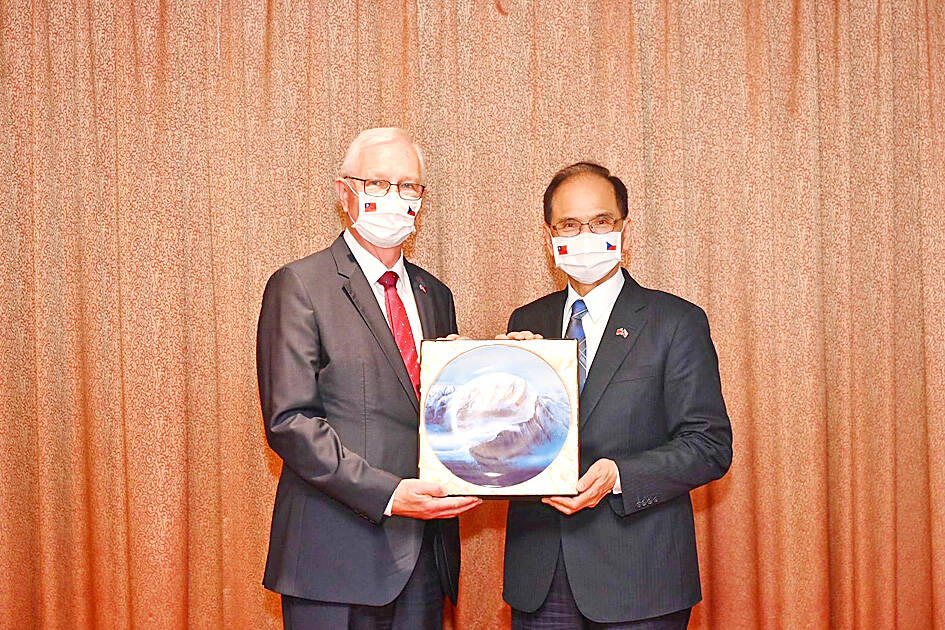
Photo courtesy of the Legislative Yuan
The Czech Republic ranks 10th in the world in terms of monetary aid to Ukraine — seventh as a percentage of GDP — and sixth in terms of military aid, You said, citing data from Germany’s Kiel Institute for the World Economy.
The nation’s defense of Ukraine in keeping with Havel’s spirit is worthy of admiration, he added.
In his address, Drahos said that although he only arrived the day before, it already feels like home.
The Czech Republic will continue to push for Taiwan’s involvement in international organizations such as the WHO and International Civil Aviation Organization, he said.
Drahos also expressed the hope of establishing direct flights between the two nations to make travel more convenient.
The delegation also includes Czech Academy of Sciences president Eva Zazimalova; Michal Lukes, general director of the National Museum in Prague; Roman Hvezda, director of the ELI Beamlines facility, an international laser research center; and officials from the fields of education, science and technology, as well as experts in epidemic prevention and information security.
Drahos had originally planned to visit Taiwan in October 2020, but postponed the trip due to the COVID-19 pandemic.
Additional reporting by CNA

The nation’s fastest supercomputer, Nano 4 (晶創26), is scheduled to be launched in the third quarter, and would be used to train large language models in finance and national defense sectors, the National Center for High-Performance Computing (NCHC) said. The supercomputer, which would operate at about 86.05 petaflops, is being tested at a new cloud computing center in the Southern Taiwan Science Park in Tainan. The exterior of the server cabinet features chip circuitry patterns overlaid with a map of Taiwan, highlighting the nation’s central position in the semiconductor industry. The center also houses Taiwania 2, Taiwania 3, Forerunner 1 and

FIRST TRIAL: Ko’s lawyers sought reduced bail and other concessions, as did other defendants, but the bail judge denied their requests, citing the severity of the sentences Former Taipei mayor Ko Wen-je (柯文哲) was yesterday sentenced to 17 years in prison and had his civil rights suspended for six years over corruption, embezzlement and other charges. Taipei prosecutors in December last year asked the Taipei District Court for a combined 28-year, six-month sentence for the four cases against Ko, who founded the Taiwan People’s Party (TPP). The cases were linked to the Core Pacific City (京華城購物中心) redevelopment project and the mismanagement of political donations. Other defendants convicted on separate charges included Chinese Nationalist Party (KMT) Taipei City Councilor Angela Ying (應曉薇), who was handed a 15-year, six-month sentence; Core Pacific

J-6 REMODEL: The converted drones are part of Beijing’s expanding mix of airpower weapons, including bombers with stand-off missiles and UAV swarms, the report said China has stationed obsolete supersonic fighters converted to attack drones at six air bases close to the Taiwan Strait, a report published this month by the Arlington, Virginia-based Mitchell Institute for Aerospace Studies said. Satellite imagery of the airfields from the institute’s “China Airpower Tracker” shows what appear to be lines of stubby, swept-winged aircraft matching the shape of J-6 fighters that first flew with the Chinese People’s Liberation Army (PLA) Air Force in the 1960s. Since their conversion to drones, the aircraft have been identified at five bases in China’s Fujian Province and one in Guangdong Province, the report said. J.

China used fake LinkedIn profiles to harvest sensitive data from NATO and EU institutions by soliciting information from staff, a European security source said on Friday. The operation, allegedly orchestrated by the Chinese Ministry of State Security, targeted dozens of employees at the military alliance or EU organizations through fictitious accounts, the source said, confirming reports in French and Belgian media. Posing as recruiters on the online professional networking platform, Chinese spies would initially request paid reports before later soliciting non-public or even classified information. One particularly active fake profile used the name “Kevin Zhang,” claiming to be the head


 RSS
RSS