


Taiwan is thoroughly reviewing four key military court system bills as part of efforts to counter Chinese infiltration, following President William Lai’s (賴清德) 17-point national security strategy unveiled in March, Executive Yuan Secretary-General Xavier Chang (張惇涵) said in an exclusive interview with Liberty Times (sister paper of Taipei Times).
Lai’s 17-point strategy is aimed at countering Chinese threats to Taiwan’s sovereignty, military infiltration, confusion of national identity, promotion of reunification and drawing in Taiwanese businesses and young people, Chang said.
The Executive Yuan has already identified 120 related tasks, including 21 laws that need to be amended or legislated as well as executive orders and administrative measures that need to be revised, he said.
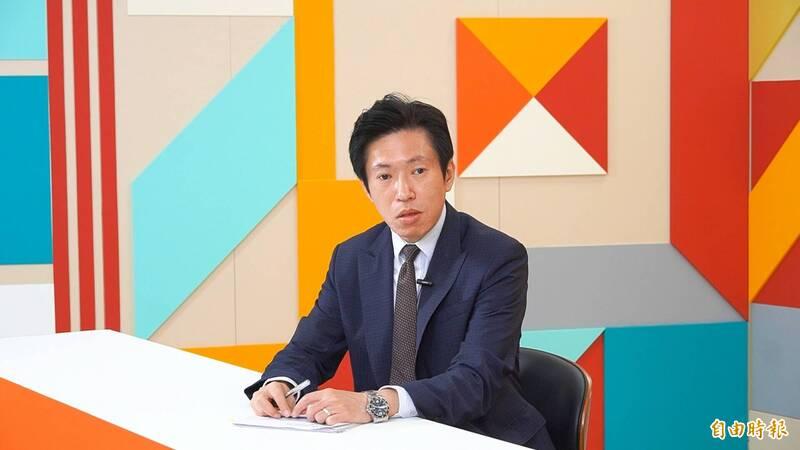
Photo: Chen Yu-jui, Taipei Times
Much of this work has already begun, including passing the Special Statute on Strengthening the Resilience of the Economy, Society and National Security in Response to International Developments (因應國際情勢強化經濟社會及民生國安韌性特別條例) and amendments to the Cyber Security Management Act (資通安全管理法) and Industrial Innovation Statute (產業創新條例), Chang said.
The Legislative Yuan has also completed an initial review of legislation concerning undersea cables, classifying them as critical infrastructure and increasing penalties for illegal vessels, he said.
The legislation would impose the same criminal liability for damaging water or natural gas pipelines as for damaging undersea cables and require ships to activate their automatic identification systems, he added.
In response to Chinese attempts to infiltrate the military, the four major bills concerning the military justice system, the Military Trial Act (軍事審判法), Military Judges Personnel Act (軍法官人事條例), Military Court Organization Act (軍事法院組織法) and Military Prosecutors Office Organization Act (軍事檢察署組織法), are being intensively reviewed, Chang said.
The National Security Act (國家安全法) and Criminal Code of the Armed Forces (陸海空軍刑法) are also being discussed and would be steadily improved, he added.
Regarding executive orders, plans and administrative measures, Chang said that next year’s national defense budget would reach three percent of national GDP, following the North Atlantic Treaty Organization’s model.
In addition, the Mainland Affairs Council in April issued a new interpretation of the Act Governing Relations Between the People of the Taiwan Area and the Mainland Area (臺灣地區與大陸地區人民關係條例), specifying that holding a permanent residency certificate issued by China would also result in the loss of “Taiwan status,” he said.
Military personnel, civil servants and teachers are prohibited from holding Chinese IDs or household registration and are required to report any contact with Chinese officials when traveling to China, Hong Kong or Macau, Chang said.
In terms of education, funding from the Higher Education Sprout Project cannot be used to sponsor trips to China, he added.
In other news, an amended regulation requiring Chinese nationals to provide notarized proof that they have renounced their People's Republic of China (PRC) passport to qualify for permanent residency in Taiwan is to take effect today, the Ministry of the Interior (MOI) announced Wednesday.
Under the amendment, the required document must be notarized and demonstrate that the applicant has "lost their household registration in the Mainland Area" and that they have "either not applied for, or renounced their PRC passport."
Before the amendment, the applicant was only required to hand in a document proving that their "original household registration" had been renounced.
The amendment is necessary because, in practice, Chinese nationals can still hold a PRC passport even after renouncing their household registration in China, the MOI said.
Additional reporting by CNA

FUKUOKA SITUATION: Japanese media reported that the pathogen is expected to be identified by the summer, while the CDC downplayed the idea that it was hMPV A “mysterious cold-like illness” reported in Japan’s Fukuoka Prefecture does not seem to be a new disease, but Japanese authorities have been asked about the situation, the Centers for Disease Control (CDC) said yesterday. The Fukuoka Prefectural Medical Association on Wednesday told a news conference that a “mystery cold” that has become a hot topic on social media is “highly likely to be caused by some kind of viral infection,” Japan’s KBC News reported. “Many people are experiencing symptoms starting with a sore throat, followed by a runny nose, phlegm and a severe cough,” KBC News reported, citing association officials. Health authorities are

Nvidia Corp CEO Jensen Huang (黃仁勳) arrived in Taiwan yesterday ahead of upcoming AI and technology events, saying he plans to meet with clients and Taiwan Semiconductor Manufacturing Co Chairman C.C. Wei (魏哲家) during his visit. After landing at Taipei Songshan Airport, Huang posed for photos with fans and handed out Yakult drinks to reporters and supporters waiting at the scene, saying he has “a lot to do” during the trip. Asked about reports that Nvidia’s planned headquarters site in Taipei’s Beitou Shilin Technology Park could break ground on May 27, Huang said that if the company holds an event, he would

The Ministry of Finance this afternoon announced the winning numbers for the March-April uniform invoice lottery. The winning number for the NT$10 million (US$318,060) special prize is 19531471, and the winning number for the NT$2 million grand prize is 85941329. Three numbers were drawn for the NT$200,000 first prize: 07225810, 20231230 and 83518781. Those with receipts matching the last seven digits of any of the first-prize numbers will win the NT$40,000 second prize, while those matching the last six digits will win the NT$10,000 third prize. Those whose receipts match the last five digits of the first-prize numbers can claim the NT$4,000 fourth prize,

SIX SUBSIDIES: The monthly allowance for older farmers is to increase to NT$10,000, and NT$5,000 is to be given to homemakers under the national pension system, Lai said The government is to implement major welfare policies for disadvantaged groups, including raising the monthly allowance for older farmers to NT$10,000 and providing homemakers with NT$5,000 per month, President William Lai (賴清德) said yesterday. Lai made the remarks during a visit to Wangling Temple in Chiayi County, saying that the planned increases were being introduced amid economic growth and an increase in tax revenue. Touting a policy, in which the government plans to provide a monthly allowance of NT$5,000 for every child under the age of 18 in a bid to address Taiwan’s low birthrate, Lai said that if received for the


 RSS
RSS