


More than 10,000 Taiwanese participated in religious activities in China last year with support from the Chinese government, a study showed, which Taipei views as part of a campaign by Beijing to win hearts and minds.
China has long taken a carrot-and-stick approach to Taiwan, subjecting it to almost daily military drills while reaching out to those it believes are receptive to Beijing’s point of view.
Last year, 10,496 Taiwanese joined more than 110 religious trips to China, supported or organized by government units across China, according to the study by IORG, a Taiwan-based non-governmental organization.
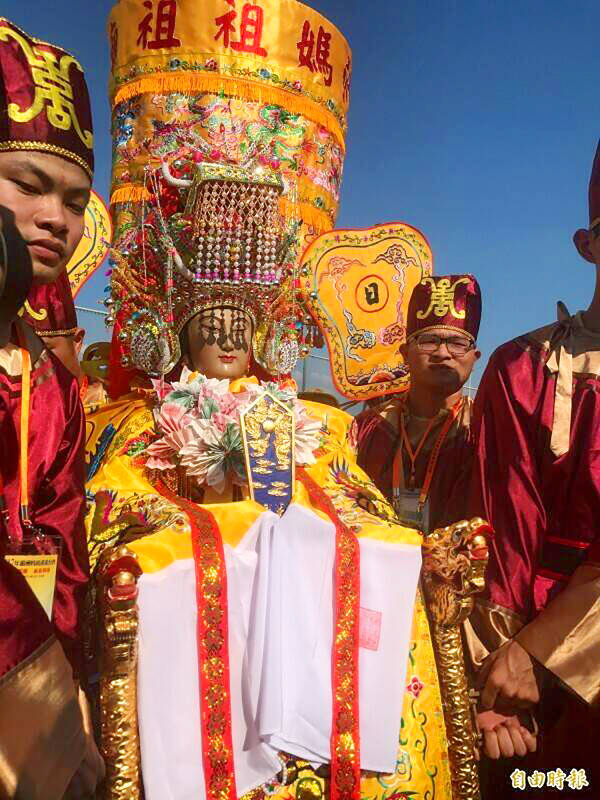
Photo: Chen Yu-fu, Taipei Times
IORG said the report, which was published late on Wednesday, revealed for the first time the scale of the Chinese campaign. Reuters has previously reported that China uses religion as a tool to influence elections in Taiwan.
China’s Taiwan Affairs Office did not immediately respond to requests for comment.
The Mainland Affairs Council yesterday said that Beijing has long used religion to conduct “united front” tactics targeting Taiwan, referring to a unit of the Chinese government tasked with bolstering Beijing’s reach abroad.
The government is closely monitoring the situation, the council said, adding that the IORG report held significant reference value.
Security officials are wary of what they see as a Beijing influence campaign using religions that are hugely important to Taiwanese life, but tightly controlled by the officially atheist ruling Chinese Communist Party.
China officially guarantees freedom of religion, but only under the leadership of the party.
IORG’s research analyzed more than 7,346 articles posted to a news portal run by China’s Taiwan Affairs Office. The articles offered details of events — including the scale, locations and agendas — and were examined by artificial intelligence-assisted tools before being verified by IORG researchers.
“The Chinese Communist Party continues to use religious exchanges as a cover for political propaganda,” the IORG report said, adding that the reviewed articles stressed narratives that the two sides share common roots and are destined to “reunify.”
In a report last week, the National Security Bureau warned that, under the guise of extensive “exchange programs,” Beijing was conducting operations to sway and infiltrate “all walks of life” in Taiwan.
“They use religious activities to win over the hearts and minds of the Taiwanese people, treating it as a political tool,” an official told Reuters.
The official requested anonymity due to the sensitivity of the matter.
The Mainland Affairs Council yesterday said that from Jan. 1 to Sept. 30 this year, it received reports of 212 cases involving Taiwanese who went missing, were detained for questioning or are suspected of having their personal freedom restricted in China. Among them, nine were members of the Taiwanese I-Kuan Tao (One Unity Sect).


UPGRADE: The Kang Ding-class frigate is replacing its Chaparall missiles with Tien Chien II and Hua Yang VLS, which would provide it with long-range, 360° air defense Taiwan plans to produce 1,200 to 1,376 Hai Chien II missiles (海劍二, Sea Sword II) — also known as TC-2N — to serve as the standard air defense system of the navy’s surface combatant fleet, a source said yesterday. Last week, the Hai Chien II, the naval version of the Tien Kung II missile (天劍二, Sky Sword II), completed a live-fire test in waters off the National Chungshan Institute of Science and Technology’s Jiupeng facility (九鵬) in Pingtung County’s Manjhou Township (滿州). The MIM72 Chaparral and other dated air defense missiles that currently arm Taiwanese ships have inadequate range to combat Chinese

REASONS FOR TRAVEL: An assistant professor said that proposed amendments to penalize drivers if they used drugs overseas would not deter people from traveling People who operate a motor vehicle under the influence of marijuana would have their driver’s license revoked, even if they used the substance while overseas, the Ministry of Transportation and Communications said yesterday, citing proposed amendments to the Road Traffic Management and Penalty Act (道路交通管理處罰條例). The amendments would also authorize the government to revoke the licenses of people determined to have used Category 1 or Category 2 narcotics, even if they were not operating a vehicle while under the influence of drugs, as well as ban them from taking the license test for three years, the ministry said. People aged 18 or
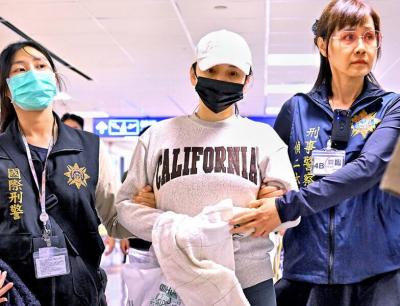
Johanne Liou (劉喬安), a Taiwanese woman who shot to unwanted fame during the Sunflower movement protests in 2014, returned to Taiwan last night after being deported from the US. She is to stand trial in Taiwan for charges involving embezzlement, fraud and drug crimes. The Criminal Investigation Bureau (CIB) said it took her into custody at Taiwan Taoyuan International Airport and would first question her before transferring her to the New Taipei District Prosecutors’ Office. She was arrested upon disembarking a flight from San Francisco that landed shortly before 7pm. Liou absconded to the US in 2019 after jumping bail
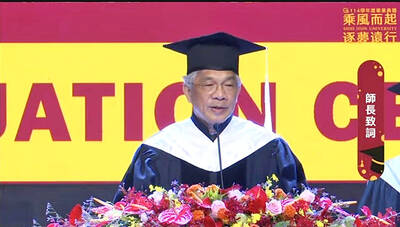
Shih Hsin University President Chen Ching-he (陳清河) yesterday issued a public apology for comments made in his commencement speech last week, stating that he has asked the school to suspend his duties and halt his wages for two months as a show of contrition. At the commencement ceremony on May 30, Chen said, “If you don’t manage your time well, or your own emotions, or your health, then I am telling every one of you — put a quick end to ‘you,’ because the world has no need for ‘you.’” The comments have sparked significant controversy online, and Chen through an open


 RSS
RSS