


A senior Taiwanese general’s appearance in full uniform at a high-profile security forum in Poland signals closer security exchanges between Taipei and Warsaw, and reflects Europe’s growing concern over China’s military ambitions, experts said yesterday.
Lieutenant General Hsieh Jih-sheng (謝日升), deputy chief of the Ministry of National Defense’s Office of the Deputy Chief of General Staff for Intelligence, attended the Warsaw Security Forum held on Monday and Tuesday in the Polish capital. Photographs and video released by the organizers showed Hsieh speaking onstage in full Republic of China Air Force uniform.
Chieh Chung (揭仲), an adjunct researcher at the Institute for National Defense and Security Research, said the conference is a non-governmental event that functions as “Track II diplomacy,” bringing together military, security and academic figures from around the world.
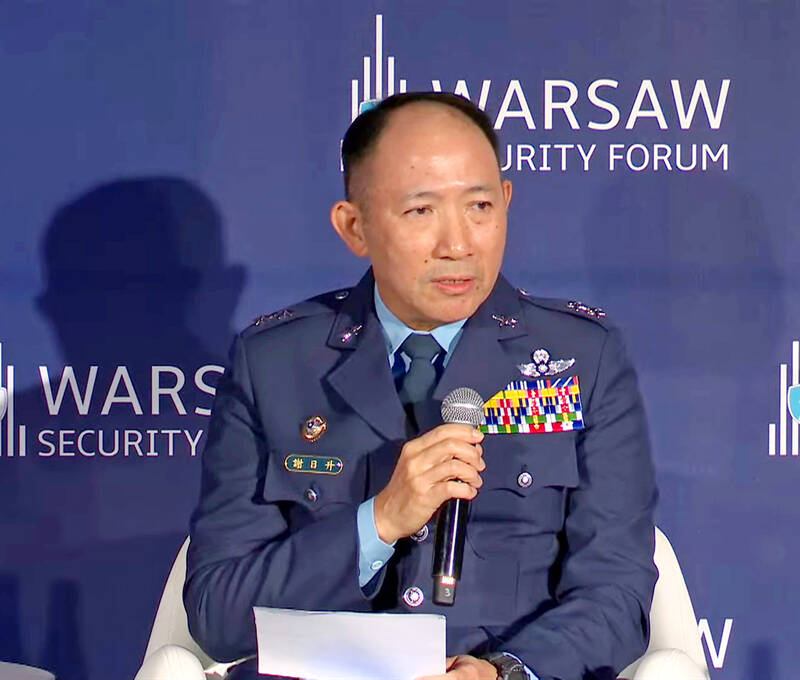
Photo: Screen grab from Warsaw Security Forum YouTube channel
Track II diplomacy refers to informal, unofficial contacts and dialogue conducted by non-state actors to facilitate communication and conflict resolution.
“If Polish authorities or other participants had been uncomfortable with seeing Hsieh wearing a uniform during his participation, he would have been in a suit,” Chieh told the Central News Agency, adding that this shows the European country is attaching higher importance to Taiwan’s security.
Su Tzu-yun (蘇紫雲), a division director at the institute, said that allowing a senior Taiwanese military official to appear in uniform and speak publicly demonstrated Europe’s increasing trust in Taipei.
It shows that European nations are recognizing the military threats posed by Beijing and the strategic importance of Taiwan, Su said.
The defense ministry said that Hsieh was invited to share perspectives and exchange experiences with international security experts, adding that the ministry seeks to raise global awareness of Taiwan Strait security issues through such forums.
Hsieh during his speech said that Taipei is closely watching the war in Ukraine, a Reuters report said.
“We wish for their victory,” he said, speaking in English, in footage streamed online from the event.
“There are many things that we can learn from the Ukrainian theater that we can elevate for our overall readiness,” Hsieh added. “The defeat of Ukraine will signal that China can take more aggression towards Taiwan.”
Hsieh raised the alarm about China and Russia’s joint military drills.
“If China moves on Taiwan while Russia increases its offensive in Ukraine, the world could face a two-front geopolitical crisis,” he said.
“Europe today, you are fighting for your own security. If you help us, we can prevent the possibility of war in the Indo-Pacific,” he said.
Hsieh added that Taiwan and Europe could learn from each other.
“We have been dealing with China’s gray zone operations for years. There is a tremendous [amount of experience about] how we counter disinformation that we can share with Europe, and also how we can benefit us, but also benefit European nations,” he said.
Minister of Foreign Affairs Lin Chia-lung (林佳龍) also spoke at the forum, calling for deeper economic cooperation between Europe and Taiwan to boost shared prosperity and innovation.

NATIONAL SECURITY: Authorities are working to confirm the identities of the military personnel involved and investigating possible illegal conduct and regulatory violations Authorities are probing possible national security implications after Kinmen police and immigration officers on Sunday found a Chinese woman allegedly posing as a tourist while engaging in prostitution involving more than 10 military personnel. The woman, surnamed Chen (陳), has since been deported, authorities said, adding that investigators are still working to confirm the identities of those implicated, as the records only listed code names and aliases. The case stemmed from a report received by the Kinmen District Prosecutors’ Office on Friday last week from the Jinhu Precinct of the Kinmen County Police Bureau. On Sunday, police, along with the National Immigration

GLOBALGIVING: ‘ Caving to external pressure is not acceptable for an organization that has cultivated justice reform and human rights for 30 years,’ one NGO said A slew of non-government organizations (NGOs) have withdrawn from the GlobalGiving fundraising platform after it announced it would use “Chinese Taipei” instead of “Taiwan” from next month. The Taiwan Good Rice Association wrote on Facebook on Friday that it was informed on April 28 via a teleconference call of the change, which was made because the platform wanted to operate in China. Taiwan Good Rice is to terminate all cooperative relationships with GlobalGiving in response to the platform’s “unilateral and non-negotiable” decision to remove references to Taiwan, the NGO said. “Taiwan is in the official name of Taiwan Good Rice Association and the

HEAVY WEATHER: Typhoon Jangmi is due to crash straight into the Ryukyus as airlines look to shift flights to larger aircraft or cancel flights to Okinawa entirely Taiwan’s international air carriers announced flight adjustments over the weekend as Typhoon Jangmi is forecast to hit the Ryukyu Islands today and tomorrow. The Central Weather Administration (CWA) upgraded Jangmi from a tropical storm to a typhoon at 8am yesterday, with the eye located 580km south of Naha city. It was moving north at 19kph. Today, China Airlines’ CI-120, CI-121, CI-122 and CI-123 flights between Taoyuan and Naha, Okinawa, have been canceled as well as CI-132 and CI-133 between Kaohsiung and Naha. EVA Air’s BR-112, BR-113, BR-186 and BR-185 flights between Taoyuan and Naha are also canceled. Low-cost carrier Tigerair Taiwan canceled IT-230,

Chinese Nationalist Party (KMT) Chairwoman Cheng Li-wun (鄭麗文) yesterday briefed her party’s Central Standing Committee regarding her scheduled visit to the US between Monday next week and June 16, saying that her purpose would be to persuade the US that the Republic of China (ROC) Constitution was a “one China” constitution that would foster stable and peaceful cross-strait relations. The ROC Constitution is the most important defense for all Taiwanese citizens, as it upholds our democracy and has contributed to our robust economy, which aligns with international and US interests, she said. “We would not be troublemakers and drag the US under,”


 RSS
RSS