


The Ministry of Foreign Affairs today extended condolences to the Philippine government and offered to provide assistance following a powerful magnitude 6.9 earthquake that struck the central Philippines last night, killing at least 69 people.
The ministry said in a statement that it had not received any reports of Taiwanese nationals being injured, killed or trapped after the quake hit off Bogo City in Cebu province, in the central Visayas region.
The ministry is closely monitoring rescue and relief efforts, and has informed Manila that Taipei is ready to provide humanitarian assistance if needed.
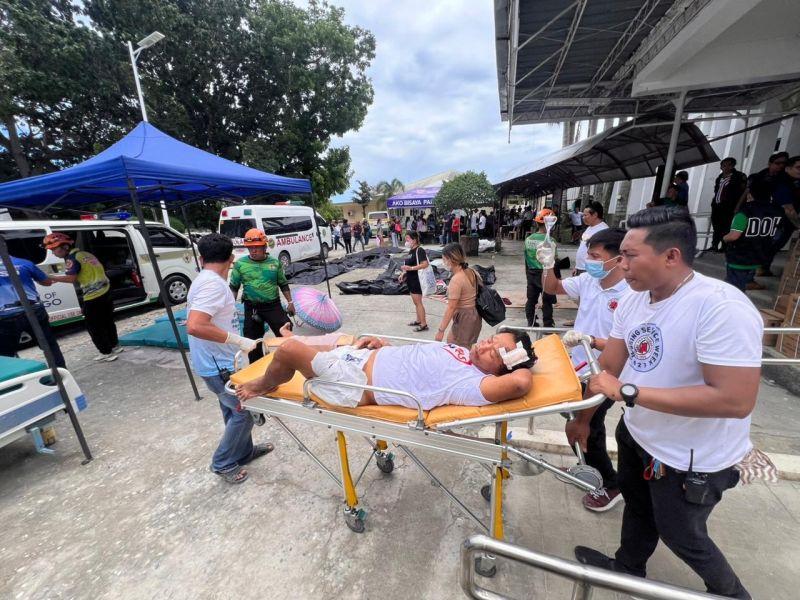
Photo: EPA
It also urged Taiwanese nationals in the Philippines to contact the Taipei Economic and Cultural Office in Manila in case of emergencies by calling its round-the-clock emergency hotline at 63-917-819-4597 or 0917-819-4597.
Meanwhile, the Tourism Administration said that no Taiwanese tour groups have reported being affected by the quake in Cebu, a popular tourist destination in the Southeast Asian country.
The earthquake struck just before 10pm last night, leaving at least 69 people dead and more than 150 injured, while hundreds of buildings collapsed, Reuters cited Philippine authorities as saying.

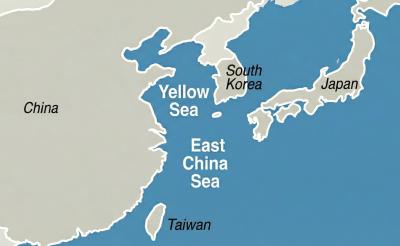
China has reserved offshore airspace in the Yellow Sea and East China Sea from March 27 to May 6, issuing alerts usually used to warn of military exercises, although no such exercises have been announced, the Wall Street Journal (WSJ) reported yesterday. Reserving such a large area for 40 days without explanation is an “unusual step,” as military exercises normally only last a few days, the paper said. These alerts, known as Notice to Air Missions (Notams), “are intended to inform pilots and aviation authorities of temporary airspace hazards or restrictions,” the article said. The airspace reserved in the alert is
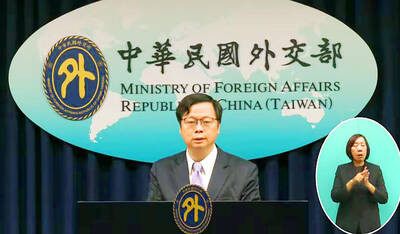
NAMING SPAT: The foreign ministry called on Denmark to propose an acceptable solution to the erroneous nationality used for Taiwanese on residence permits Taiwan has revoked some privileges for Danish diplomatic staff over a Danish permit that lists “Taiwan” as “China,” Eric Huang (黃鈞耀), head of the Ministry of Foreign Affairs’ Department of European Affairs, told a news conference in Taipei yesterday. Reporters asked Huang whether the Danish government had responded to the ministry’s request that it correct the nationality on Danish residence permits of Taiwanese, which has been listed as “China” since 2024. Taiwan’s representative office in Denmark continues to communicate with the Danish government, and the ministry has revoked some privileges previously granted to Danish representatives in Taiwan and would continue to review
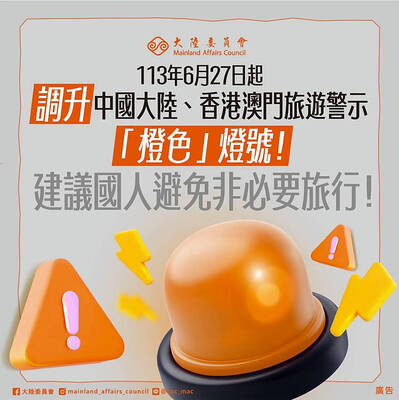
More than 6,000 Taiwanese students have participated in exchange programs in China over the past two years, despite the Mainland Affairs Council’s (MAC) “orange light” travel advisory, government records showed. The MAC’s publicly available registry showed that Taiwanese college and university students who went on exchange programs across the Strait numbered 3,592 and 2,966 people respectively. The National Immigration Agency data revealed that 2,296 and 2,551 Chinese students visited Taiwan for study in the same two years. A review of the Web sites of publicly-run universities and colleges showed that Taiwanese higher education institutions continued to recruit students for Chinese educational programs without

China has reserved offshore airspace over the Yellow Sea and East China Sea from March 27 to May 6, issuing alerts that are usually used to warn of military exercises, although no such exercises have been announced, the Wall Street Journal (WSJ) reported on Sunday. Reserving such a large area for 40 days without explanation is an “unusual step,” as military exercises normally only last a few days, the paper said. The alerts, known as notice to air missions (NOTAMs), “are intended to inform pilots and aviation authorities of temporary airspace hazards or restrictions,” the article said. The airspace reserved in the alert


 RSS
RSS