


Prosecutors in the Matsu Islands (Lienchiang County) said yesterday they have indicted 11 individuals in connection with the alleged smuggling of more than 4,500 fertilized eggs of parrots to China.
An investigation found that the 11 persons had purchased fertilized parrot eggs from Thailand and Vietnam, the Lienchiang District Prosecutors Office said in a statement.
The two main suspects, surnamed Chang (張) and Yang (楊), allegedly targeted the lucrative Chinese market, where rare parrot species are popular pets, prosecutors added.
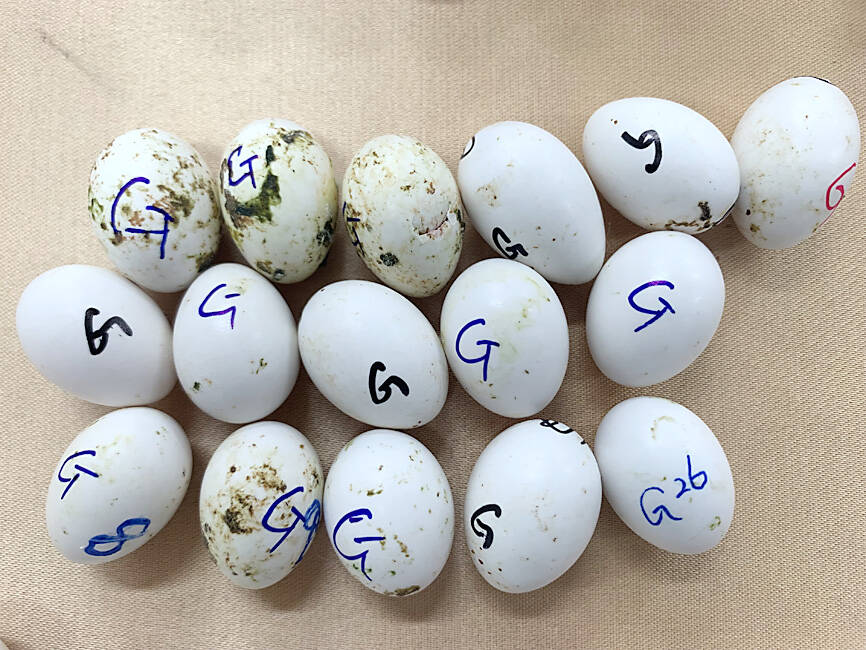
Photo courtesy of the Lienchiang District Prosecutors Office via CNA
Using the offshore counties of Lienchiang and Kinmen as transit points, they transported the uninspected eggs without an export/import permit from Thailand or Vietnam by air to Taiwan where the eggs were hatched.
The parrots were raised in a facility in Nantou and Yunlin counties, and the eggs they produced were then shipped by sea to Kinmen or Matsu before being transferred to Chinese smugglers at sea, according to the statement.
Between 2024 and March 2025, the suspects smuggled a total of 4,512 parrot eggs out of Taiwan, earning an estimated NT$5.68 million (US$195,578) in illicit profits. The largest single shipment involved over 1,000 eggs, prosecutors said.
Prosecutors have recommended the confiscation of illicit gains and have charged the suspects with smuggling under the Wildlife Conservation Act (野生動物保育法), the Act on the Prevention and Control of Infectious Animal Disease (動物傳染病防治條例), and the Money Laundering Control Act (洗錢防制法).
According to prosecutors, among the smuggled eggs, 570 were eggs of protected parrot species listed in the appendices of the Convention on International Trade in Endangered Species of Wild Fauna and Flora (CITES).
These included the grey parrot, blue-and-yellow macaw, white-bellied parrot, white cockatoo, and yellow-naped parrot, prosecutors said.
Chief Prosecutor Tsai Chieh-cheng (蔡杰承) said the investigation was launched after a tip-off led authorities to the smuggled parrot eggs in Kinmen and Matsu.
Subsequent analysis of the suspects’ communications and financial records confirmed the smuggling of 4,512 eggs to China, he said.

UNREASONABLE SURVEILLANCE: A camera targeted on an road by a neighbor captured a man’s habitual unsignaled turn into home, netting him dozens of tickets The Taichung High Administrative Court has canceled all 45 tickets given to a man for failing to use a turn signal while driving, as it considered long-term surveillance of his privacy more problematic than the traffic violations. The man, surnamed Tseng (曾), lives in Changhua County and was reported 45 times within a month for failing to signal while driving when he turned into the alley where his residence is. The reports were filed by his neighbor, who set up security cameras that constantly monitored not only the alley but also the door and yard of Tseng’s house. The surveillance occurred from July

A Japan Self-Defense Forces vessel entered the Taiwan Strait yesterday, Japanese media reported. After passing through the Taiwan Strait, the Ikazuchi was to proceed to the South China Sea to take part in a joint military exercise with the US and the Philippines, the reports said. Japan Self-Defense Force vessels were first reported to have passed through the strait in September, 2024, with two further transits taking place in February and June last year, the Asahi Shimbun reported. Yesterday’s transit also marked the first time since Japanese Prime Minister Sanae Takaichi took office that a Japanese warship has been sent through the Taiwan

SECURITY: Starlink owner Elon Musk has taken pro-Beijing positions, and allowing pro-China companies to control Taiwan’s critical infrastructure is risky, a legislator said Starlink was reluctant to offer services in Taiwan because of the nation’s extremely high penetration rates in 4G and 5G services, the Ministry of Digital Affairs said yesterday. The ministry made the comments at a meeting of the legislature’s Transportation Committee, which reviewed amendments to Article 36 of the Telecommunications Management Act (電信管理法). Article 36 bans foreigners from holding more than 49 percent of shares in public telecommunications networks, while shares foreigners directly and indirectly hold are also capped at 60 percent of the total, unless specified otherwise by law. The amendments, sponsored by Chinese Nationalist Party (KMT) Legislator Ko
‘SAME OLD TRICK’: Even if Beijing resumes individual travel to Taiwan, it would only benefit Chinese tourism companies, the Economic Democracy Union convener said China’s 10 new “incentives” are “sugar-coated poison,” an official said yesterday, adding that Taiwanese businesses see them clearly for what they are, but that Beijing would inevitably find some local collaborators to try to drums up support. The official, speaking on condition of anonymity, made the remark ahead of a news conference the General Chamber of Commerce is to hold today. The event, titled “Industry Perspectives on China’s Recent Pro-Taiwan Policies,” is expected to include representatives from industry associations — such as those in travel, hotels, food and agriculture — to request the government cooperate with China’s new measures, people familiar with


 RSS
RSS