


Taiwan's first domestically built submarine is almost certain to miss the date that sea trials were scheduled to begin, with only one day remaining until the deadline.
According to the timeline set by the Ministry of National Defense (MND), sea trials for the Hai Kun (海鯤), or “Narwhal,” Taiwan's Indigenous Defense Submarine (IDS) prototype, were supposed to begin this month and be completed by Sept. 30.

Photo: Taipei Times
"April was the original goal... We are currently working on improvements and final calibrations to meet the requirements set for sea trials. That is our main goal," navy Chief of Staff Chiu Chun-jung (邱俊榮) said yesterday at an MND news conference when asked whether the schedule had been delayed.
Pressed to say whether the MND would fail to deliver on its word, Chiu said the navy is focusing on reaching the "technology readiness level required for the vessel to go out to sea, not on the schedule."
The MND had said on several occasions that sea trials would begin this month, in response to news reports that tests regarding the Hai Kun had experienced setbacks.
On Feb. 26, it said that harbor trials were on schedule and sea trials would proceed as planned this month, amid reports of potential testing delays due to voltage surges from a land-based power supply used in testing causing some components in the submarine to fail.
The IDS program has faced several delays.
Three days prior to the unveiling of the prototype at a photo op attended by then-president Tsai Ing-wen (蔡英文) in September 2023, Huang Shu-kuang (黃曙光), then convener of the program, said the prototype would undergo a harbor acceptance test beginning on Oct. 1, 2023.
That would be followed by a sea acceptance test, and the submarine would hopefully be delivered to the navy before the end of last year, Huang said.
At some point last year, the scheduled delivery was pushed back by about a year, to November.
Given that timing, and the MND's acknowledgement in September last year that the Haikun had failed more than 10 categories in the harbor trials, the Chinese Nationalist Party (KMT) and Taiwan People's Party took aim at the submarine's budget in January.
Lawmakers from the two parties voted to freeze NT$2 billion (US$61.91 million) of the funding proposed for this fiscal year for the IDS program, or about half of the proposed total, with the proviso that the funds can only be unfrozen after the submarine passes the sea trials.
Chiu said yesterday that the funding would be unfrozen if sea trials are finished on time and the MND gives a briefing about them at the legislature.
Minister of National Defense Wellington Koo (顧立雄) told reporters at the legislature last week that the submarine's contractor, CSBC Corp, is to face a fine if it fails to deliver the sub to the navy in November, as per the contract.

The Ministry of Finance this afternoon announced the winning numbers for the March-April uniform invoice lottery. The winning number for the NT$10 million (US$318,060) special prize is 19531471, and the winning number for the NT$2 million grand prize is 85941329. Three numbers were drawn for the NT$200,000 first prize: 07225810, 20231230 and 83518781. Those with receipts matching the last seven digits of any of the first-prize numbers will win the NT$40,000 second prize, while those matching the last six digits will win the NT$10,000 third prize. Those whose receipts match the last five digits of the first-prize numbers can claim the NT$4,000 fourth prize,

SIX SUBSIDIES: The monthly allowance for older farmers is to increase to NT$10,000, and NT$5,000 is to be given to homemakers under the national pension system, Lai said The government is to implement major welfare policies for disadvantaged groups, including raising the monthly allowance for older farmers to NT$10,000 and providing homemakers with NT$5,000 per month, President William Lai (賴清德) said yesterday. Lai made the remarks during a visit to Wangling Temple in Chiayi County, saying that the planned increases were being introduced amid economic growth and an increase in tax revenue. Touting a policy, in which the government plans to provide a monthly allowance of NT$5,000 for every child under the age of 18 in a bid to address Taiwan’s low birthrate, Lai said that if received for the
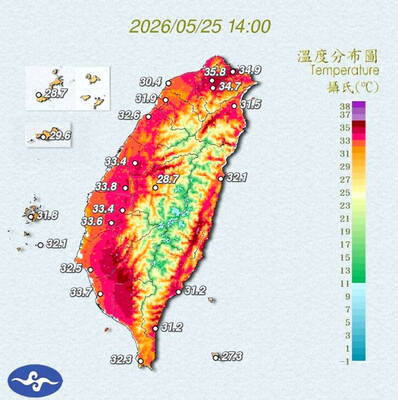
STAY COOL: The HPA recommended that people stay hydrated, use air-conditioning or fans while indoors, wear loose-fitting clothes and walk in the shade while outdoors Employers must implement measures such as installing cooling equipment, and providing drinking water and rest breaks for outdoor workers starting from Monday next week, the Taipei Department of Labor said on Sunday. Employers who fail to comply could face fines of NT$30,000 to NT$300,000 under the Occupational Safety and Health Act (職業安全衛生法), the department said. Businesses in Taipei employing fewer than 100 workers, as well as registered self-employed workers with labor insurance coverage, could receive on-site assessments and guidance from occupational safety consultants to help them apply for central government subsidies to implement or improve heat-protection measures, it said. Under the Ministry of

NATIONAL SECURITY: Authorities are working to confirm the identities of the military personnel involved and investigating possible illegal conduct and regulatory violations Authorities are probing possible national security implications after Kinmen police and immigration officers on Sunday found a Chinese woman allegedly posing as a tourist while engaging in prostitution involving more than 10 military personnel. The woman, surnamed Chen (陳), has since been deported, authorities said, adding that investigators are still working to confirm the identities of those implicated, as the records only listed code names and aliases. The case stemmed from a report received by the Kinmen District Prosecutors’ Office on Friday last week from the Jinhu Precinct of the Kinmen County Police Bureau. On Sunday, police, along with the National Immigration


 RSS
RSS