


One of the three new weapon procurement contracts signed with the US last year is to be delivered by the end of this year, the Ministry of National Defense announced today.
The three contracts are for Norwegian Advanced Surface-to-Air Missile Systems (NASAMS), an L-band electronic array radar and a non-L-band electronic array radar, the ministry said.
Given the frequent military activities in the Taiwan Strait by the Chinese Communist Party (CCP), the NASAMS and new radar systems will deepen Taiwan’s air defense capabilities, the ministry said.
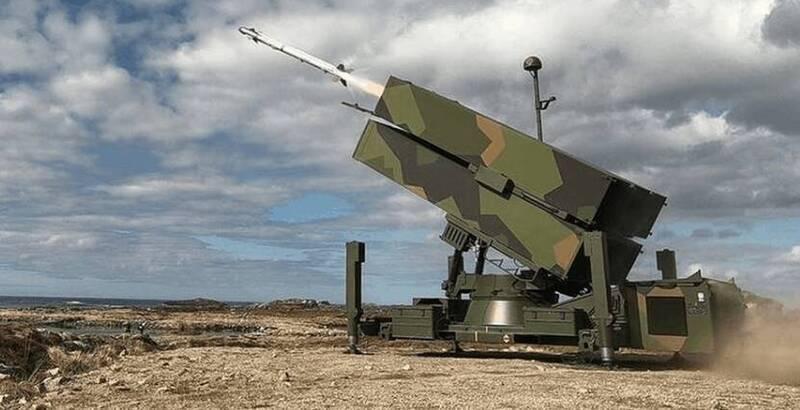
Photo courtesy of the Norwegian Ministry of Defense
NASAMS have been used effectively in Ukraine, offering up automated detection capability, distributed firepower capabilities, a supporting command and control component, the ministry added.
The two new radar systems will improve detection rates and be resistant to jamming or interference, the ministry said.
NASAMS integrates the MPQ-64 “Sentinel,” multiple types of short and medium-range air defense missiles, and the Link 16 military tactical data link, allowing it to defend against aircraft within a range of 40 to 50 kilometers.
NASAMS will be deployed in Greater Taipei, with one located in Taipei’s Songshan District (松山) and the other in New Taipei’s Tamsui District (淡水), as both locations would be crucial in defending the capital, the ministry said.
The electronic array systems will be spread across the country, the ministry added.
NASAMS has performed well in Ukraine, making it a priority item for the US to recommend to Taiwan as part of the country’s push to increase its asymmetric warfare capabilities, defense expert Mei Fu-hsing (梅復興) said.
Unlike several other arms sales, Mei said, this system aligns well with that goal.
The US government announced on Oct. 26 last year that it would notify the US Congress of the agreements, totaling US$1.988 billion.
This is the 17th arm sale to Taiwan under outgoing US President Joe Biden.
The contract for NASAMS amounts to NT$10.31 billion (US$312.7 million), has a fulfillment date of Dec. 27 of last year, and will run until Feb. 25, 2034.
The L-band electronic array radar will cost NT$6.42 billion and run until 2030, while the non-L model will cost NT$7.61 billion and expire at the same time.

SPACE VETERAN: Kjell N. Lindgren, who helps lead NASA’s human spaceflight missions, has been on two expeditions on the ISS and has spent 311 days in space Taiwan-born US astronaut Kjell N. Lindgren is to visit Taiwan to promote technological partnerships through one of the programs organized by the US for its 250th national anniversary. Lindgren would be in Taiwan from Tuesday to Saturday next week as part of the US Bureau of Educational and Cultural Affairs’ US Speaker Program, organized to celebrate the 250th anniversary of the signing of the Declaration of Independence, the American Institute in Taiwan (AIT) said in a statement yesterday. Lindgren plans to engage with key leaders across the nation “to advance cutting-edge technological partnerships and inspire the next generation of scientists and engineers,”

The Chinese Nationalist Party (KMT) caucus yesterday said it opposes the introduction of migrant workers from India until a mechanism is in place to prevent workers from absconding. Minister of Labor Hung Sun-han (洪申翰) on Thursday told the Legislative Yuan that the first group of migrant workers from India could be introduced as early as this year, as part of a government program. The caucus’ opposition to the policy is based on the assessment that “the risk is too high,” KMT caucus secretary-general Lin Pei-hsiang (林沛祥) said. Taiwan has a serious and long-standing problem of migrant workers absconding from their contracts, indicating that

UNREASONABLE SURVEILLANCE: A camera targeted on an road by a neighbor captured a man’s habitual unsignaled turn into home, netting him dozens of tickets The Taichung High Administrative Court has canceled all 45 tickets given to a man for failing to use a turn signal while driving, as it considered long-term surveillance of his privacy more problematic than the traffic violations. The man, surnamed Tseng (曾), lives in Changhua County and was reported 45 times within a month for failing to signal while driving when he turned into the alley where his residence is. The reports were filed by his neighbor, who set up security cameras that constantly monitored not only the alley but also the door and yard of Tseng’s house. The surveillance occurred from July

TRADE-OFF: Beijing seeks to trade a bowl of tempura for a Chinese delicacy, an official said, while another said its promises were attempts to interfere in the polls The government must carefully consider the national security implications of building a bridge connecting Kinmen County and Xiamen, China, the Public Construction Commission (PCC) said yesterday. PCC Commissioner Derek Chen (陳金德), who is also a minister without portfolio, made the remarks in a meeting of the legislature’s Transportation Committee, after Democratic Progressive Party Legislator Hsu Fu-kuei (徐富癸) asked about China’s proposal of new infrastructure projects to further connect Kinmen and Lienchiang (Matsu) counties with Xiamen. China unveiled the bridge plan, along with nine other policies for Taiwan, on Sunday, the last day of Chinese Nationalist Party (KMT) Chairwoman Cheng Li-wun’s (鄭麗文) visit


 RSS
RSS