


The Executive Yuan today said it is to discuss remedial options with experts and the Examination Yuan, after the legislature passed a bill this week on pension reform for police by amending the Police Personnel Management Act (警察人員人事條例), saying the amendments contravene the Constitution and the Budget Act (預算法).
The Legislative Yuan on Tuesday passed a bill on pension reform for police by raising the maximum income replacement ratio to 80 percent for those who have served for 36 years or more.
The amended bill stated that the monthly income replacement ratio for police, firefighters, coast guard personnel, National Immigration Agency officers and airborne service personnel should be set at 43.25 percent for those who have served 15 years, with the ratio going up by 1.75 percentage points per year until it reaches 80 percent at 36 years of service.

Photo courtesy of the Executive Yuan
The Executive Yuan had not been consulted regarding some of the amendments, Cabinet spokesperson Michelle Lee (李慧芝) told a news conference today.
Lee also said the bill does not indicate the source of funds, which contravenes Article 70 of the Constitution and relevant regulations stated in the Budget Act.
The bill has not yet been sent to the Executive Yuan, Lee said, citing Premier Cho Jung-tai (卓榮泰) as saying that he hopes relevant procedures would be conducted legally without any political considerations.
Chinese Nationalist Party (KMT) caucus whip Fu Kun-chi (傅崐萁) yesterday said the party’s next steps would be to “take care of” civil servants and teachers by proposing amendments to relevant laws.
“What kind of government does not ensure civil servants are taken care of when they get old?” he asked.
Regarding the potential amendment, Lee said she hopes it would not go against the current pension system, and that generational justice and the sustainability of the pension fund should be upheld so that everyone is treated equally.
The National Federation of Teachers’ Union said civil servants and teachers are being treated unfairly in a statement issued today.
Federation president Hou Chun-liang (侯俊良) said the government should perform its duty as an employer to correct the flaws in the pension reform.
Additional reporting by Hsieh Chun-lin, Lin Hsin-han, Jake Chung, Sam Garcia and Lin Hsiao-yun

Taiwan has received more than US$70 million in royalties as of the end of last year from developing the F-16V jet as countries worldwide purchase or upgrade to this popular model, government and military officials said on Saturday. Taiwan funded the development of the F-16V jet and ended up the sole investor as other countries withdrew from the program. Now the F-16V is increasingly popular and countries must pay Taiwan a percentage in royalties when they purchase new F-16V aircraft or upgrade older F-16 models. The next five years are expected to be the peak for these royalties, with Taiwan potentially earning
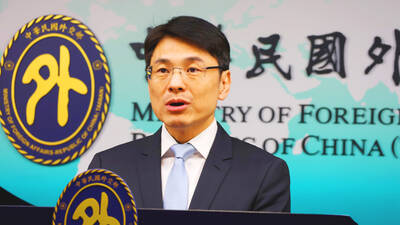
STAY IN YOUR LANE: As the US and Israel attack Iran, the ministry has warned China not to overstep by including Taiwanese citizens in its evacuation orders The Ministry of Foreign Affairs (MOFA) yesterday rebuked a statement by China’s embassy in Israel that it would evacuate Taiwanese holders of Chinese travel documents from Israel amid the latter’s escalating conflict with Iran. Tensions have risen across the Middle East in the wake of US and Israeli airstrikes on Iran beginning Saturday. China subsequently issued an evacuation notice for its citizens. In a news release, the Chinese embassy in Israel said holders of “Taiwan compatriot permits (台胞證)” issued to Taiwanese nationals by Chinese authorities for travel to China — could register for evacuation to Egypt. In Taipei, the ministry yesterday said Taiwan
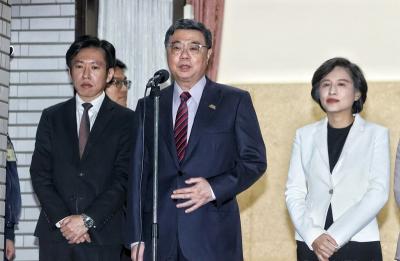
Taiwan is awaiting official notification from the US regarding the status of the Agreement on Reciprocal Trade (ART) after the US Supreme Court ruled US President Donald Trump's global tariffs unconstitutional. Speaking to reporters before a legislative hearing today, Premier Cho Jung-tai (卓榮泰) said that Taiwan's negotiation team remains focused on ensuring that the bilateral trade deal remains intact despite the legal challenge to Trump's tariff policy. "The US has pledged to notify its trade partners once the subsequent administrative and legal processes are finalized, and that certainly includes Taiwan," Cho said when asked about opposition parties’ doubts that the ART was
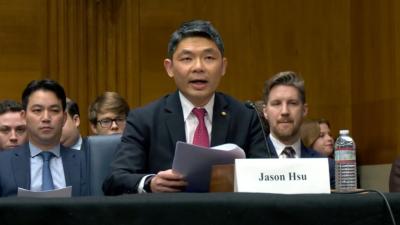
If China chose to invade Taiwan tomorrow, it would only have to sever three undersea fiber-optic cable clusters to cause a data blackout, Jason Hsu (許毓仁), a senior fellow at the Hudson Institute and former Chinese Nationalist Party (KMT) legislator, told a US security panel yesterday. In a Taiwan contingency, cable disruption would be one of the earliest preinvasion actions and the signal that escalation had begun, he said, adding that Taiwan’s current cable repair capabilities are insufficient. The US-China Economic and Security Review Commission (USCC) yesterday held a hearing on US-China Competition Under the Sea, with Hsu speaking on


 RSS
RSS