


The Chinese Nationalist Party (KMT) today defended amendments to the Act Governing the Allocation of Government Revenues and Expenditures (財政收支劃分法) that the Democratic Progressive Party (DPP) said would necessitate an overhaul of next year's general budget.
The amendments, if promulgated into law, would allocate 60 percent of available funding to local governments rather than the current 25 percent, resulting in central government spending power being reduced annually by NT$375.3 billion (US$11.49 billion), according to the Directorate-General of Budgeting, Accounting and Statistics (DGBAS).
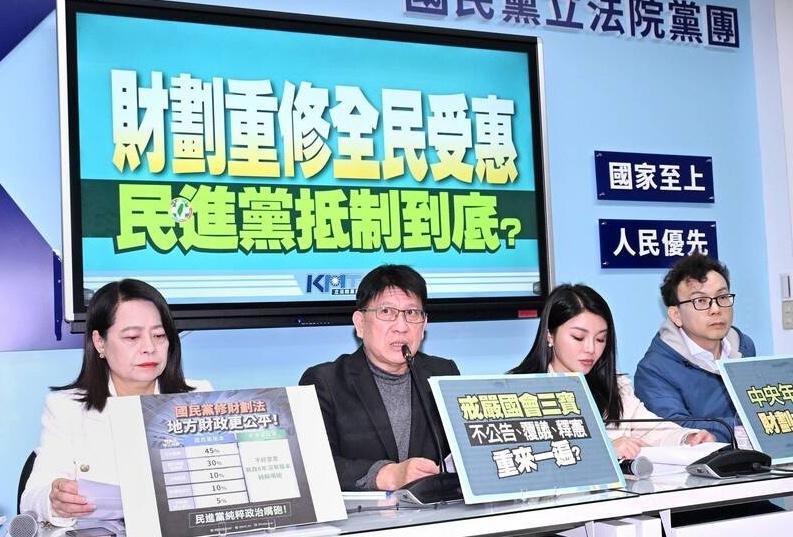
Photo: Fang Pin-chao, Taipei Times
At a news conference, KMT caucus Secretary-General Lin Szu-ming (林思銘) rejected claims made earlier in the day by government ministers that the revisions, which cleared the legislature on Friday last week following brawls between lawmakers, would harm central government spending on defense, social welfare and other major programs.
Lin suggested that the reallocation of funding would instead reward fiscally responsible local governments and encourage them to promote economic development and create jobs, rather than relying on central government handouts.
"When President William Lai (賴清德) was mayor of Tainan, he called for amendments to the Act Governing the Allocation of Government Revenues and Expenditures," Lin said, suggesting that the DPP also sought greater funds for local governments when it previously was in opposition.
"Basically, what [for them] was right yesterday is wrong today," Lin said. "They changed places and changed their minds."
The KMT news conference — titled "The funding allocation overhaul will benefit everyone: Will the DPP resist endlessly?" — took place on the same day the DPP caucus held its own news conference titled "The sinister funding allocation amendments will harm everyone."
At a separate news conference today, DGBAS Minister Chen Shu-tzu (陳淑姿) said that the changes would cause "procedural chaos" in relation to next year's general budget, which has already been hotly contested by lawmakers.
The minister also said that the central government would lose NT$375.3 billion, or 9 percent of its total revenue, if the law goes into effect.
This would necessitate massive reductions in spending, Chen said, including cuts for defense equivalent to 28 percent.

Kenting National Park service technician Yang Jien-fon (楊政峰) won a silver award in World Grand Prix Photography Awards Spring Season for his photograph of two male rat snakes intertwined in combat. Yang’s colleagues at Kenting National Park said he is a master of nature photography who has been held back by his job in civil service. The awards accept entries in all four seasons across six categories: architectural and urban photography, black-and-white and fine art photography, commercial and fashion photography, documentary and people photography, nature and experimental photography, and mobile photography. Awards are ranked according to scores and divided into platinum, gold and

More than half of the bamboo vipers captured in Tainan in the past few years were found in the city’s Sinhua District (新化), while other districts had smaller catches or none at all. Every year, Tainan captures about 6,000 snakes which have made their way into people’s homes. Of the six major venomous snakes in Taiwan, the cobra, the many-banded krait, the brown-spotted pit viper and the bamboo viper are the most frequently captured. The high concentration of bamboo vipers captured in Sinhua District is puzzling. Tainan Agriculture Bureau Forestry and Nature Conservation Division head Chu Chien-ming (朱健明) earlier this week said that the
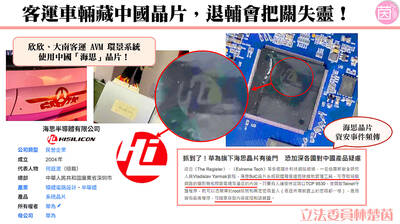
BREACH OF CONTRACT: The bus operators would seek compensation and have demanded that the manufacturer replace the chips with ones that meet regulations Two bus operators found to be using buses with China-made chips are to demand that the original manufacturers replace the systems and provide compensation for breach of contract, the Veterans Affairs Council said yesterday. Democratic Progressive Party Legislator Michelle Lin (林楚茵) yesterday said that Da Nan Bus Co and Shin-Shin Bus Co Ltd have fielded a total of 82 buses that are using Chinese chips. The bus models were made by Tron-E, while the systems provider was CYE Electronics, Lin said. Lin alleged that the buses were using chips manufactured by Huawei subsidiary HiSilicon Co, which presents a national security risk if the

The National Immigration Agency has banned two Chinese from returning to Taiwan, after they published social media content it described as disrespectful to national sovereignty. The agency imposed a two-month ban on a Chinese man surnamed Liang (梁) and a permanent ban on a woman surnamed Yang (楊), an influencer with 23 million followers, in October last year and last week respectively. Minister of the Interior Liu Shyh-fang (劉世芳) yesterday said on the sidelines of a legislative meeting that Chinese visitors to Taiwan are required to comply with the rules and regulations governing their entry permits. The government has handled the ban and


 RSS
RSS