


The Keelung Election Commission would be required to verify a petition submitted by a campaign drive to recall Keelung Mayor George Hsieh (謝國樑) of the Chinese Nationalist Party (KMT), the Central Election Commission said yesterday.
Under the Public Officials Election and Recall Act (公職人員選舉罷免法), an election commission is responsible for verifying the list of signatories and removing invalid signatures from the count within 40 days of a petition’s submission, the commission said in a statement.
The “Shanhai citizens’ movement to remove Liang” said the petition comprising 40,000 signatures was submitted to the Keelung Election Commission yesterday afternoon.

Photo: Lu Hsien-hsiu, Taipei Times
The number of signatures received has exceeded the threshold (30,792 signatures) required to initiate a recall vote.
The law stipulates that a recall of the mayor of an administrative region can be initiated if at least 10 percent of the area’s voters sign a petition supporting it.
After the signatures have been reviewed, if the final count is below the threshold, the Keelung commission is to return the petition to proponents and give them 10 days to make up the difference.
If enough valid signatures are collected, a recall vote should be held in 20 to 60 days, Article 87 of the law stipulates.
The procedures and standards of a recall election would be the same as in previous cases, the commission said, citing the example of Legislative Speaker Han Kuo-yu (韓國瑜) of the KMT, who was recalled from his Kaohsiung mayorship in 2020.
For a recall vote to succeed, the number of votes cast in favor would have to exceed those cast against it and equal at least one-quarter of all eligible voters in the district.
Considering that 312,207 people in Keelung were eligible to vote in the presidential election in January, about 78,000 people would have to support the recall for it to have a chance to pass.
The move to recall Hsieh, who has been in office since 2022, was initiated in March after a dispute over the controversial changing of the operator of Keelung E-Square Mall (基隆東岸商場).

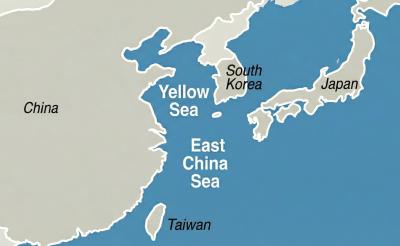
China has reserved offshore airspace in the Yellow Sea and East China Sea from March 27 to May 6, issuing alerts usually used to warn of military exercises, although no such exercises have been announced, the Wall Street Journal (WSJ) reported yesterday. Reserving such a large area for 40 days without explanation is an “unusual step,” as military exercises normally only last a few days, the paper said. These alerts, known as Notice to Air Missions (Notams), “are intended to inform pilots and aviation authorities of temporary airspace hazards or restrictions,” the article said. The airspace reserved in the alert is

NAMING SPAT: The foreign ministry called on Denmark to propose an acceptable solution to the erroneous nationality used for Taiwanese on residence permits Taiwan has revoked some privileges for Danish diplomatic staff over a Danish permit that lists “Taiwan” as “China,” Eric Huang (黃鈞耀), head of the Ministry of Foreign Affairs’ Department of European Affairs, told a news conference in Taipei yesterday. Reporters asked Huang whether the Danish government had responded to the ministry’s request that it correct the nationality on Danish residence permits of Taiwanese, which has been listed as “China” since 2024. Taiwan’s representative office in Denmark continues to communicate with the Danish government, and the ministry has revoked some privileges previously granted to Danish representatives in Taiwan and would continue to review

More than 6,000 Taiwanese students have participated in exchange programs in China over the past two years, despite the Mainland Affairs Council’s (MAC) “orange light” travel advisory, government records showed. The MAC’s publicly available registry showed that Taiwanese college and university students who went on exchange programs across the Strait numbered 3,592 and 2,966 people respectively. The National Immigration Agency data revealed that 2,296 and 2,551 Chinese students visited Taiwan for study in the same two years. A review of the Web sites of publicly-run universities and colleges showed that Taiwanese higher education institutions continued to recruit students for Chinese educational programs without

China has reserved offshore airspace over the Yellow Sea and East China Sea from March 27 to May 6, issuing alerts that are usually used to warn of military exercises, although no such exercises have been announced, the Wall Street Journal (WSJ) reported on Sunday. Reserving such a large area for 40 days without explanation is an “unusual step,” as military exercises normally only last a few days, the paper said. The alerts, known as notice to air missions (NOTAMs), “are intended to inform pilots and aviation authorities of temporary airspace hazards or restrictions,” the article said. The airspace reserved in the alert


 RSS
RSS