


About 30 Indonesian migrant workers gathered outside the Indonesian Economic and Trade Office (IETO) to Taipei yesterday to demand better protection of their rights and the abolition of the broker system.
During the rally, Indonesians working in the caregiving and manufacturing sectors urged the IETO to put an end to the broker system and improve the office’s services.
Holding signs with slogans such as “stop overcharging” and “Sunday service every week,” they shared experiences of what they described as poor treatment by brokers or the IETO.
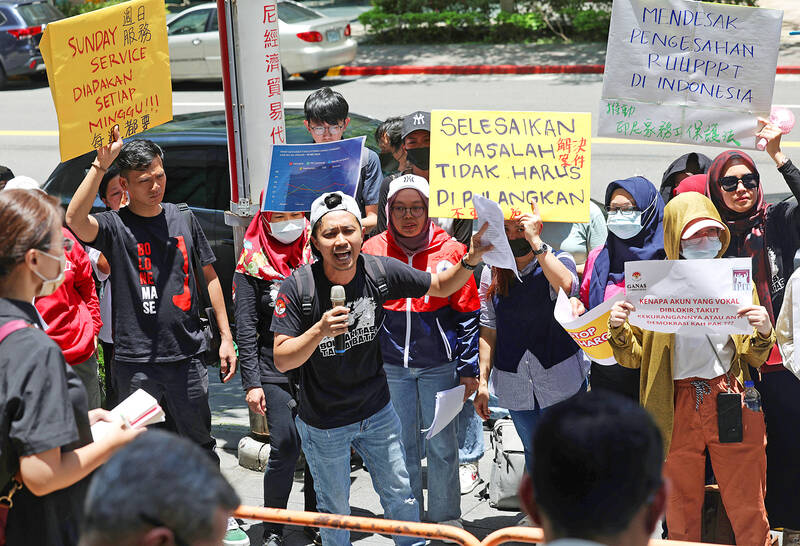
Photo: CNA
“When I was in Indonesia, I signed a contract to take care of an elderly person [in Taiwan]. However, when I arrived in Taiwan, I was assigned to work on a farm,” said Maesaroh, a migrant worker who has been in Taiwan for less than a year.
Unable to endure the pain in her back from shoveling dirt from dawn to dusk every day, she asked the broker to allow her to change jobs.
“They threatened me, saying that if I switched to another employer, I would have to pay tens of millions of Indonesian rupiah as penalties [for violating the contract],” Maesaroh said, choking up, referring to an amount equal to tens of thousands of New Taiwan dollars.
The broker system was legalized in 1992 to introduce overseas workers to employment opportunities in Taiwan, manage the workers and help them process any necessary documents while in Taiwan.
Muchsin, an Indonesian factory worker who broke his leg in a work-related incident, recounted an incident in which an IETO staff member conducted a live broadcast on TikTok to share information about labor regulations.
“I asked him about the rights of migrant workers who fall ill and those who suffer from work-related injuries... He became angry and blocked my account,” Muchsin said.
“According to the [Indonesian] government’s slogan ‘Protect Indonesian migrant workers from head to toe,’ they should protect and uphold my rights,” he added.
The IETO should also increase the frequency of office services on Sundays — the day of the week when most migrant workers can take their days off — to more than just once a month, said Fajar, a caregiver and the president of the Indonesian workers solidarity organization Ganas Community, which organized the rally.
At the end of the rally, Iqbal Shoffan Shofwan, head of the IETO and Indonesia’s representative to Taiwan, received a petition from the group after discussing their appeals with them.
He said the office would discuss those issues and look into how their services can be improved.
“It is our responsibility to respond to all of the demands of our migrant workers,” Iqbal said. “We should not ignore any demand that comes from our migrant workers.”

Yangmingshan National Park authorities yesterday urged visitors to respect public spaces and obey the law after a couple was caught on a camera livestream having sex at the park’s Qingtiangang (擎天崗) earlier in the day. The Shilin Police Precinct in Taipei said it has identified a suspect and his vehicle registration number, and would summon him for questioning. The case would be handled in accordance with public indecency charges, it added. The couple entered the park at about 11pm on Thursday and began fooling around by 1am yesterday, the police said, adding that the two were unaware of the park’s all-day live

Fast food chain McDonald's is to raise prices by up to NT$5 on some products at its restaurants across Taiwan, starting on Wednesday next week, the company announced today. The prices of all extra value meals and sharing boxes are to increase by NT$5, while breakfast combos and creamy corn soup would go up by NT$3, the company said in a statement. The price of the main items of those meals, if ordered individually, would remain the same. Meanwhile, the price of a medium-sized lemon iced tea and hot cappuccino would rise by NT$3, extra dipping sauces for chicken nuggets would go up

Yangmingshan National Park’s Qingtiangang (擎天崗) nature area has gone viral after a park livestream camera observed a couple in the throes of intimate congress, which was broadcast live on YouTube, drawing large late-night crowds and sparking a backlash over noise, bright lights and disruption to wildlife habitat. The area’s livestream footage appeared to show a couple engaging in sexual activity on a picnic table in the park on Friday last week, with the uncensored footage streamed publicly online. The footage quickly spread across social media, prompting a tide of visitors to travel to the site to “check in” and recreate the

Minister of Digital Affairs Lin Yi-ching (林宜敬) yesterday cited regulatory issues and national security concerns as an expert said that Taiwan is among the few Asian regions without Starlink. Lin made the remarks on Facebook after funP Innovation Group chief executive officer Nathan Chiu (邱繼弘) on Friday said Taiwan and four other countries in Asia — China, North Korea, Afghanistan and Syria — have no access to Starlink. Starlink has become available in 166 countries worldwide, including Ukraine, Malaysia, the Philippines and Vietnam, in the six years since it became commercial, he said. While China and North Korea block Starlink, Syria is not


 RSS
RSS