

The Taipei Theater Awards were launched on Thursday, with the hope of becoming Taiwan’s equivalent of the Tony Awards for contemporary theater and musical productions, Department of Cultural Affairs commissioner Tsai Shih-ping (蔡詩萍) said.
Tsai said establishing top awards for Taiwan’s stage productions has been one of his priorities since taking office because of his guest-starring roles in such productions.
It has also been a wish of theater producers, Tsai said, with directors Ko I-chen (柯一正) and Wu Nien-jen (吳念真) telling him there was a need for high-level honors and recognition for the industry.
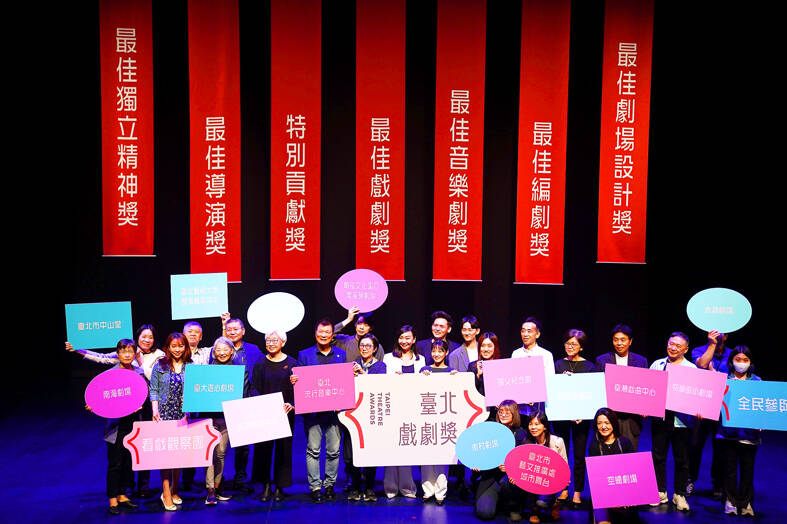
Photo: CNA
The inaugural awards, to be presented in June next year, are to include awards for best theater production, best musical production and best experimental and innovative theater or musical production, which would be picked from the nominees in the first two categories, the organizers said.
Awards for individuals include best director, best playwright, best production design, best actor and actress in theater productions, as well as best actor and best actress in musicals.
A special contribution award for either a theater group or individual would be picked from nominees recommended by a group of experts and theatergoers, as well as by members of the public between Oct. 1 and Nov. 30, the organizers said.
Only ticketed productions staged in venues owned or run by the government in Taipei are eligible to compete in the inaugural edition of the awards, except for productions of traditional and children’s theater, the organizers said.
Even if a national theater awards program is established, the Taipei Theatre Awards would continue, Tsai said, citing the example of the coexistence of the Taipei Film Awards and the Golden Horse Awards.
The Taipei Theater Awards would be an important benchmark for Taiwan, since “many productions premiere in Taipei,” Tsai said. “Audiences in Taipei can decide whether a production makes it or not.”
Organizers are scheduled to begin accepting submissions from theater and musical productions from May 1 to June 14 for ticketed productions staged in Taipei between July 1 and Dec. 31.
In addition to trophies for the winners, the city government is to hand out total prize money of NT$2.7 million (US$83,609), the organizers said.
Meanwhile, the privately run Taishin Bank Foundation for Art and Culture, which announced 17 nominees for the 22nd edition of its Taishin Arts Awards early last month, is to hold its awards ceremony on June 1.
The foundation is to present one prize for a visual artwork, one for a performing arts production and a grand prize picked from nominees from both categories.
The grand prize winner is to receive NT$1.5 million, while the two other winners are to be awarded NT$1 million each, the foundation said.

A Straits Exchange Foundation official today warned that yielding to political pressure in exchange for access to China’s entertainment industry rarely ends well, amid rumors that China is seeking to lure Taiwanese K-pop star Chou Tzu-yu (周子瑜). Chou, more commonly known as Tzuyu, is the only Taiwanese member of the girl group Twice. Her contract with JYP Entertainment is set to expire at the end of this year, and there have been widespread reports that she would not renew it. She is reportedly planning to pursue solo activities under her parents’ agency, Yu Hai Entertainment (瑜海娛樂), although China has also reportedly offered
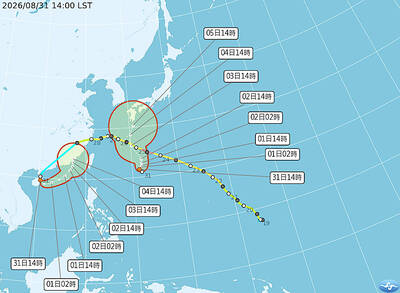
A tropical depression near Hainan that was once Typhoon Saudel may once again strengthen into a tropical storm, the Central Weather Administration (CWA) said yesterday, but a sea warning for waters around Taiwan is unlikely. CWA forecaster Huang En-hung (黃恩鴻) said that Saudel would return to being a weak tropical storm by late yesterday or early this morning. However, as the storm is to gradually weaken again and would head toward China’s Guangdong Province away from Taiwan, the chances that it would affect Taiwan enough for the CWA to issue a sea warning are relatively low,

Yielding to political pressure in exchange for access to China’s entertainment industry rarely ends well, a Straits Exchange Foundation official said yesterday amid rumors that China is seeking to lure Taiwanese K-pop star Chou Tzu-yu (周子瑜). Chou, who goes by Tzuyu, is the only Taiwanese member of the girl group Twice. Her contract with JYP Entertainment is set to expire at the end of this year, and there have been widespread rumors that she would not renew it. She is reportedly planning to pursue a solo career under her parents’ agency, Yu Hai Entertainment, although China has also reportedly offered to help Tzuyu
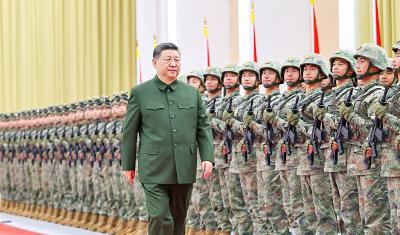
China has revised its National Defense Mobilization Law to prepare for a rapid transition to wartime, with an official today saying the measures are aimed at helping Chinese President Xi Jinping (習近平) fulfill his “historic mission of national unification.” The revised version of the mobilization law is to take effect on Oct. 1, marking the first major revision since the law was enacted in 2010. The amendments define national defense mobilization as measures taken in response to threats to national sovereignty, unification, territorial integrity, security and development interests, including efforts to ensure rapid transition between peacetime and wartime and convert economic and


 RSS
RSS