


Japanese Prime Minister Fumio Kishida yesterday visited a new semiconductor plant for which his government has pledged a support of more than ¥1 trillion (US$6.6 billion) to secure a steady supply of chips.
“I believe this project will have positive ripple effects throughout Japan. It is key for not only the semiconductor industry, but also a wide range of businesses such as electric vehicles and electronics,” he said while touring the facility.
The plant, located in the southwestern island of Kyushu, was opened in February and is Japan Advanced Semiconductor Manufacturing Company’s first in the country. It is majority owned by Taiwan Semiconductor Manufacturing Co (TSMC), the world’s largest contract chipmaker.
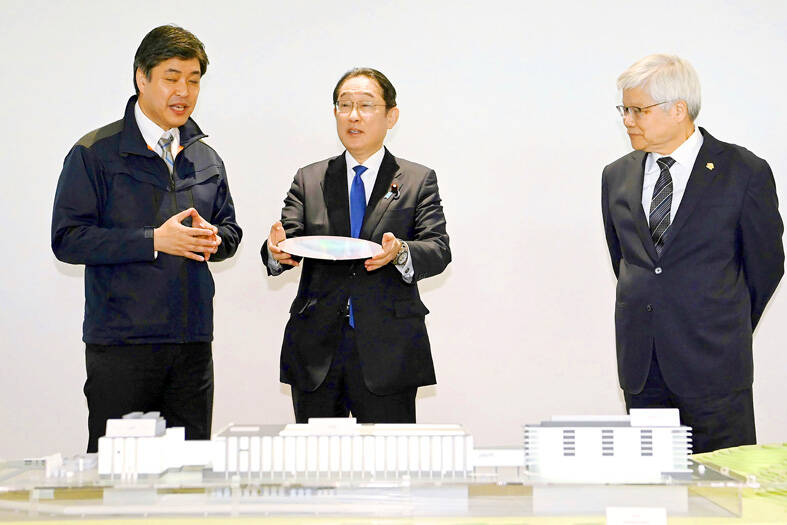
Photo: Kyodo News via AP
Japanese companies like Sony, Denso and Toyota are investing in the TSMC subsidiary, although the Taiwanese giant retained an 86.5 percent stake. The project underlines Japan’s hopes to regain its presence in the computer chips industry.
Four decades ago, Japan dominated in chips, with Toshiba and NEC controlling half the world’s production. That has since declined to less than 10 percent, amid competition from South Korean, US and European manufacturers, as well as TSMC.
Japan has recently earmarked about ¥5 trillion to revive its chips industry, seeking to become less dependent on imports, in the wake of pandemic-era shortages that affected auto production and other industries for months.
Ensuring an ample supply of the most advanced chips is vital with the growing popularity of electric vehicles, as well as artificial intelligence.
Private sector investment totals US$20 billion for the plants in the Kumamoto region of Japan. The second plant is set to be up and running in three years. The two plants are expected to create 3,400 high-tech jobs directly, TSMC said.
The plant is a bright spot for Kishida, whose popularity has plummeted amid a corruption scandal in his ruling Liberal Democratic Party.
Highlighting Japan’s ties with Taiwan and the US, its most important ally, is one way the prime minister can hope to boost flagging poll numbers.
Kishida is scheduled to meet US President Joe Biden in Washington next week.

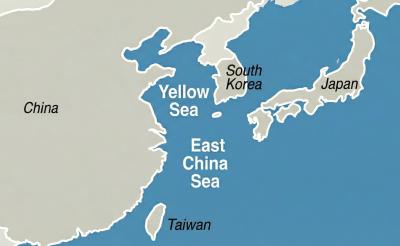
China has reserved offshore airspace in the Yellow Sea and East China Sea from March 27 to May 6, issuing alerts usually used to warn of military exercises, although no such exercises have been announced, the Wall Street Journal (WSJ) reported yesterday. Reserving such a large area for 40 days without explanation is an “unusual step,” as military exercises normally only last a few days, the paper said. These alerts, known as Notice to Air Missions (Notams), “are intended to inform pilots and aviation authorities of temporary airspace hazards or restrictions,” the article said. The airspace reserved in the alert is
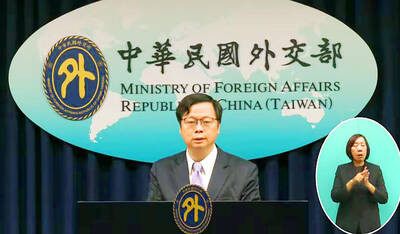
NAMING SPAT: The foreign ministry called on Denmark to propose an acceptable solution to the erroneous nationality used for Taiwanese on residence permits Taiwan has revoked some privileges for Danish diplomatic staff over a Danish permit that lists “Taiwan” as “China,” Eric Huang (黃鈞耀), head of the Ministry of Foreign Affairs’ Department of European Affairs, told a news conference in Taipei yesterday. Reporters asked Huang whether the Danish government had responded to the ministry’s request that it correct the nationality on Danish residence permits of Taiwanese, which has been listed as “China” since 2024. Taiwan’s representative office in Denmark continues to communicate with the Danish government, and the ministry has revoked some privileges previously granted to Danish representatives in Taiwan and would continue to review
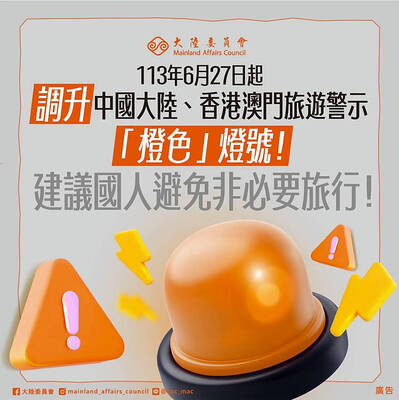
More than 6,000 Taiwanese students have participated in exchange programs in China over the past two years, despite the Mainland Affairs Council’s (MAC) “orange light” travel advisory, government records showed. The MAC’s publicly available registry showed that Taiwanese college and university students who went on exchange programs across the Strait numbered 3,592 and 2,966 people respectively. The National Immigration Agency data revealed that 2,296 and 2,551 Chinese students visited Taiwan for study in the same two years. A review of the Web sites of publicly-run universities and colleges showed that Taiwanese higher education institutions continued to recruit students for Chinese educational programs without

China has reserved offshore airspace over the Yellow Sea and East China Sea from March 27 to May 6, issuing alerts that are usually used to warn of military exercises, although no such exercises have been announced, the Wall Street Journal (WSJ) reported on Sunday. Reserving such a large area for 40 days without explanation is an “unusual step,” as military exercises normally only last a few days, the paper said. The alerts, known as notice to air missions (NOTAMs), “are intended to inform pilots and aviation authorities of temporary airspace hazards or restrictions,” the article said. The airspace reserved in the alert


 RSS
RSS