


China constantly hasfour warships deployed around Taiwan, possibly to prevent the US military from approaching the island if conflict breaks out in the Taiwan Strait, Japan’s Yomiuri Shimbun reported yesterday.
China launched large-scale military drills in August 2022 in response to then-US House speaker Nancy Pelosi’s visit to Taiwan and has been regularly deploying four frigates around Taiwan ever since, the newspaper reported yesterday, citing several Japanese government officials.
One of the four vessels is deployed around Yonaguni Island in Japan’s Okinawa Prefecture, the westernmost tip of Japan; one between Yonaguni Island and the Philippines; and one each in waters southwest and north of Taiwan, it said.
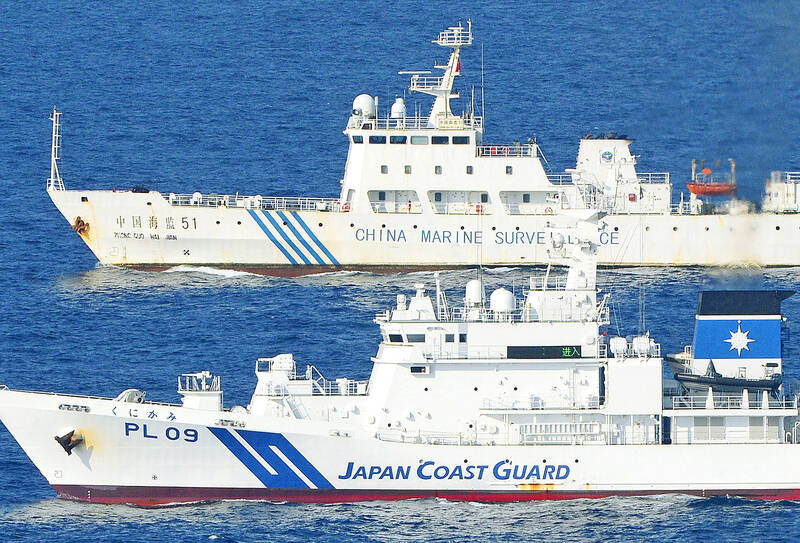
Photo: AP via Kyodo News
In addition, one vessel is said to be permanently deployed to the northwest of the Diaoyutai Islands (釣魚台列嶼), also known as the Senkaku Islands in Japanese, it added.
Chinese warships are constantly present around the islands on three sides, it said, adding that if China decides to invade Taiwan, a conflict is likely to break out in the Senkaku Islands at the same time.
China has been strengthening its “anti-access/area denial” (A2/AD) capabilities, aiming to prevent the US military from entering the first island chain, which stretches from the Japanese archipelago to the Philippines, it said.
Former Japan Maritime Self-Defense Force vice admiral Yoji Koda called on Japan to be “fully prepared” as China is highly likely to invade the Senkaku Islands by force if there is “an opening.”
The paper previously reported that since about 2020, China has been regularly deploying at least three naval vessels near the border of an air defense identification zone (ADIZ) it declared in the East China Sea, multiple Japanese government officials were cited as saying.
In November 2013, China unilaterally declared its ADIZ, which includes the Senkaku Islands, going against international practice and not based on international law, the newspaper said.
The newspaper filmed a standoff between a Chinese Jiangkai II-class missile frigate and a Japan Maritime Self-Defense Force destroyer inside the claimed zone on Dec. 30 last year, it said.
Chinese vessels and frigates, which are equipped with high-performance radars and are highly capable of shooting down aircraft, have maintained a regular presence, it said.
By doing so, China aims to prevent Japan’s Self-Defense Forces and the US military from entering the area during a Taiwan contingency, a Japan Self-Defense Forces official was quoted as saying.

FUKUOKA SITUATION: Japanese media reported that the pathogen is expected to be identified by the summer, while the CDC downplayed the idea that it was hMPV A “mysterious cold-like illness” reported in Japan’s Fukuoka Prefecture does not seem to be a new disease, but Japanese authorities have been asked about the situation, the Centers for Disease Control (CDC) said yesterday. The Fukuoka Prefectural Medical Association on Wednesday told a news conference that a “mystery cold” that has become a hot topic on social media is “highly likely to be caused by some kind of viral infection,” Japan’s KBC News reported. “Many people are experiencing symptoms starting with a sore throat, followed by a runny nose, phlegm and a severe cough,” KBC News reported, citing association officials. Health authorities are

Nvidia Corp CEO Jensen Huang (黃仁勳) arrived in Taiwan yesterday ahead of upcoming AI and technology events, saying he plans to meet with clients and Taiwan Semiconductor Manufacturing Co Chairman C.C. Wei (魏哲家) during his visit. After landing at Taipei Songshan Airport, Huang posed for photos with fans and handed out Yakult drinks to reporters and supporters waiting at the scene, saying he has “a lot to do” during the trip. Asked about reports that Nvidia’s planned headquarters site in Taipei’s Beitou Shilin Technology Park could break ground on May 27, Huang said that if the company holds an event, he would

Carrefour Taiwan is to begin using a new name from the start of July, but it cannot divulge the name until then, the chairman of the supermarket chain's parent company said today. President Chain Store Co chairman Lo Chih-hsien (羅智先) was asked by reporters after a shareholders' meeting to confirm whether the company has settled on a new name for the supermarket brand. In March, the government-registered name of two Carrefour Taiwan branches was quietly changed to "Le Chia Kang" (樂家康) in Chinese, raising speculation that has been selected as the name. Lo said that because of local regulations and contractual obligations, the

The Philippines would likely be involved in any conflict over Taiwan due to its proximity to the democracy claimed by China, President Ferdinand Marcos Jr said, reiterating a stance that risks angering Beijing. “In the Philippines, we do not have a choice because Taiwan is so close to the Philippines and we have almost 200,000 Filipino nationals living and working in Taiwan,” Marcos said in an interview with Japanese media in Manila on Monday. The Philippine leader’s comments come ahead of a state visit to Japan next week, where he is to meet with Japanese Prime Minister Sanae Takaichi to discuss security


 RSS
RSS