


Taiwan People’s Party (TPP) Legislator and vice presidential candidate Cynthia Wu (吳欣盈) yesterday reiterated that the information missing from her financial disclosure statement is being dealt with, with the election just days away.
She made the remark on the sidelines of a campaign rally in Kaohsiung when asked about gaps in the most recent version of her financial information published on the Central Election Commission’s Web site, which is dated Monday last week.
The updated information includes NT$168,000 in accounts belonging to Wu’s son, but not the assets of her husband, Renaud van der Elst, a baron in Belgium.

Photo courtesy of the Taiwan People’s Party
“I have said time and again that the declaration process is ongoing and that everything is being handled as the law requires,” Wu said, before ending the question-and-answer session with reporters.
Wu has been stumping for TPP legislative candidates in central and southern regions to demonstrate the party’s resolve to become an alternative to the nation’s two-party system, she said, urging people to vote.
Separately, TPP Chairman and presidential candidate Ko Wen-je (柯文哲) traveled through Taoyuan in a motorcade that stopped at temples and toured urban districts.
Asked about a video uploaded by Democratic Progressive Party (DPP) presidential candidate Vice President William Lai’s (賴清德) campaign team, Ko said that the DPP’s social media department is faking enthusiasm for its material because the video had 50,000 views, but only 20,000 likes.
“Your cyberbrigade is being lazy,” he said without elaborating on which DPP-affiliated channel he was referring to.
The video suggests Lai would continue President Tsai Ing-wen’s (蔡英文) foreign policy, he said.
“If that were true, the US would not be constantly questioning your [Lai’s] stance,” Ko said.
Asked if he believed the DPP’s recent advertisement highlighting the importance of choosing the right vice presidential candidate was an attack on his campaign, Ko said he agreed with the spirit of the message, but has to ask whether Lai was personally responsible for selecting his running mate.
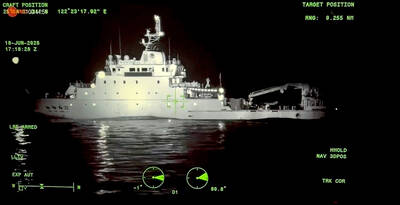
EXCUSES: Beijing is using government and research vessels as a pretext to harass the nation and enter its EEZ, and engage in ‘hegemonic expansion,’ the coast guard said The Coast Guard Administration yesterday said it drove away Chinese oceanographic research vessel Xiang Yang Hong 22 (向陽紅33) from restricted waters after warning it that it was in Taiwan’s exclusive economic zone (EEZ). The Chinese vessel entered restricted waters off the coast of Yilan County’s Suao (蘇澳) at 11:35pm on Thursday, the coast guard said, adding that it dispatched the Lanyu patrol vessel and the boat PP-10077 to shadow the Chinese ship and issue radio warnings ordering it to leave. China has no sovereignty over waters off Taiwan’s east coast, Lanyu’s crew told Xiang Yang Hong 22 over the radio, and demanded
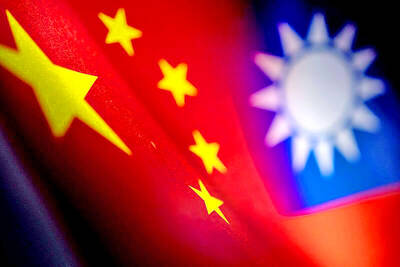
BAIT AND SWITCH: Allowing KMT-run counties to sell to China while the threat of abrupt cancelations hangs overhead is another form of coercion, officials said Beijing is using agricultural purchase offers announced during the Straits Forum to deepen Taiwan’s dependence on the Chinese market, a Taiwanese official said yesterday as they criticized the Taitung County commissioner’s participation in the initiative. During the Straits Forum held in Xiamen on Saturday, Chinese officials announced a sales and purchase agreement for agricultural products from some counties led by the Chinese Nationalist Party (KMT). Taitung County Commissioner Yao Ching-ling (饒慶鈴), who was barred from attending the event in person by the Mainland Affairs Council, participated via video. Under the agreement, China would purchase atemoyas, pomeloes, tea and grouper harvested in Taitung,
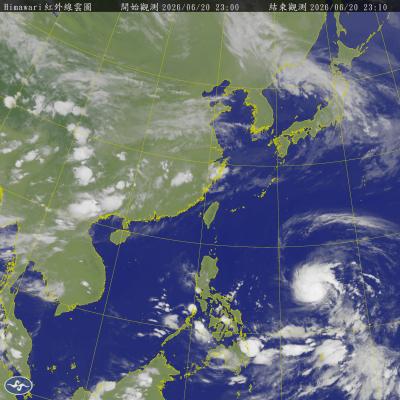
Tropical Storm Mekkhala is forecast to strengthen into a typhoon tomorrow and could come close enough to Taiwan later in the week to prompt a sea warning, the Central Weather Administration (CWA) said yesterday. As of 2 pm, the storm was located 1,870 kilometers southeast of Taiwan's southern tip and moving west- northwest at 23 km per hour. CWA forecaster Cheng Chieh-jen (鄭傑仁) said Mekkhala is expected to continue moving west-northwest through Tuesday under the influence of the Pacific high- pressure system before gradually turning north toward waters east of Taiwan or south of the Ryukyu Islands. The timing and angle of the
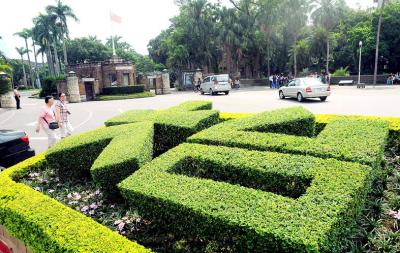
Four Taiwanese universities have been ranked among the world's top 200 institutions in the Quacquarelli Symonds (QS) World University Rankings for next year, the highest Taiwan has ever placed in the category, with National Taiwan University (NTU) achieving its best performance at 54th globally and 17th in Asia. The four Taiwanese institutions in the global top 200 are NTU (54th), National Tsing Hua University (142nd), National Yang Ming Chiao Tung University (177th) and National Cheng Kung University (191st), the rankings showed. All four universities achieved their highest-ever global rankings this year, QS data showed. National Cheng Kung University entered the top 200 for


 RSS
RSS