


Taiwan People’s Party (TPP) Chairman and presidential candidate Ko Wen-je (柯文哲) has pledged to donate to charity all proceeds from farmland he part owns that had been illegally used as a parking lot.
Ko’s campaign chief of staff Vivian Huang (黃珊珊) yesterday at a news conference said that the Hsinchu City plot of land co-owned by Ko was originally farmland, as shown in an 2006 aerial photograph.
After the infraction was revealed by the media, Ko on Thursday said that on Tuesday he asked someone to check on the land and they found an unspecified number of tour buses parked on it.
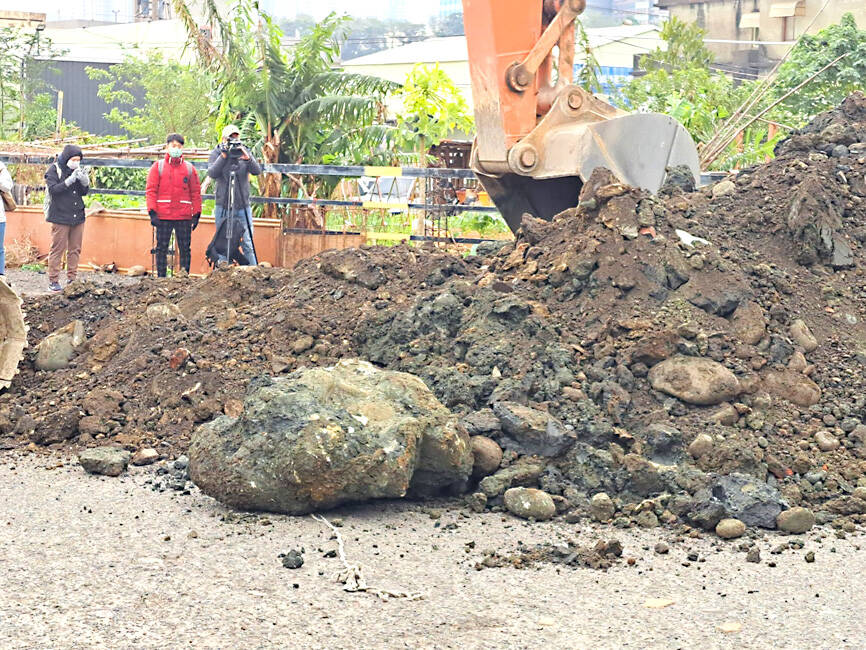
Photo: Hung Mei-hsiu, Taipei Times
The Hsinchu City Government on Thursday said that it would send Ko a notice asking him to make the necessary improvements to bring the land’s use into line with its designated agricultural status or be fined NT$60,000 to NT$300,000 (US$1,923 to US$9,614).
“The original owner did some landscaping work in June 2007, and then in September turned it into a parking lot. This took place before Ko and the other co-owners purchased it,” Huang said.
“It was the original owner who in 2008 signed a contract with a real-estate company to rent out the farmhouse on the plot on an annual basis,” she said. “Each year Ko’s family receives NT$6,250 from the firm. Then in 2020 a tour bus company signed an agreement to pay rent at NT$6,729 per month, but that deal has now been terminated.”
Ko has been paid NT$1.05 million for the farmhouse and NT$198,000 for the parking lot, which he will donate to Hsinchu City Department of Social Affairs for charity work, she said.
The work to restore the parking lot back to farmland began yesterday morning with Ko having authorized TPP Hsinchu City chapter interim director Lee Kuo-chang (李國墇) to supervise the operation.
Accompanied by reporters and camera crews, Lee oversaw the operation to break up the asphalt, and clear away pieces of concrete and brick, metal fragments and what looked like rubble from a construction site.
“All the excavated material is to be transported to a landfill. The priority is to restore the land back to farmland,” Lee said.
Democratic Progressive Party (DPP) Hsinchu City Council caucus convenor Chen Chien-ming (陳建名) alleged that Ko had broken the law.
“Today the excavation work dug up large volumes of construction materials and industrial debris, which contravenes the Waste Disposal Act (廢棄物清理法). A criminal prosecution could proceed if the co-owners permitted illegal dumping on farmland,” Chen said. “It is not so easy to evade legal responsibility, as Ko is trying to do by promising to donate to charity.”
The DPP demanded a judicial investigation.
Additional reporting by Chen Yun and Hong Mei-hsiu

FUKUOKA SITUATION: Japanese media reported that the pathogen is expected to be identified by the summer, while the CDC downplayed the idea that it was hMPV A “mysterious cold-like illness” reported in Japan’s Fukuoka Prefecture does not seem to be a new disease, but Japanese authorities have been asked about the situation, the Centers for Disease Control (CDC) said yesterday. The Fukuoka Prefectural Medical Association on Wednesday told a news conference that a “mystery cold” that has become a hot topic on social media is “highly likely to be caused by some kind of viral infection,” Japan’s KBC News reported. “Many people are experiencing symptoms starting with a sore throat, followed by a runny nose, phlegm and a severe cough,” KBC News reported, citing association officials. Health authorities are

Nvidia Corp CEO Jensen Huang (黃仁勳) arrived in Taiwan yesterday ahead of upcoming AI and technology events, saying he plans to meet with clients and Taiwan Semiconductor Manufacturing Co Chairman C.C. Wei (魏哲家) during his visit. After landing at Taipei Songshan Airport, Huang posed for photos with fans and handed out Yakult drinks to reporters and supporters waiting at the scene, saying he has “a lot to do” during the trip. Asked about reports that Nvidia’s planned headquarters site in Taipei’s Beitou Shilin Technology Park could break ground on May 27, Huang said that if the company holds an event, he would

Carrefour Taiwan is to begin using a new name from the start of July, but it cannot divulge the name until then, the chairman of the supermarket chain's parent company said today. President Chain Store Co chairman Lo Chih-hsien (羅智先) was asked by reporters after a shareholders' meeting to confirm whether the company has settled on a new name for the supermarket brand. In March, the government-registered name of two Carrefour Taiwan branches was quietly changed to "Le Chia Kang" (樂家康) in Chinese, raising speculation that has been selected as the name. Lo said that because of local regulations and contractual obligations, the
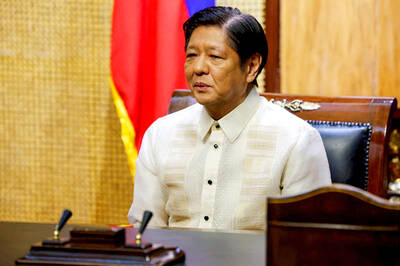
The Philippines would likely be involved in any conflict over Taiwan due to its proximity to the democracy claimed by China, President Ferdinand Marcos Jr said, reiterating a stance that risks angering Beijing. “In the Philippines, we do not have a choice because Taiwan is so close to the Philippines and we have almost 200,000 Filipino nationals living and working in Taiwan,” Marcos said in an interview with Japanese media in Manila on Monday. The Philippine leader’s comments come ahead of a state visit to Japan next week, where he is to meet with Japanese Prime Minister Sanae Takaichi to discuss security


 RSS
RSS