


Taiwan is obligated to reciprocate to the international community and stand with global religious leaders and the pan-democratic camp, Vice President William Lai (賴清德) told the opening ceremony of the Taiwan International Religious Freedom Summit yesterday.
Lai thanked Samuel Brownback, who in February 2020 invited him to attend the National Prayer Breakfast in Washington, for allowing him to participate in the international religious summit and roundtable conference.
He said that event had taught him a lot, such as how religious freedom is still severely persecuted in many places.
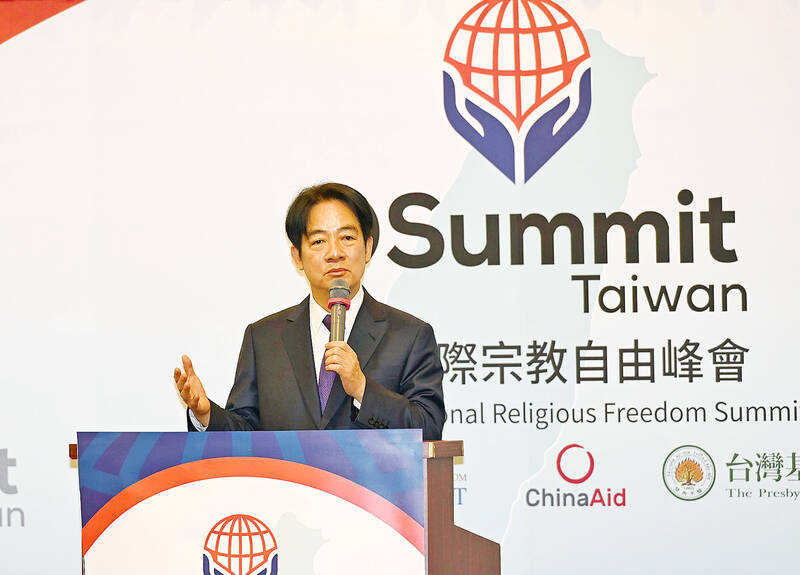
Photo: Chang Chia-ming, Taipei Times
Taiwan has been through its share of dictatorial oppression, and the liberty and democracy it enjoys is the result of the people bravely standing against such pressure, he said.
Taiwan’s has been ranked 10th in the world and first in Asia in terms of democratic achievements, according to The Economist, while US-based Freedom House has given Taiwan a score of 94 in terms of democracy, placing it only slightly behind Japan and ranking second in Asia, he said.
Taiwan has 100 percent religious freedom, regardless of the institution, he added.
Lai also commented on the venue, the Grand Hotel, which was where the Democratic Progressive Party (DPP) was founded.
Legislative Yuan Speaker You Si-kun (游錫?) was there on that day, Lai said as You looked on.
As long as there is autocracy, there will be religious persecution, he said.
Like many other emerging countries, Taiwan has been through its share of colonization and oppression, but it has matured into a fully democratic country, touted as the “Beacon of Democracy in Asia,” You said.
Taiwan’s efforts and achievements show that the words of former Singaporean prime minister Lee Kuan Yew (李光耀) — who died in 2015 — that “human rights and democracy are Western creations that are unsuitable for Asian nations” were false, You added.
Pew Research Center in 2014 put Taiwan second among 232 countries on its Religion Diversity Index, while Freedom House had the nation 17th on its Freedom Index, he said.
Taiwan’s experience of fighting oppression and autocracy has created a tolerant society that respects cultural diversity, he said.
Religious freedom is a fundamental right guaranteed by the Constitution, and the government fully respects different cultures and beliefs, You added.
“We are proud to say that a church can exist side by side with a mosque, both of which can exist side by side with a traditional Taiwanese temple,” he said.
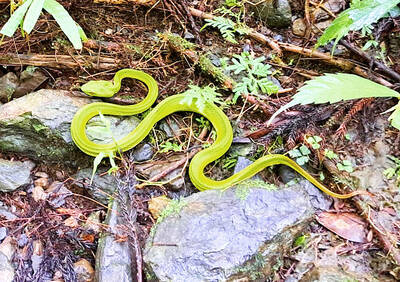
More than half of the bamboo vipers captured in Tainan in the past few years were found in the city’s Sinhua District (新化), while other districts had smaller catches or none at all. Every year, Tainan captures about 6,000 snakes which have made their way into people’s homes. Of the six major venomous snakes in Taiwan, the cobra, the many-banded krait, the brown-spotted pit viper and the bamboo viper are the most frequently captured. The high concentration of bamboo vipers captured in Sinhua District is puzzling. Tainan Agriculture Bureau Forestry and Nature Conservation Division head Chu Chien-ming (朱健明) earlier this week said that the
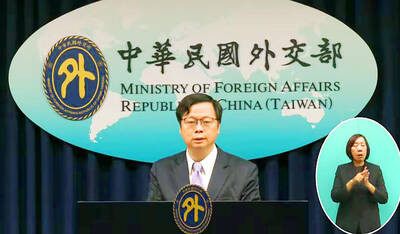
NAMING SPAT: The foreign ministry called on Denmark to propose an acceptable solution to the erroneous nationality used for Taiwanese on residence permits Taiwan has revoked some privileges for Danish diplomatic staff over a Danish permit that lists “Taiwan” as “China,” Eric Huang (黃鈞耀), head of the Ministry of Foreign Affairs’ Department of European Affairs, told a news conference in Taipei yesterday. Reporters asked Huang whether the Danish government had responded to the ministry’s request that it correct the nationality on Danish residence permits of Taiwanese, which has been listed as “China” since 2024. Taiwan’s representative office in Denmark continues to communicate with the Danish government, and the ministry has revoked some privileges previously granted to Danish representatives in Taiwan and would continue to review
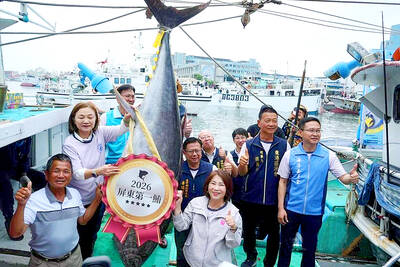
The first bluefin tuna of the season, brought to shore in Pingtung County and weighing 190kg, was yesterday auctioned for NT$10,600 (US$333.5) per kilogram, setting a record high for the local market. The auction was held at the fish market in Donggang Fishing Harbor, where the Siaoliouciou Island-registered fishing vessel Fu Yu Ching No. 2 delivered the “Pingtung First Tuna” it had caught for bidding. Bidding was intense, and the tuna was ultimately jointly purchased by a local restaurant and a local company for NT$10,600 per kilogram — NT$300 ,more than last year — for a total of NT$2.014 million. The 67-year-old skipper

China has reserved offshore airspace over the Yellow Sea and East China Sea from March 27 to May 6, issuing alerts that are usually used to warn of military exercises, although no such exercises have been announced, the Wall Street Journal (WSJ) reported on Sunday. Reserving such a large area for 40 days without explanation is an “unusual step,” as military exercises normally only last a few days, the paper said. The alerts, known as notice to air missions (NOTAMs), “are intended to inform pilots and aviation authorities of temporary airspace hazards or restrictions,” the article said. The airspace reserved in the alert


 RSS
RSS