


EVA Airways was ranked the eighth-best airline in the world for this year, the only Taiwanese carrier to make it into the top 25 Airline Excellence Awards this year, aviation reviews Web site AirlineRatings.com said on Wednesday.
AirlineRatings.com has a seven-star rating system to evaluate more than 360 airlines around the world every year, EVA Airways said in a statement on Thursday.
“We are delighted that efforts by the entire EVA staff have been recognized by Airline Ratings,” EVA Airways president Clay Sun (孫嘉明) said in the release.
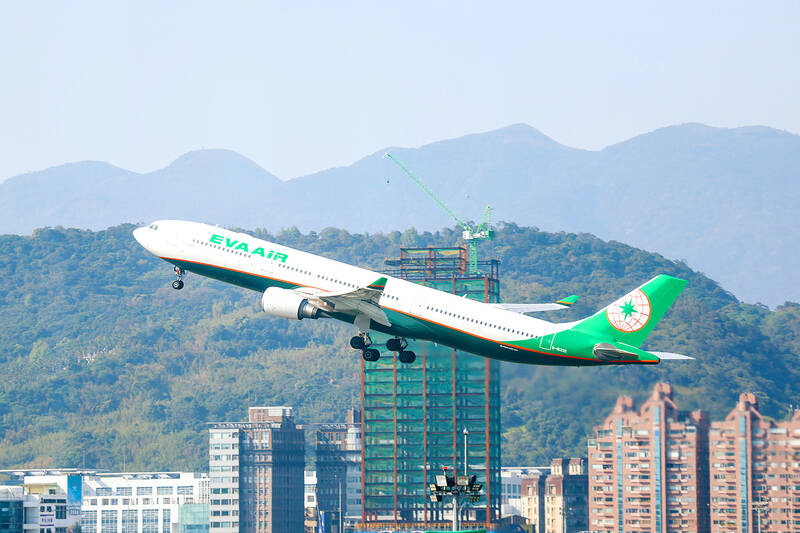
Photo: CNA
During the COVID-19 pandemic, the company identified and adopted services and procedures that enhance and improve personalized airline travel experiences for passengers, Sun said.
These include employing the latest technologies to accelerate digital convenience such as automatic check-in and electronic onboard reading materials such as newspapers and magazines, while also launching new inflight meals created in collaboration with Michelin-rated chefs, he said.
AirlineRatings.com ranked Air New Zealand as the best airline of the year, followed by Qatar Airways and Etihad Airways in second and third.
From fourth to 25th were Korean Air, Singapore Airlines, Qantas, Virgin Australia/Virgin Atlantic, EVA Airways, Cathay Pacific Airways, Emirates, Lufthansa/Swiss, SAS, TAP Portugal, All Nippon Airways, Delta Air Lines, Air Canada, British Airways, Jet Blue, JAL, Vietnam Airlines, Turkish Airlines, Hawaiian Airlines, KLM, Alaska Airlines and United Airlines.
The Airline Excellence Awards, judged by five editors with 180 years of combined industry experience, take into consideration major safety and government audits, with 12 key criteria that include fleet age, passenger reviews, profitability, investment rating, product offerings and staff relations, the airline reviews Web site said.
EVA Airways last month was certified by airline-ranking company Skytrax as a five-star airline for the eighth consecutive year since 2016.
It ranked ninth among the top 20 safest airlines in the world in a survey released in January by AirlineRatings.com.

AGING: While Japan has 22 submarines, Taiwan only operates four, two of which were commissioned by the US in 1945 and 1946, and transferred to Taiwan in 1973 Taiwan would need at least 12 submarines to reach modern fleet capabilities, CSBC Corp, Taiwan chairman Chen Cheng-hung (陳政宏) said in an interview broadcast on Friday, citing a US assessment. CSBC is testing the nation’s first indigenous defense submarine, the Hai Kun (海鯤, Narwhal), which is scheduled to be delivered to the navy next month or in July. The Hai Kun has completed torpedo-firing tests and is scheduled to undergo overnight sea trials, Chen said on an SET TV military affairs program. Taiwan would require at least 12 submarines to establish a modern submarine force after assessing the nation’s operational environment and defense

A white king snake that frightened passengers and caused a stir on a Taipei MRT train on Friday evening has been claimed by its owner, who would be fined, Taipei Rapid Transit Corp (TRTC) said yesterday. A person on Threads posted that he thought he was lucky to find an empty row of seats on Friday after boarding a train on the Bannan (Blue) Line, only to spot a white snake with black stripes after sitting down. Startled, he jumped up, he wrote, describing the encounter as “terrifying.” “Taipei’s rat control plan: Release snakes on the metro,” one person wrote in reply, referring

Yangmingshan National Park authorities yesterday urged visitors to respect public spaces and obey the law after a couple was caught on a camera livestream having sex at the park’s Qingtiangang (擎天崗) earlier in the day. The Shilin Police Precinct in Taipei said it has identified a suspect and his vehicle registration number, and would summon him for questioning. The case would be handled in accordance with public indecency charges, it added. The couple entered the park at about 11pm on Thursday and began fooling around by 1am yesterday, the police said, adding that the two were unaware of the park’s all-day live

The coast guard today said that it had disrupted "illegal" operations by a Chinese research ship in waters close to the nation and driven it away, part of what Taipei sees a provocative pattern of China's stepped up maritime activities. The coast guard said that it on Thursday last week detected the Chinese ship Tongji (同濟號), which was commissioned only last year, 29 nautical miles (54km) southeast of the southern tip of Taiwan, although just outside restricted waters. The ship was observed lowering ropes into the water, suspected to be the deployment of scientific instruments for "illegal" survey operations, and the coast


 RSS
RSS