


The nation’s five telecoms would waive part or all of last month’s mobile phone service fees for registered residents of and visitors to Lienchiang County after communication was disrupted by damage to two undersea cables connecting the outlying county to Taiwan proper, the National Communications Commission (NCC) said yesterday.
Telecom services in the county are provided by two marine cables: the Taima No. 2 cable connecting Dongyin Island (東引島) to New Taipei City’s Tamsui District (淡水), and the Taima No. 3 cable connecting Nangan Island (南竿島) to Taoyuan.
The cables were damaged by Chinese boats on Feb. 2 and 8 respectively, leaving residents with slow Internet connections and unstable phone service.
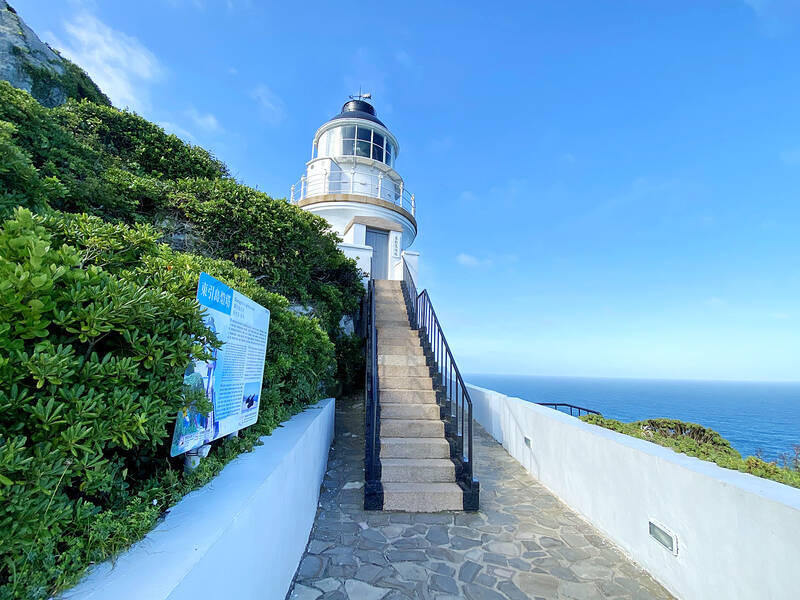
Photo: Yu Chao-fu, Taipei Times
NCC Deputy Chairman and spokesman Wong Po-tsung (翁柏宗) said that the commission is aiming to resolve the matter from three aspects: repairing the cables, expanding the bandwidth of a microwave system connecting Taiwan proper and the county, and offering a compensation package for all parties affected by the incident.
“All five telecoms have agreed to completely waive last month’s service fees for their mobile phone service subscribers in Matsu, including those who have their billing addresses or registered home addresses in the outlying islands,” Wong said.
Monthly fees for those who traveled to Matsu last month would be reduced based on the duration of their stay there, Wong said.
For example, if a person spent five days in Matsu last month, 5/28 of the monthly fee would be deducted, Wong said.
Chunghwa Telecom would waive monthly fees for subscribers to its Hinet Internet service, as well as its multimedia-on-demand service for last month and this month, Wong said.
Whether the monthly fees for next month would be waived as well depends on the progress made in repairing the cables and expanding the bandwidth of the microwave system, he said.
Chunghwa Telecom last month said that it had booked a cable maintenance ship to start the repairs on April 20, but Wong said that the telecom has been contacting other ships to see if repairs could start earlier.
Meanwhile, the bandwidth of the microwave system is expected to be increased to 3.8 gigabits per second (Gbps) by the middle of this month and 8.148Gbps by the end of this year, Wong said, adding that the latter would achieve connection speeds close to those provided by cables.
Expanding the capacity of the microwave system is not an easy task, he said.
“Engineers must first install a receptor, with one end at Bamboo Lake (竹子湖) in Yangmingshan (陽明山) and the other on Dongyin Island,” he said.
“The antenna in Dongyin has a diameter of 4.5m and weighs 950kg. The construction crane that lifts the antenna weighs 25 tonnes and needs to be transported from Taiwan to Dongyin, and the construction process could be disrupted by bad weather,” he added.
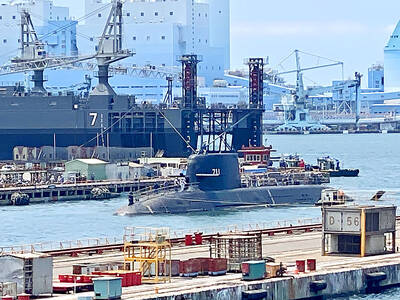
AGING: While Japan has 22 submarines, Taiwan only operates four, two of which were commissioned by the US in 1945 and 1946, and transferred to Taiwan in 1973 Taiwan would need at least 12 submarines to reach modern fleet capabilities, CSBC Corp, Taiwan chairman Chen Cheng-hung (陳政宏) said in an interview broadcast on Friday, citing a US assessment. CSBC is testing the nation’s first indigenous defense submarine, the Hai Kun (海鯤, Narwhal), which is scheduled to be delivered to the navy next month or in July. The Hai Kun has completed torpedo-firing tests and is scheduled to undergo overnight sea trials, Chen said on an SET TV military affairs program. Taiwan would require at least 12 submarines to establish a modern submarine force after assessing the nation’s operational environment and defense

A white king snake that frightened passengers and caused a stir on a Taipei MRT train on Friday evening has been claimed by its owner, who would be fined, Taipei Rapid Transit Corp (TRTC) said yesterday. A person on Threads posted that he thought he was lucky to find an empty row of seats on Friday after boarding a train on the Bannan (Blue) Line, only to spot a white snake with black stripes after sitting down. Startled, he jumped up, he wrote, describing the encounter as “terrifying.” “Taipei’s rat control plan: Release snakes on the metro,” one person wrote in reply, referring
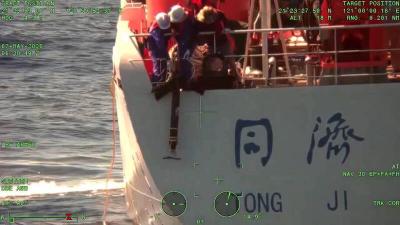
The coast guard today said that it had disrupted "illegal" operations by a Chinese research ship in waters close to the nation and driven it away, part of what Taipei sees a provocative pattern of China's stepped up maritime activities. The coast guard said that it on Thursday last week detected the Chinese ship Tongji (同濟號), which was commissioned only last year, 29 nautical miles (54km) southeast of the southern tip of Taiwan, although just outside restricted waters. The ship was observed lowering ropes into the water, suspected to be the deployment of scientific instruments for "illegal" survey operations, and the coast

Taiwan’s two cases of hantavirus so far this year are on par with previous years’ case numbers, and the government is coordinating rat extermination work, so there should not be any outbreaks, Centers for Disease Control (CDC) Director-General Philip Lo (羅一鈞) said today in an interview with the Liberty Times (the Taipei Times’ sister newspaper). An increase in rat sightings in Taipei and New Taipei City has raised concerns about the spread of hantavirus, as rats can carry the disease. In January, a man in his 70s who lived in Taipei’s Daan District (大安) tested positive posthumously for hantavirus, Taiwan’s


 RSS
RSS