


Bird-watchers and wildlife photography clubs are engaging in illegal activities leading to the abuse and deaths of birds, animal rights advocates said yesterday.
“There have been many reports of abuse and cruel behavior by members of Taiwan’s wildlife photography clubs, but due to the inaction and negligence of authorities, it has worsened, spreading like a cancer to more locations and involving more flagrant offenses,” Environment and Animal Society of Taiwan (EAST) director Chen Yu-min (陳玉敏) told a news conference at the legislature in Taipei.
He and Democratic Progressive Party (DPP) Legislator Lin Shu-fen (林淑芬) presented evidence from a two-year investigation.
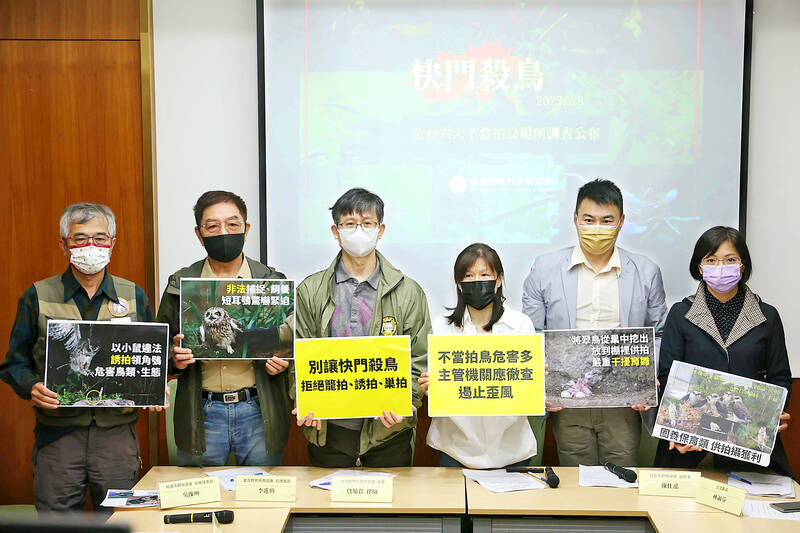
Photo: CNA
EAST, together with wildlife conservationists, conducted on-site investigations, covertly joining wildlife photography clubs and chatting on their social media sites, as well as participating in outings to businesses and farms offering bird photography tours, Chen said.
They documented evidence and took “shocking” photographs of bird abuse, she said, adding that and it was “heart-wrenching to see the cruel treatment ... even of baby birds.”
She and advocates at the news conference listed six bird farms and related businesses across the nation that they said were the worst offenders.
“We have accumulated evidence ... documenting the smuggling of non-native birds, illegal poaching, the illicit rearing of protected species, presenting caged birds for photography … [and] shots being staged by fixing birds to tree branches,” Chen said. “ There were many instances of abuse, torment and rough handling of birds.”
Lin said that authorities must penalize offenders.
“The responsible agencies from the central government down to the local level have not acted on the complaints filed,” Lin said. “Also, the sources of photographs of birds or wildlife for official tourism promotions are often not checked.”
EAST members said that the proprietors of a farm in Taoyuan removed bird’s nests from trees, picking out the baby birds and placing them on tree branches for customers to photograph.
All the baby birds had died by end of the day, they said,
Another farm in Nantou County had caught a number of indigenous owls that belonged to a protected species. Mice were released so that clubs could take pictures of the owls catching them.
Chen said she estimated that most of these businesses were making millions of New Taiwan dollars in profit each year.
Some proprietors charged NT$500 for a photographer to take pictures in a staged booth or NT$1,000 to take photos of birds mating, while others offered for NT$8,000 for unlimited photography opportunities during packaged outings.
EAST’s attorney, Chan Shun-kuei (詹順貴), said the contraventions uncovered fall under the Wildlife Conservation Act (野生動物保育法), the Smuggling Penalty Act (懲治走私條例), the Statute for Prevention and Control of Infectious Animal Diseases (動物傳染病防治條例), among other laws.
“I have been a bird-watcher for more than 20 years... The abusive and cruel behavior of photographers has turned this recreation of sighting beautiful birds into an ugly scene,” Chan said. “We urge the public to boycott all these illegal businesses, and leave wild birds in their natural habitats by ending the practice of staged shots and the mishandling of birds.”

FUKUOKA SITUATION: Japanese media reported that the pathogen is expected to be identified by the summer, while the CDC downplayed the idea that it was hMPV A “mysterious cold-like illness” reported in Japan’s Fukuoka Prefecture does not seem to be a new disease, but Japanese authorities have been asked about the situation, the Centers for Disease Control (CDC) said yesterday. The Fukuoka Prefectural Medical Association on Wednesday told a news conference that a “mystery cold” that has become a hot topic on social media is “highly likely to be caused by some kind of viral infection,” Japan’s KBC News reported. “Many people are experiencing symptoms starting with a sore throat, followed by a runny nose, phlegm and a severe cough,” KBC News reported, citing association officials. Health authorities are

Nvidia Corp CEO Jensen Huang (黃仁勳) arrived in Taiwan yesterday ahead of upcoming AI and technology events, saying he plans to meet with clients and Taiwan Semiconductor Manufacturing Co Chairman C.C. Wei (魏哲家) during his visit. After landing at Taipei Songshan Airport, Huang posed for photos with fans and handed out Yakult drinks to reporters and supporters waiting at the scene, saying he has “a lot to do” during the trip. Asked about reports that Nvidia’s planned headquarters site in Taipei’s Beitou Shilin Technology Park could break ground on May 27, Huang said that if the company holds an event, he would

The Ministry of Finance this afternoon announced the winning numbers for the March-April uniform invoice lottery. The winning number for the NT$10 million (US$318,060) special prize is 19531471, and the winning number for the NT$2 million grand prize is 85941329. Three numbers were drawn for the NT$200,000 first prize: 07225810, 20231230 and 83518781. Those with receipts matching the last seven digits of any of the first-prize numbers will win the NT$40,000 second prize, while those matching the last six digits will win the NT$10,000 third prize. Those whose receipts match the last five digits of the first-prize numbers can claim the NT$4,000 fourth prize,

SIX SUBSIDIES: The monthly allowance for older farmers is to increase to NT$10,000, and NT$5,000 is to be given to homemakers under the national pension system, Lai said The government is to implement major welfare policies for disadvantaged groups, including raising the monthly allowance for older farmers to NT$10,000 and providing homemakers with NT$5,000 per month, President William Lai (賴清德) said yesterday. Lai made the remarks during a visit to Wangling Temple in Chiayi County, saying that the planned increases were being introduced amid economic growth and an increase in tax revenue. Touting a policy, in which the government plans to provide a monthly allowance of NT$5,000 for every child under the age of 18 in a bid to address Taiwan’s low birthrate, Lai said that if received for the


 RSS
RSS