


Taiwan might soon acquire Aegis-equipped warships or other in-demand weapons systems if reports are accurate that the US Congress plans to authorize US$10 billion of military aid to Taiwan, Taiwanese defense experts said.
US lawmakers are ready to back military aid packages to Taiwan in that amount as part of the National Defense Authorization Act (NDAA) for the next fiscal year, a Bloomberg reporter on Thursday wrote on Twitter, adding that details are to be released imminently.
In Taipei, a defense official said on condition of anonymity that information about specific items is classified, adding that Taiwan continues to exchange views about its force planning with the US.

Photo: Reuters
Taipei and Washington should carefully consider which weapons Taiwan needs that cannot be developed or obtained independently, Institute for National Defense and Security Research analyst Shu Hsiao-huang (舒孝煌) said.
These weapons include next-generation principal surface combatants equipped with the Aegis combat system, anti-submarine warfare helicopters, electronic warfare enhancements, airborne early warning and control systems, and drones, he said.
Taiwan urgently needs such capabilities to protect vital air and sea communication links that would likely be attacked in a Chinese military operation, he said, citing the Pentagon’s China Military Power Report 2022.
Defence International editor Chen Kuo-ming (陳國銘) said the significance of the reported increase in US military aid can be inferred from its scale, given that US aid to Ukraine is US$18 billion.
The dramatic boost in aid also suggests that Washington believes that the risks confronting Taiwan are extremely high, he added.
Taipei can make use of the aid packages by purchasing precision-guided munitions, Javelin anti-tank weapons and Stinger anti-aircraft systems, or use the money to pay for existing orders, he said.

FUKUOKA SITUATION: Japanese media reported that the pathogen is expected to be identified by the summer, while the CDC downplayed the idea that it was hMPV A “mysterious cold-like illness” reported in Japan’s Fukuoka Prefecture does not seem to be a new disease, but Japanese authorities have been asked about the situation, the Centers for Disease Control (CDC) said yesterday. The Fukuoka Prefectural Medical Association on Wednesday told a news conference that a “mystery cold” that has become a hot topic on social media is “highly likely to be caused by some kind of viral infection,” Japan’s KBC News reported. “Many people are experiencing symptoms starting with a sore throat, followed by a runny nose, phlegm and a severe cough,” KBC News reported, citing association officials. Health authorities are

Nvidia Corp CEO Jensen Huang (黃仁勳) arrived in Taiwan yesterday ahead of upcoming AI and technology events, saying he plans to meet with clients and Taiwan Semiconductor Manufacturing Co Chairman C.C. Wei (魏哲家) during his visit. After landing at Taipei Songshan Airport, Huang posed for photos with fans and handed out Yakult drinks to reporters and supporters waiting at the scene, saying he has “a lot to do” during the trip. Asked about reports that Nvidia’s planned headquarters site in Taipei’s Beitou Shilin Technology Park could break ground on May 27, Huang said that if the company holds an event, he would

The Ministry of Finance this afternoon announced the winning numbers for the March-April uniform invoice lottery. The winning number for the NT$10 million (US$318,060) special prize is 19531471, and the winning number for the NT$2 million grand prize is 85941329. Three numbers were drawn for the NT$200,000 first prize: 07225810, 20231230 and 83518781. Those with receipts matching the last seven digits of any of the first-prize numbers will win the NT$40,000 second prize, while those matching the last six digits will win the NT$10,000 third prize. Those whose receipts match the last five digits of the first-prize numbers can claim the NT$4,000 fourth prize,
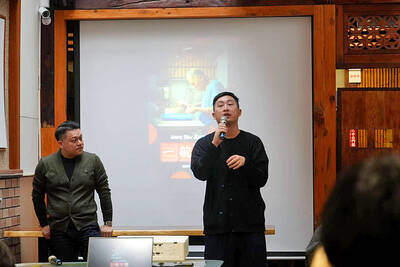
Taiwan Travelogue (臺灣漫遊錄), which earlier this week became the first Taiwanese novel to win the International Booker Prize, is to be adapted into a television series through a Taiwan-Japan coproduction, producer Chang Chen-yu (張辰漁) said yesterday. Chang, a producer at World Softest Production Film Co, wrote on Facebook that the company had been searching for projects with international appeal that retain a strong Taiwanese identity after colleagues and Japanese partners strongly recommended the novel. After reading the book, Chang said he immediately decided to pursue the screen rights. “A great story has the power to transcend time and borders, and connect countless people,”


 RSS
RSS