


The Economic Democracy Union (EDU) yesterday called on the government to tighten financial regulations to stop China increasing its influence through the flow of Chinese capital into Taiwan’s business sector.
Staging a protest in front of the Legislative Yuan in Taipei, attorneys and campaigners from EDU said the problem mainly lies in the pervasive influence of the Ministry of Economic Affairs’ (MOEA) old “Gang of Four” from the past Chinese Nationalist Party (KMT) administration.
EDU convener Lai Chung-chiang (賴中強) pointed to the three major loopholes in approval and oversight mechanisms at the ministry and its agencies.
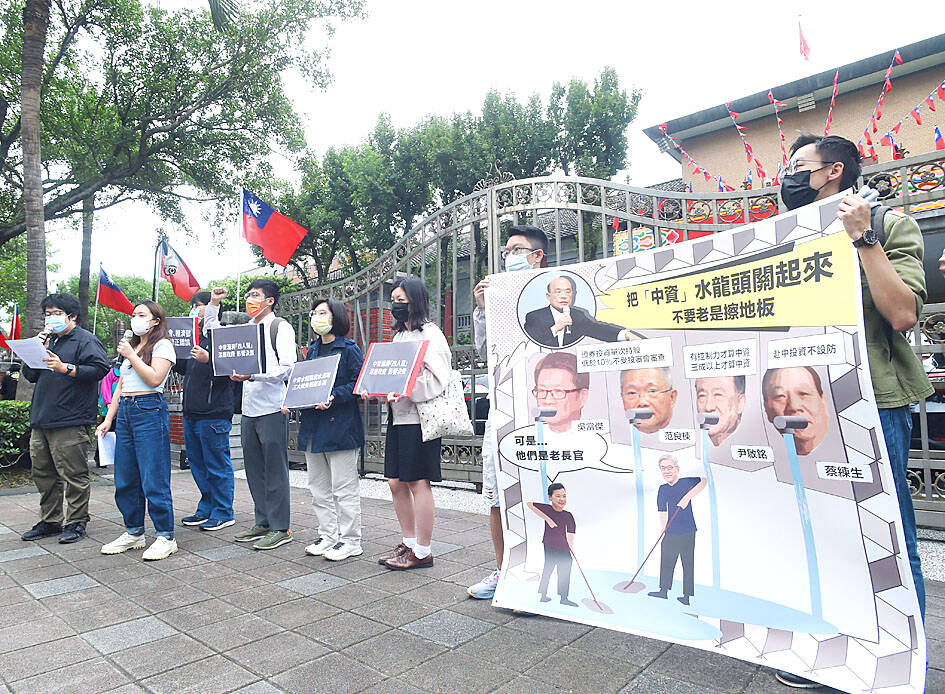
Photo: Fang Pin-chao, Taipei Times
The first allows overseas investors to continue to trade daily on the Taiwan Stock Exchange without review by the ministry’s Investment Commission, if the purchased amount does not exceed 10 percent of the company’s issued shares, Lai said.
The second allows Chinese investment through a third country if the Chinese shareholding in the overseas company does not exceed 30 percent of the company’s stock, he said.
The third loophole is a lack of prohibitions on the export of semiconductor technology, he said.
Lai and EDU researcher Ou Hsu-shao (歐栩韶) called on the Democratic Progressive Party (DPP) government to patch these “leaking faucets” that allow unmitigated Chinese capital to enter and gain majority control of Taiwan’s business sectors, including semiconductors and information technology.
Premier Su Tseng-chang (蘇貞昌) had used the faucet analogy in March, promising to “turn off” the taps so that water would not overflow, when questioned about a perceived lack of control and oversight of Chinese capital coming into Taiwan.
However, “the economics ministry and its agencies are still full of loopholes, with enforcement lacking and negligence by government officials... The ministry has completely disregarded Premier Su’s promise to fix these leaks,” Ou said.
Lai alleged that it is the MOEA’s old “Gang of Four” and their cabal that are still influencing decisions at the ministry and its agencies, with former economic affairs minister Yiin Chii-ming (尹啟銘) leading the gang.
Appointed by then-president Ma Ying-jeou (馬英九), Yiin headed the ministry from 2008 to 2009, followed by stints as minister without portfolio and head of the Council for Economic Planning and Development from 2012 to 2013.
Lai alleged that the other three were the Ma administration’s Investment Commission executive secretaries Fan Liang-tung (范良棟) and Tsai Lien-sheng (蔡練生), and Financial Supervisory Commission (FSC) vice chairperson Wu Tang-chieh (吳當傑).
“Headed by Yiin, these four figures were in charge of key MOEA policies. Despite the change in government, these four have not really retired, as they continue to play important roles linking businesses between China and Taiwan,” said Lai said, adding that they now serve as executives at China’s Cross-Strait CEO Summit.”
“The other figures took jobs at government-affiliated bodies, from which they continue to exert a lot of influence on the decisions made by the MOEA, the FSC and the Investment Commission. Their power is known to exceed current Minister of Economic Affairs Wang Mei-hua (王美花) and the head of the FSC,” Lai alleged.
“In effect, these four figures and their cabal at MOEA and other government agencies are part of Taiwan’s ‘deep state,’” Laid said, as they work to undermine the DPP government’s economic policies, despite Taiwan’s democratic transformation.

The military has spotted two Chinese warships operating in waters near Penghu County in the Taiwan Strait and sent its own naval and air forces to monitor the vessels, the Ministry of National Defense (MND) said. Beijing sends warships and warplanes into the waters and skies around Taiwan on an almost daily basis, drawing condemnation from Taipei. While the ministry offers daily updates on the locations of Chinese military aircraft, it only rarely gives details of where Chinese warships are operating, generally only when it detects aircraft carriers, as happened last week. A Chinese destroyer and a frigate entered waters to the southwest
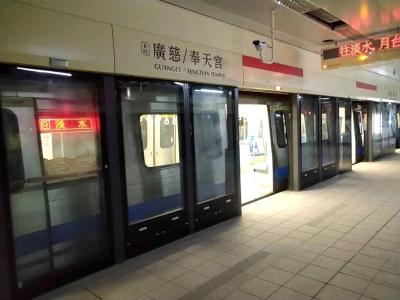
The eastern extension of the Taipei MRT Red Line could begin operations as early as late June, the Taipei Department of Rapid Transit Systems said yesterday. Taipei Rapid Transit Corp said it is considering offering one month of free rides on the new section to mark its opening. Construction progress on the 1.4km extension, which is to run from the current terminal Xiangshan Station to a new eastern terminal, Guangci/Fengtian Temple Station, was 90.6 percent complete by the end of last month, the department said in a report to the Taipei City Council's Transportation Committee. While construction began in October 2016 with an
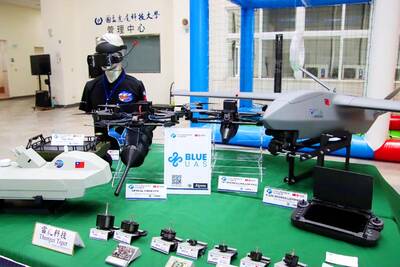
NON-RED SUPPLY: Boosting the nation’s drone industry is becoming increasingly urgent as China’s UAV dominance could become an issue in a crisis, an analyst said Taiwan’s drone exports to Europe grew 41.7-fold from 2024 to last year, with demand from Ukraine’s fight against Russian aggression the most likely driver of growth, a study showed. The Institute for Democracy, Society and Emerging Technology (DSET) in a statement on Wednesday said it found that many of Taiwan’s uncrewed aerial vehicle (UAV) sales were from Poland and the Czech Republic. These countries likely transferred the drones to Ukraine to aid it in its fight against the Russian invasion that started in 2022, it said. Despite the gains, Taiwan is not the dominant drone exporter to these markets, ranking second and fourth
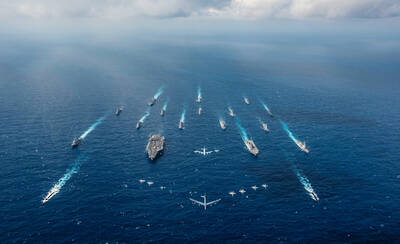
Japanese Prime Minister Sanae Takaichi’s comment last year on Tokyo’s potential reaction to a Taiwan-China conflict has forced Beijing to rewrite its invasion plans, a retired Japanese general said. Takaichi told the Diet on Nov. 7 last year that a Chinese naval blockade or military attack on Taiwan could constitute a “survival-threatening situation” for Japan, potentially allowing Tokyo to exercise its right to collective self-defense. Former Japan Ground Self-Defense Force general Kiyofumi Ogawa said in a recent speech that the remark has been interpreted as meaning Japan could intervene in the early stages of a Taiwan Strait conflict, undermining China’s previous assumptions


 RSS
RSS