


Days from Double Ten National Day, a long line of people snakes out of Chang Lao-wang’s (張老旺) restaurant, where the Chinese Civil War refugee displays his ardent love for the Republic of China (ROC) national flag while serving up Yunnan-style rice noodles to the lunchtime crowd.
Chang has hung 30,000 flags around his “National Flag House” restaurant and an adjacent park ahead of the public holiday that marks the founding of the ROC.
“This national flag, the whole country must love it together. Only if everyone collectively loves the flag, does the country have a future,” Chang, 81, said at the park in Taoyuan. “If everyone loves this flag, other countries won’t dare to bully you.”
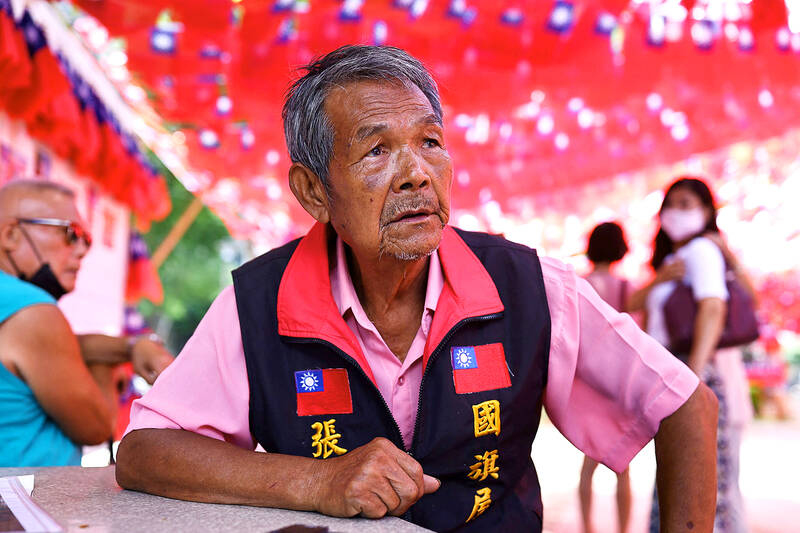
Photo: Ann Wang, Reuters
The red flag, featuring a white sun against a blue sky, holds different meanings for people in Taiwan, and is generally not flown outside of Taiwan as other countries seek to avoid upsetting China.
Many in Taiwan, especially among the younger generation, associate the flag with the Martial Law era under the regime led by the Chinese Nationalist Party (KMT), which fled to Taiwan with the defeated ROC government in 1949 at the end the Chinese Civil War.
Some Taiwanese think a new flag is needed to avoid association with China. However, Chang is proud of the flag, the sight of which he says helped him and his mother track down his father after battles.
His family would not have stayed together and found safety in Taiwan if not for the flag, Chang said.
Born in China’s Yunnan Province, he and his family fled to Myanmar at the end of the civil war along with the remnants of KMT troops before arriving in Taiwan in 1953.
Chang started hanging flags at age 37, putting out fewer than 100. Back then, the flags were ubiquitous around National Day, but he says he sees few people hanging them today.
Each year, he receives complaints, with some describing the flags as “garbage” and asking him to take them down.
However, his flag-raising ceremony draws large crowds each year, with an estimated 20,000 last year, Chang said.
“In those moments, I forget myself,” he said. “I think: ‘Oh, there are still so many people who love this flag and my heart feels very comforted.’”

Taiwan has received more than US$70 million in royalties as of the end of last year from developing the F-16V jet as countries worldwide purchase or upgrade to this popular model, government and military officials said on Saturday. Taiwan funded the development of the F-16V jet and ended up the sole investor as other countries withdrew from the program. Now the F-16V is increasingly popular and countries must pay Taiwan a percentage in royalties when they purchase new F-16V aircraft or upgrade older F-16 models. The next five years are expected to be the peak for these royalties, with Taiwan potentially earning
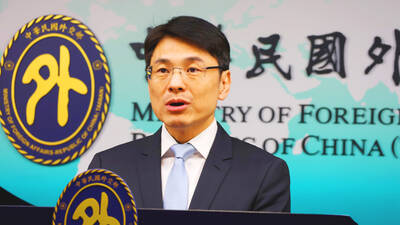
STAY IN YOUR LANE: As the US and Israel attack Iran, the ministry has warned China not to overstep by including Taiwanese citizens in its evacuation orders The Ministry of Foreign Affairs (MOFA) yesterday rebuked a statement by China’s embassy in Israel that it would evacuate Taiwanese holders of Chinese travel documents from Israel amid the latter’s escalating conflict with Iran. Tensions have risen across the Middle East in the wake of US and Israeli airstrikes on Iran beginning Saturday. China subsequently issued an evacuation notice for its citizens. In a news release, the Chinese embassy in Israel said holders of “Taiwan compatriot permits (台胞證)” issued to Taiwanese nationals by Chinese authorities for travel to China — could register for evacuation to Egypt. In Taipei, the ministry yesterday said Taiwan
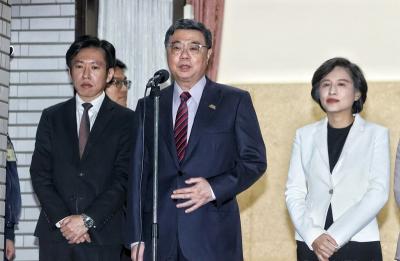
Taiwan is awaiting official notification from the US regarding the status of the Agreement on Reciprocal Trade (ART) after the US Supreme Court ruled US President Donald Trump's global tariffs unconstitutional. Speaking to reporters before a legislative hearing today, Premier Cho Jung-tai (卓榮泰) said that Taiwan's negotiation team remains focused on ensuring that the bilateral trade deal remains intact despite the legal challenge to Trump's tariff policy. "The US has pledged to notify its trade partners once the subsequent administrative and legal processes are finalized, and that certainly includes Taiwan," Cho said when asked about opposition parties’ doubts that the ART was
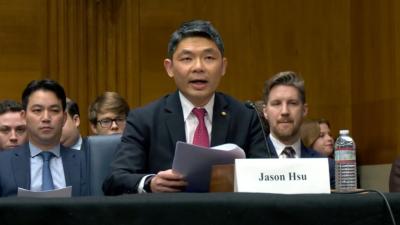
If China chose to invade Taiwan tomorrow, it would only have to sever three undersea fiber-optic cable clusters to cause a data blackout, Jason Hsu (許毓仁), a senior fellow at the Hudson Institute and former Chinese Nationalist Party (KMT) legislator, told a US security panel yesterday. In a Taiwan contingency, cable disruption would be one of the earliest preinvasion actions and the signal that escalation had begun, he said, adding that Taiwan’s current cable repair capabilities are insufficient. The US-China Economic and Security Review Commission (USCC) yesterday held a hearing on US-China Competition Under the Sea, with Hsu speaking on


 RSS
RSS