


Minister of the Interior Hsu Kuo-yung (徐國勇) yesterday said that his comments last week on the nation’s real-estate industry were taken out of context to make it appear that he was encouraging the practice of property flipping.
Hsu on Tuesday last week reportedly told participants at an award ceremony for outstanding real-estate agents that the real-estate industry is like a shield for Taiwan and a locomotive for the domestic economy.
“The context of my speech was that we need to ensure the stability of the real-estate market and prevent it from soaring or plummeting,” Hsu said yesterday on the sidelines of a meeting of the legislature’s Internal Administration Committee.

Photo: Tu Chien-jung, Taipei Times
“However, regrettably, some only focused on the part about the real-estate market being a locomotive for the domestic economy, and deliberately took that statement out of context,” he said.
Hsu said the Ministry of the Interior has spared no effort in cracking down on property flippers, adding that he does not need to change his statement.
Instead, people should focus on what he said about the importance of maintaining the stability of the real-estate market, he said.
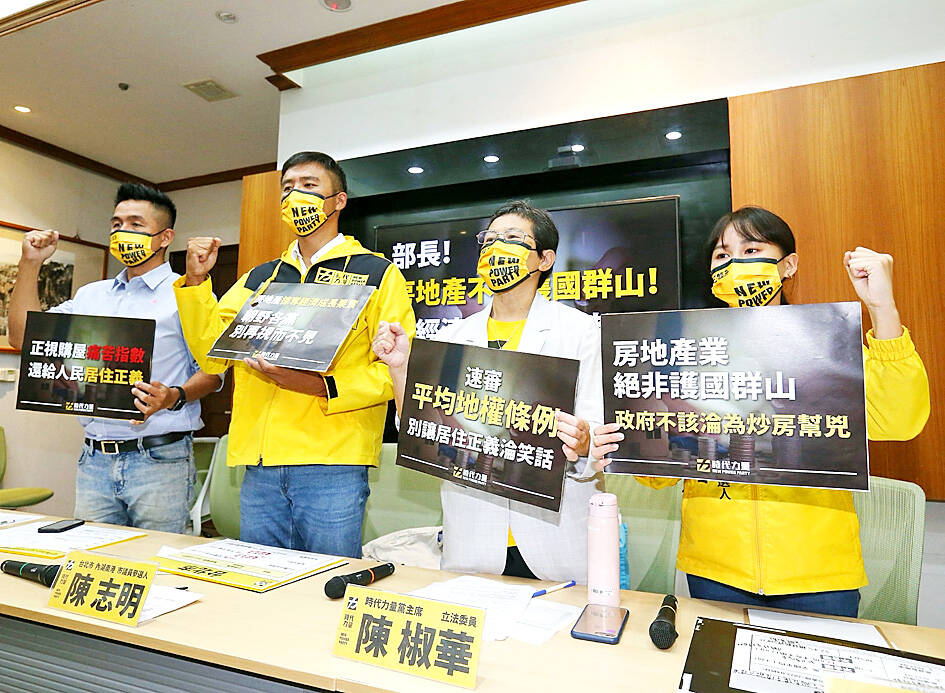
Photo: CNA
The ministry was separately accused of “shelling out money” to Taitung County residents by offering subsidies of NT$500,000 per household to help people whose homes or farmhouses were damaged by a magnitude 6.8 earthquake on Sept. 18.
“The government is offering subsidies so that residents whose homes have sustained damage can resume a normal life. They did not profit from the subsidies,” he said, adding that people should stop using political language to misinterpret the government’s good intentions.
New Power Party (NPP) Chairwoman Chen Jiau-hua (陳椒華) said Hsu’s real-estate remarks conflicted with President Tsai Ing-wen’s (蔡英文) campaign promise of achieving housing justice.
“Many young Taiwanese are suffocating because of high housing prices. Rather than addressing the problem, the ministry under Hsu’s leadership is praising the real-estate industry,” Chen said.
Although the ministry’s proposed amendments to the Equalization of Land Rights Act (平均地權條例) have already been submitted to the Legislative Yuan for deliberation, the Democratic Progressive Party and Chinese Nationalist Party (KMT) caucuses have told reporters that the bill should not be reviewed at this legislative session, Chen said.
Citing government data, NPP Taipei city councilor candidate Jerry Liu (劉仕傑) said that Taiwanese workers’ salaries have grown by an average of 13 percent in the past 10 years, while housing prices have surged 40 percent over the period.
“This shows the difficulty for a salaried employee to buy a house in Taiwan. Rising housing prices are eroding Taiwan’s economy and the situation will only deteriorate if nothing is done about it,” he said.
NPP Taipei city councilor candidate Chen Chih-ming (陳志明) asked Hsu whether he stands for housing justice.
Chen said that Taiwan’s housing price-to-income ratio climbed to 9.69 in the second quarter of this year, citing data released by the ministry on Sunday.
In Taipei, the ratio was 16.17, which means that city residents cannot afford to buy a house even if they do not eat or drink and save all their earnings for 16 years, he said, adding that the data on mortgage burden rates showed that the average household in Taipei spends about 66 percent of its disposable income on mortgage payments.
Fast food chain McDonald's is to raise prices by up to NT$5 on some products at its restaurants across Taiwan, starting on Wednesday next week, the company announced today. The prices of all extra value meals and sharing boxes are to increase by NT$5, while breakfast combos and creamy corn soup would go up by NT$3, the company said in a statement. The price of the main items of those meals, if ordered individually, would remain the same. Meanwhile, the price of a medium-sized lemon iced tea and hot cappuccino would rise by NT$3, extra dipping sauces for chicken nuggets would go up
Yangmingshan National Park’s Qingtiangang (擎天崗) nature area has gone viral after a park livestream camera observed a couple in the throes of intimate congress, which was broadcast live on YouTube, drawing large late-night crowds and sparking a backlash over noise, bright lights and disruption to wildlife habitat. The area’s livestream footage appeared to show a couple engaging in sexual activity on a picnic table in the park on Friday last week, with the uncensored footage streamed publicly online. The footage quickly spread across social media, prompting a tide of visitors to travel to the site to “check in” and recreate the

GROUNDED: A KMT lawmaker proposed eliminating drone development programs and freezing funding for counterdrone systems, despite China’s adoption of the technology China has deployed attack drones at air bases near the Taiwan Strait in a strategy aimed at overwhelming Taiwan’s air defense systems through saturation attacks, the Mainland Affairs Council (MAC) said. The council’s latest quarterly report on China said that satellite imagery and open-source intelligence indicate that the Chinese People’s Liberation Army (PLA) had converted retired J-6 fighter jets into J-6W drones, which the PLA has stationed at six air bases near Taiwan, five in China’s Fujian Province and one in Guangdong Province. The report cited J. Michael Dahm, a senior fellow at the US-based Mitchell Institute, as saying that China has

Carrefour Taiwan is to begin using a new name from the start of July, but it cannot divulge the name until then, the chairman of the supermarket chain's parent company said today. President Chain Store Co chairman Lo Chih-hsien (羅智先) was asked by reporters after a shareholders' meeting to confirm whether the company has settled on a new name for the supermarket brand. In March, the government-registered name of two Carrefour Taiwan branches was quietly changed to "Le Chia Kang" (樂家康) in Chinese, raising speculation that has been selected as the name. Lo said that because of local regulations and contractual obligations, the


 RSS
RSS