


The Chinese Nationalist Party (KMT) yesterday occupied the podium during the opening of the legislative session, saying that the government’s handling of the COVID-19 pandemic demanded an apology.
KMT caucus whip William Tseng (曾銘宗) and others stood in the middle of the hall holding signs and shouting slogans saying that the government’s processing of vaccine compensation claims was slow and that there were “shady deals” behind the procurement of vaccines.
The administration lacked transparency in its purchase of COVID-19 vaccines early in the pandemic and disparaged the Buddhist Compassion Relief Tzu Chi Charity Foundation, which had purchased vaccines to donate for public use, Tseng said.
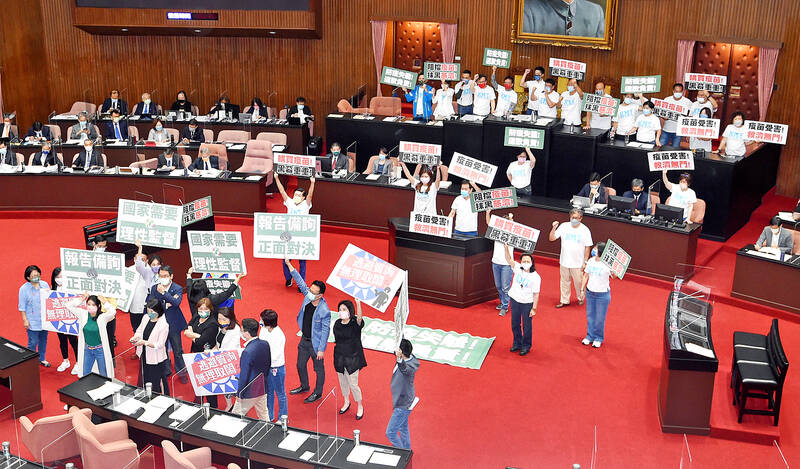
Photo: Liao Chen-hui, Taipei Times
People who were harmed by COVID-19 vaccines also had no recourse for compensation, he said.
“More than 10,000 people in Taiwan have died from COVID-19 since the pandemic started,” he said. “Where is the administration’s apology?”
At about 11am after occupying the podium for about an hour, Tseng said that the KMT had reached a consensus with other parties following negotiations called by Legislative Speaker You Si-kun (游錫?).
The KMT legislators vacated the podium, but due to time constraints, Premier Su Tseng-chang’s (蘇貞昌) policy report scheduled for 10am was put off until a remedial session on Tuesday, with only additional agenda items discussed yesterday.
In an agreement signed with the Democratic Progressive Party (DPP) and the Taiwan People’s Party (TPP), the KMT demanded that Su apologize to the families of those who died from COVID-19 or from a reaction to a COVID-19 vaccine.
It also demanded that the Ministry of Health and Welfare increase the number of personnel processing applications from people seeking compensation after a harmful reaction to a vaccine, as well as a simplified and expedited review process for those seeking COVID-19-related relief funds, with reports submitted to the legislature every six months about compensation claims.
The rules stipulate that meetings of the Vaccine Injury Compensation Program be convened under the ministry’s supervision, with claims to be completed within six months of submission.
In the event that more time is required, the review period can be extended once for no longer than three months.
The New Power Party, which did not sign the deal, objected to putting off Su’s policy address and asked for a vote.
However, the vote also backed rescheduling the address.
In a statement released following the session, the KMT said that although it reached an agreement with the DPP and the TPP on its pandemic-related demands, it would continue to supervise the administration, and would hold Su and the ministry accountable.
Additional reporting by CNA
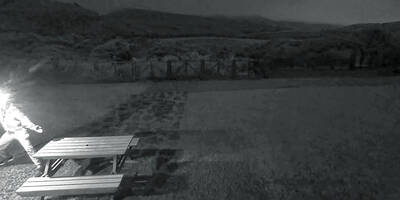
Yangmingshan National Park authorities yesterday urged visitors to respect public spaces and obey the law after a couple was caught on a camera livestream having sex at the park’s Qingtiangang (擎天崗) earlier in the day. The Shilin Police Precinct in Taipei said it has identified a suspect and his vehicle registration number, and would summon him for questioning. The case would be handled in accordance with public indecency charges, it added. The couple entered the park at about 11pm on Thursday and began fooling around by 1am yesterday, the police said, adding that the two were unaware of the park’s all-day live
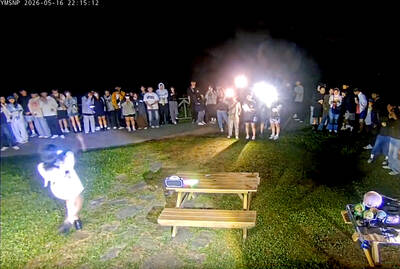
Yangmingshan National Park’s Qingtiangang (擎天崗) nature area has gone viral after a park livestream camera observed a couple in the throes of intimate congress, which was broadcast live on YouTube, drawing large late-night crowds and sparking a backlash over noise, bright lights and disruption to wildlife habitat. The area’s livestream footage appeared to show a couple engaging in sexual activity on a picnic table in the park on Friday last week, with the uncensored footage streamed publicly online. The footage quickly spread across social media, prompting a tide of visitors to travel to the site to “check in” and recreate the
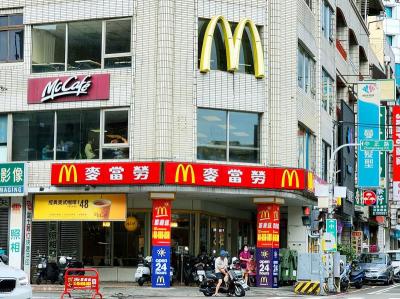
Fast food chain McDonald's is to raise prices by up to NT$5 on some products at its restaurants across Taiwan, starting on Wednesday next week, the company announced today. The prices of all extra value meals and sharing boxes are to increase by NT$5, while breakfast combos and creamy corn soup would go up by NT$3, the company said in a statement. The price of the main items of those meals, if ordered individually, would remain the same. Meanwhile, the price of a medium-sized lemon iced tea and hot cappuccino would rise by NT$3, extra dipping sauces for chicken nuggets would go up

Minister of Digital Affairs Lin Yi-ching (林宜敬) yesterday cited regulatory issues and national security concerns as an expert said that Taiwan is among the few Asian regions without Starlink. Lin made the remarks on Facebook after funP Innovation Group chief executive officer Nathan Chiu (邱繼弘) on Friday said Taiwan and four other countries in Asia — China, North Korea, Afghanistan and Syria — have no access to Starlink. Starlink has become available in 166 countries worldwide, including Ukraine, Malaysia, the Philippines and Vietnam, in the six years since it became commercial, he said. While China and North Korea block Starlink, Syria is not


 RSS
RSS