


Chinese Nationalist Party (KMT) Legislator Sandy Yeh (葉毓蘭) yesterday called for an investigation into organized online harassment campaigns.
Yeh, a member of the legislature’s Judiciary and Organic Laws and Statutes Committee, convened a special report on disruptions caused by organized groups, sometimes referred to as “cyberarmies,” that harass public officials or spread misinformation.
Nobody is safe from anonymous attacks online, Yeh said, adding that members of the Democratic Progressive Party (DPP) have also been targeted.
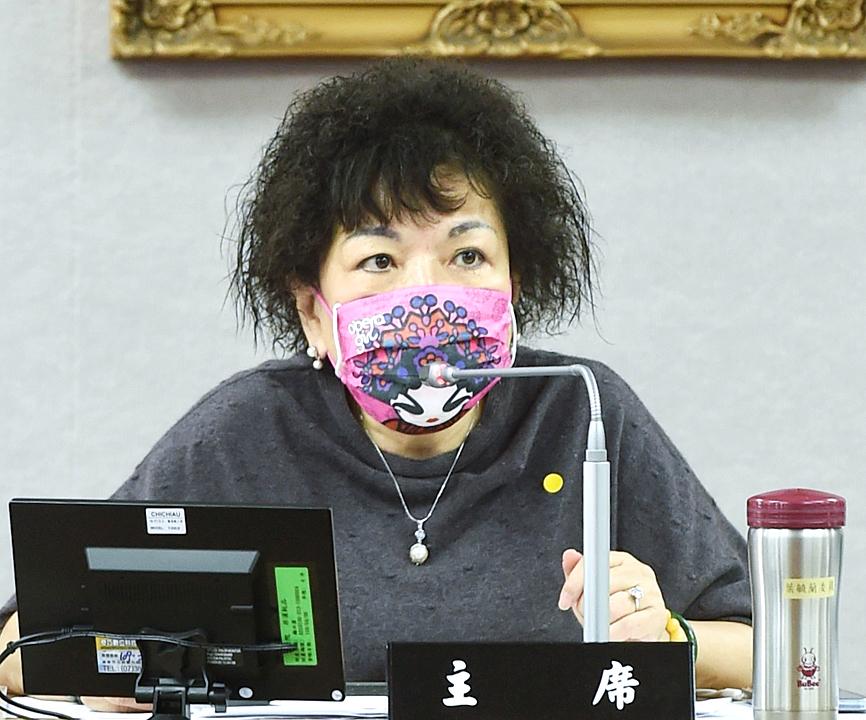
Photo: Fang Pin-chao, Taipei Times
“Yet no one takes the issue seriously,” she said. “Is the Ministry of Justice also afraid of being targeted?”
She said that the problem has extended beyond the nation’s borders, driving WHO Director-General Tedros Adhanom Ghebreyesus last year to plead with Taiwanese to stop “racist attacks” against him.
Saying she feared DPP caucus whip Ker Chien-ming (柯建銘) would declare yesterday’s proceedings unconstitutional, Yeh said the investigation would not focus on any single case.
New incidents are happening every day, making people fearful that they could be next, creating a “collective anxiety,” she said.
If the law did not protect DPP Legislator Kao Chia-yu (高嘉瑜) from allegedly being assaulted by her boyfriend last month, “how could anyone be protected from being defamed or harmed by a cyberarmy?” she asked.
Minister of Justice Tsai Ching-hsiang (蔡清祥) said that the police would investigate crimes according to the law, no matter who is involved.
Freedom of speech is protected, but spreading misinformation to harm others online would be severely punished, Tsai said.
In related news, the Cabinet yesterday said that many people sent in feedback after Taipei Mayor Ko Wen-je (柯文哲) called for a letter drive urging the government to crack down on online trolling.
Premier Su Tseng-chang’s (蘇貞昌) inbox is full of messages, although the exact number is unclear, Executive Yuan spokesman Lo Ping-cheng (羅秉成) told a news conference in Taipei.
The government has an obligation to report on its specific policies and positions, Lo said, rejecting insinuations that it has a cyberarmy to harass political enemies.
There are certain legal protections against making online threats or spreading misinformation, he said, referencing fact-checking and other approaches that have achieved international recognition.
Ko’s former photographer, Pan Jin-lin (潘俊霖), criticized the mayor’s letter drive, saying in an interview on Wednesday that the mayor was the “progenitor of the dark forces.”
Ko claiming the moral high ground is absurd, Pan said, claiming that his former boss said nothing when Pan was attacked online by the mayor’s supporters and his Taiwan People’s Party (TPP).
Ko laughed off the remarks when asked to respond, saying that all the perpetrators who have been caught are DPP supporters.
He did not directly respond when asked if the TPP has its own cyberarmy.
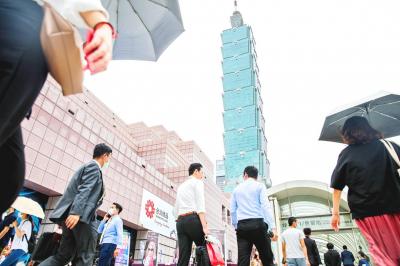
Japanese footwear brand Onitsuka Tiger today issued a public apology and said it has suspended an employee amid allegations that the staff member discriminated against a Vietnamese customer at its Taipei 101 store. Posting on the social media platform Threads yesterday, a user said that an employee at the store said that “those shoes are very expensive” when her friend, who is a migrant worker from Vietnam, asked for assistance. The employee then ignored her until she asked again, to which she replied: "We don't have a size 37." The post had amassed nearly 26,000 likes and 916 comments as of this

US President Donald Trump said "it’s up to" Chinese President Xi Jinping (習近平) what China does on Taiwan, but that he would be "very unhappy" with a change in the "status quo," the New York Times said in an interview published yesterday. Xi "considers it to be a part of China, and that’s up to him what he’s going to be doing," Trump told the newspaper on Wednesday. "But I’ve expressed to him that I would be very unhappy if he did that, and I don’t think he’ll do that," he added. "I hope he doesn’t do that." Trump made the comments in
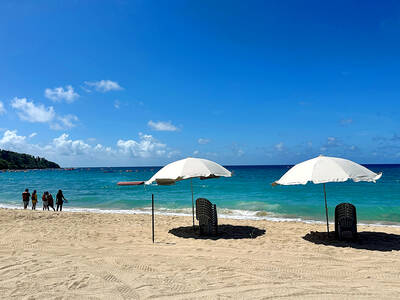
Tourism in Kenting fell to a historic low for the second consecutive year last year, impacting hotels and other local businesses that rely on a steady stream of domestic tourists, the latest data showed. A total of 2.139 million tourists visited Kenting last year, down slightly from 2.14 million in 2024, the data showed. The number of tourists who visited the national park on the Hengchun Peninsula peaked in 2015 at 8.37 million people. That number has been below 2.2 million for two years, although there was a spike in October last year due to multiple long weekends. The occupancy rate for hotels
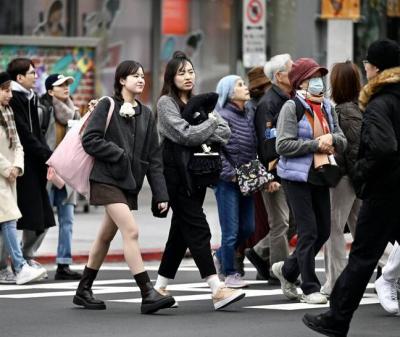
A cold surge advisory was today issued for 18 cities and counties across Taiwan, with temperatures of below 10°C forecast during the day and into tonight, the Central Weather Administration (CWA) said. New Taipei City, Taipei, Taoyuan and Hsinchu, Miaoli and Yilan counties are expected to experience sustained temperatures of 10°C or lower, the CWA said. Temperatures are likely to temporarily drop below 10°C in most other areas, except Taitung, Pingtung, Penghu and Lienchiang (Matsu) counties, CWA data showed. The cold weather is being caused by a strong continental cold air mass, combined with radiative cooling, a process in which heat escapes from


 RSS
RSS