


A high-profile Taiwanese TV host found herself the latest to draw fire from Chinese Internet users after referring to Taiwan’s Olympians as “national competitors.”
Dee Hsu (徐熙娣) — better known as “Little S” — made the comment in an Instagram post on Sunday during the women’s singles badminton final between Tai Tzu-ying (戴資穎) of Taiwan and Chen Yufei (陳雨菲) of China.
The post drew an angry reaction in China, where nationalist Internet users often police the comments of celebrities and companies for views that clash with the Chinese Communist Party’s official narrative that both sides of the Taiwan Strait are part of “one China.”
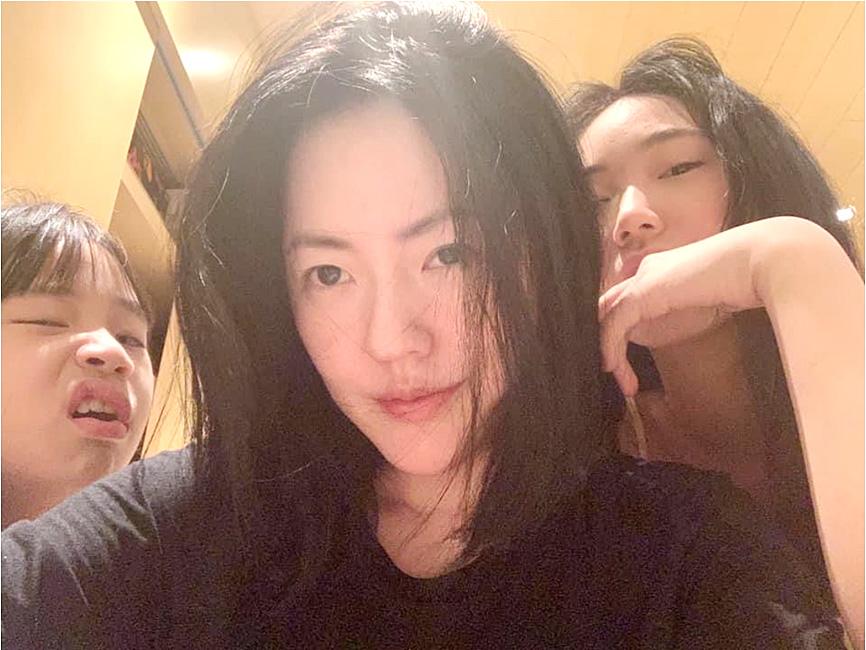
Photo copied by Chen Hui-ling, Taipei Times
“Hsu’s Ins” — short for Hsu’s Instagram — quickly became one of the most-searched topics on Sina Weibo on Monday, garnering more than 480 million views as of yesterday.
“Just stay in Taiwan. That way you don’t need to work so hard at being two-faced,” one online commentator said.
A representative for Hsu, who started out as a singer in the 1990s before becoming one of Taiwan’s most high-profile talk show hosts, could not immediately be reached for comment. The Instagram comment that drew outrage has since been deleted.
Most Taiwanese celebrities are careful never to reveal their stance on Taiwan’s political status for fear of being locked out of the lucrative Chinese market or angering fans at home who identify as Taiwanese rather than Chinese.
Hsu was unusual in celebrity circles for being outspoken in her support for former president Ma Ying-jeou (馬英九) of the Chinese Nationalist Party (KMT).
Last year, she was highly critical of the government’s decision to ban exports of medical masks in the early stages of the COVID-19 pandemic, saying they were more urgently needed “in China.”
In the past few years, Hsu has spent an increasing amount of time across the Strait building her brand.
Several companies that sponsor Hsu, including Unilever and sex-toy maker Osuga, have sought to distance themselves from Hsu, saying they would not extend contracts with her, according to the United Daily News and other local media.
Oriental House, a Ningbo, China-based maker of traditional medicinal teas, said it had canceled its contract with Hsu after her Instagram post.
“The nation’s interests are more important than anything else,” it said in a Sina Weibo post. “Resolutely support the one China principle.”
Taiwanese singer Jolin Tsai (蔡依林) was also targeted on Monday after congratulating several of Taiwan’s athletes at the Olympics, with angry Chinese Internet users asking why she had failed to celebrate any Chinese competitors.
Those outside China have found themselves targeted by Chinese state media and Internet users as Chinese President Xi Jinping (習近平) encourages the country to challenge those seen as trying to split or weaken it.
The threat of losing market share in the world’s most populous country has prompted sports leagues, airlines and other multinationals to edit perceived political slights.
Japanese actor Yuki Furukawa was similarly assailed online last week after asking his 4.5 million Sina Weibo users whether they were watching the Olympics as Japan broke China’s 17-year gold-medal streak in mixed doubles table tennis.
“I asked at the wrong time. Should have been more careful of my words,” Furukawa said, after deleting the original post.
Taiwanese athletes have so far won 10 medals in Tokyo — two gold, four silver and four bronze — their best-ever haul.

The Centers for Disease Control (CDC) yesterday reported the first case of a new COVID-19 subvariant — BA.3.2 — in a 10-year-old Singaporean girl who had a fever upon arrival in Taiwan and tested positive for the disease. The girl left Taiwan on March 20 and the case did not have a direct impact on the local community, it said. The WHO added the BA.3.2 strain to its list of Variants Under Monitoring in December last year, but this was the first imported case of the COVID-19 variant in Taiwan, CDC Deputy Director-General Lin Ming-cheng (林明誠) said. The girl arrived in Taiwan on

South Korea is planning to revise its controversial electronic arrival card, a step Taiwanese officials said prompted them to hold off on planned retaliatory measures, a South Korean media report said yesterday. A Yonhap News Agency report said that the South Korean Ministry of Foreign Affairs is planning to remove the “previous departure place” and “next destination” fields from its e-arrival card system. The plan, reached after interagency consultations, is under review and aims to simplify entry procedures and align the electronic form with the paper version, a South Korean ministry official said. The fields — which appeared only on the electronic form

The Ministry of Foreign Affairs (MOFA) is suspending retaliation measures against South Korea that were set to take effect tomorrow, after Seoul said it is updating its e-arrival system, MOFA said today. The measures were to be a new round of retaliation after Taiwan on March 1 changed South Korea's designation on government-issued alien resident certificates held by South Korean nationals to "South Korea” from the "Republic of Korea," the country’s official name. The move came after months of protests to Seoul over its listing of Taiwan as "China (Taiwan)" in dropdown menus on its new online immigration entry system. MOFA last week

A bipartisan group of US senators has introduced a bill to enhance cooperation with Taiwan on drone development and to reduce reliance on supply chains linked to China. The proposed Blue Skies for Taiwan Act of 2026 was introduced by Republican US senators Ted Cruz and John Curtis, and Democratic US senators Jeff Merkley and Andy Kim. The legislation seeks to ease constraints on Taiwan-US cooperation in uncrewed aerial systems (UAS), including dependence on China-sourced components, limited access to capital and regulatory barriers under US export controls, a news release issued by Cruz on Wednesday said. The bill would establish a "Blue UAS


 RSS
RSS