


The US’ joint strikes with Israel on Iran dismantled a key pillar of China’s regional strategy, removing an important piece in Beijing’s potential Taiwan Strait scenario, said Zineb Riboua, a senior researcher at the Hudson Institute’s Center for Middle East Peace and Security.
In an article titled: “The Iran Question Is All About China,” Riboua said that understanding the Iran issue in the context of China’s “grand strategy” is essential to fully grasp the complexity of the situation.
Beijing has spent billions of dollars over the years turning Iran into a “structural strategic asset,” diverting US military resources in the Pacific region, she said.
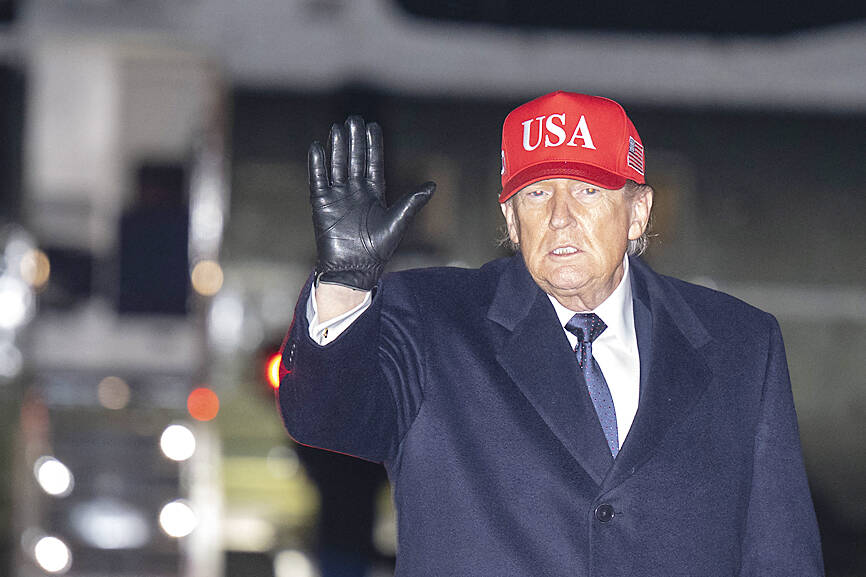
Photo: Getty Images via AFP
Oil is the starting point of the entire relationship, Riboua said, adding that China purchases 90 percent of Iran’s exported crude oil and uses “ghost fleets” to help Tehran evade sanctions.
Since 2021, the two sides have accumulated more than US$140 billion in trade, which has not only made Iran highly dependent on Chinese capital, but also granted Beijing lasting influence in one of the world’s most important energy corridors, she said.
Iran’s strategic value to China extends beyond economics into proxy conflicts, she said.
In late 2023, the Iran-backed Houthi rebels targeted shipping in the Red Sea, disrupting global trade and forcing the US military to spend heavily on interceptions, with each missile costing US$1 million to US$4 million, she said.
“Every dollar the United States spends defending Red Sea shipping lanes is a dollar unavailable for submarine production, Pacific basing, or Taiwan contingency planning,” she said.
Iran’s threat has also allowed China to deepen its ties with Gulf countries, she said, adding that as Beijing’s influence in the region grows, these countries would be less likely to align with the US on issues such as Taiwan, chip export controls or financial sanctions.
The US’ “Epic Fury” operation highlights Washington’s recognition that the ongoing conflict in the Middle East is eroding its deterrence in the Pacific, she said.
“Iran is where Beijing’s Middle East architecture is most concentrated and most vulnerable,” she said.
Targeting Iran would effectively remove a key piece from Beijing’s Taiwan Strait scenario, preventing the Middle East from becoming a secondary front in China’s broader plan, she said.
“[US President Donald] Trump’s strikes are the first move by an American president who appears to understand that the road to the Pacific runs through Tehran,” she added.

The Ministry of Finance this afternoon announced the winning numbers for the March-April uniform invoice lottery. The winning number for the NT$10 million (US$318,060) special prize is 19531471, and the winning number for the NT$2 million grand prize is 85941329. Three numbers were drawn for the NT$200,000 first prize: 07225810, 20231230 and 83518781. Those with receipts matching the last seven digits of any of the first-prize numbers will win the NT$40,000 second prize, while those matching the last six digits will win the NT$10,000 third prize. Those whose receipts match the last five digits of the first-prize numbers can claim the NT$4,000 fourth prize,

SIX SUBSIDIES: The monthly allowance for older farmers is to increase to NT$10,000, and NT$5,000 is to be given to homemakers under the national pension system, Lai said The government is to implement major welfare policies for disadvantaged groups, including raising the monthly allowance for older farmers to NT$10,000 and providing homemakers with NT$5,000 per month, President William Lai (賴清德) said yesterday. Lai made the remarks during a visit to Wangling Temple in Chiayi County, saying that the planned increases were being introduced amid economic growth and an increase in tax revenue. Touting a policy, in which the government plans to provide a monthly allowance of NT$5,000 for every child under the age of 18 in a bid to address Taiwan’s low birthrate, Lai said that if received for the
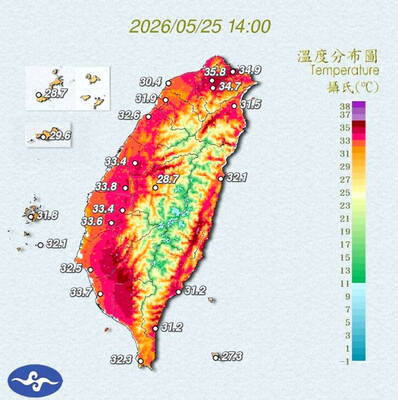
STAY COOL: The HPA recommended that people stay hydrated, use air-conditioning or fans while indoors, wear loose-fitting clothes and walk in the shade while outdoors Employers must implement measures such as installing cooling equipment, and providing drinking water and rest breaks for outdoor workers starting from Monday next week, the Taipei Department of Labor said on Sunday. Employers who fail to comply could face fines of NT$30,000 to NT$300,000 under the Occupational Safety and Health Act (職業安全衛生法), the department said. Businesses in Taipei employing fewer than 100 workers, as well as registered self-employed workers with labor insurance coverage, could receive on-site assessments and guidance from occupational safety consultants to help them apply for central government subsidies to implement or improve heat-protection measures, it said. Under the Ministry of
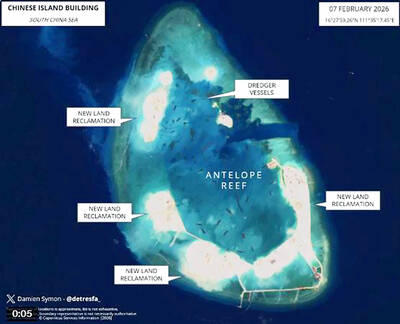
ISOLATION: The outposts would serve as support and backup bases, forcing US forces to either face China head-on or reroute, increasing travel time and operational costs China’s outposts in the South China Sea could be used to delay and constrain foreign forces during a conflict in the Taiwan Strait, giving Beijing a critical window to carry out amphibious landing and blockade operations, a report said. The Chinese Communist Party’s (CCP) forward operating bases on islands and reclaimed features in the South China Sea could delay foreign forces long enough for the Chinese People’s Liberation Army (PLA) to secure a key 48-to-72-hour window in the Taiwan Strait, a report commissioned by the Mainland Affairs Council found. The report, conducted by the Institute for National Defense and Security Research, examined


 RSS
RSS