


The New Power Party (NPP) yesterday proposed mandating paid childcare leave to help people take care of their families as the government announced an extension of a nationwide COVID-19 level 3 alert.
The Central Epidemic Command Center on Thursday announced that the level 3 alert would be extended to July 26, but that regulations would be eased for some activities and venues, including restaurants, cinemas, museums and exhibition halls.
Given Taiwan’s low vaccination coverage, the government must be more cautious and issue clearer guidelines on the relaxation of disease prevention measures to prevent community spread, NPP Chairwoman Chen Jiau-hua (陳椒華) told an online news conference.
Many companies have asked their workers to go back to work as the local outbreak eased, and this trend would only increase with the relaxation of COVID-19 curbs next week, NPP spokesman Chang Wei-hang said.
However, as schools remain closed, parents are faced with the problem of who would take care of their children when they return to work, Chang said.
Keeping schools and childcare centers closed while movie theaters and other entertainment venues reopen is confusing and illogical, he said.
The government must find a way to safely reopen childcare centers and schools, or give workers paid “disease prevention childcare leave” and subsidies until the outbreak is under control, he said.
“Parents should not be forced to choose between taking care of their children while going without pay or exposing them to risks of community spread,” he said.
The NPP also proposed creating a standard system that proves a person has been vaccinated or has tested negative for COVID-19.
Such proof is required for people taking part in indoor events with more than 5,000 attendees in the US or dining in a restaurant in Germany, while France uses a QR-code-based health passport, NPP think tank executive director Lee Chao-li (李兆立) said.
Taiwan should consider issuing similar health certificates or digital proof, which must be standardized to avoid counterfeiting and facilitate verification, he added.

More than half of the bamboo vipers captured in Tainan in the past few years were found in the city’s Sinhua District (新化), while other districts had smaller catches or none at all. Every year, Tainan captures about 6,000 snakes which have made their way into people’s homes. Of the six major venomous snakes in Taiwan, the cobra, the many-banded krait, the brown-spotted pit viper and the bamboo viper are the most frequently captured. The high concentration of bamboo vipers captured in Sinhua District is puzzling. Tainan Agriculture Bureau Forestry and Nature Conservation Division head Chu Chien-ming (朱健明) earlier this week said that the

NAMING SPAT: The foreign ministry called on Denmark to propose an acceptable solution to the erroneous nationality used for Taiwanese on residence permits Taiwan has revoked some privileges for Danish diplomatic staff over a Danish permit that lists “Taiwan” as “China,” Eric Huang (黃鈞耀), head of the Ministry of Foreign Affairs’ Department of European Affairs, told a news conference in Taipei yesterday. Reporters asked Huang whether the Danish government had responded to the ministry’s request that it correct the nationality on Danish residence permits of Taiwanese, which has been listed as “China” since 2024. Taiwan’s representative office in Denmark continues to communicate with the Danish government, and the ministry has revoked some privileges previously granted to Danish representatives in Taiwan and would continue to review
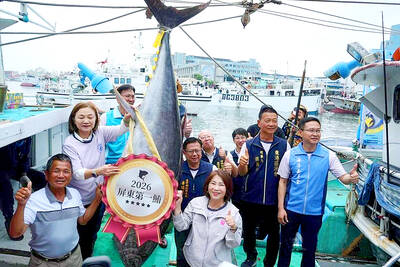
The first bluefin tuna of the season, brought to shore in Pingtung County and weighing 190kg, was yesterday auctioned for NT$10,600 (US$333.5) per kilogram, setting a record high for the local market. The auction was held at the fish market in Donggang Fishing Harbor, where the Siaoliouciou Island-registered fishing vessel Fu Yu Ching No. 2 delivered the “Pingtung First Tuna” it had caught for bidding. Bidding was intense, and the tuna was ultimately jointly purchased by a local restaurant and a local company for NT$10,600 per kilogram — NT$300 ,more than last year — for a total of NT$2.014 million. The 67-year-old skipper

China has reserved offshore airspace over the Yellow Sea and East China Sea from March 27 to May 6, issuing alerts that are usually used to warn of military exercises, although no such exercises have been announced, the Wall Street Journal (WSJ) reported on Sunday. Reserving such a large area for 40 days without explanation is an “unusual step,” as military exercises normally only last a few days, the paper said. The alerts, known as notice to air missions (NOTAMs), “are intended to inform pilots and aviation authorities of temporary airspace hazards or restrictions,” the article said. The airspace reserved in the alert


 RSS
RSS