


Visas of all remaining Taiwanese personnel at the Taipei Economic and Cultural Office (TECO) in Hong Kong are to expire before the end of this year, raising concerns that its operations will be seriously affected.
During a legislative session on Monday, Mainland Affairs Council (MAC) spokesman Chiu Chui-cheng (邱垂正) said that there are eight Taiwanese officials remaining at the TECO.
However, the office has activated a “proxy mechanism” so that there will be no leadership vacuum in its departments, Chiu said.
The 55 locally hired personnel are doing their best to maintain the office’s normal operations, such as visa issuance and document authentication, he said.
Asked by legislators whether the visas of the eight Taiwanese officials would be renewed, Chiu said that they have applied for renewals with Hong Kong authorities in accordance with the regulations.
However, the Hong Kong side has yet to give a positive response to their applications, he said.
He urged the Hong Kong authorities to respect an agreement signed by the two sides in 2011 on the exchange of offices.
TECO, which is operated by the council, was established in July 2011.
It replaced the Chung Hwa Travel Service, which had carried out similar functions for more than four decades at that time.
The office has lacked a director since 2018, as Hong Kong has yet to issue a visa to Lu Chang-shui (盧長水).
TECO Acting Director-General Kao Ming-tsun (高銘村) and three other Taiwanese officials last year were forced to return to Taiwan after the Hong Kong government refused to extend their visas.
Media reports at the time said that they were denied visa extensions for refusing to sign an affidavit recognizing Beijing’s “one China” principle.
Meanwhile, Chiu urged Beijing to stop its military coercion against Taiwan and to settle differences on cross-strait issues through dialogue.
He reiterated that there is no need for Taiwan to discuss the so-called “1992 consensus.”
This is because by Beijing’s definition, the essence of the “consensus” is the so-called “one China” principle, which is not acceptable for the majority of Taiwanese, he said.
The “1992 consensus,” a term former MAC chairman Su Chi (蘇起) in 2006 admitted making up in 2000, refers to a tacit understanding between the Chinese Nationalist Party (KMT) and the Chinese government that both sides of the Taiwan Strait acknowledge there is “one China,” with each side having its own interpretation of what “China” means.

Yangmingshan National Park authorities yesterday urged visitors to respect public spaces and obey the law after a couple was caught on a camera livestream having sex at the park’s Qingtiangang (擎天崗) earlier in the day. The Shilin Police Precinct in Taipei said it has identified a suspect and his vehicle registration number, and would summon him for questioning. The case would be handled in accordance with public indecency charges, it added. The couple entered the park at about 11pm on Thursday and began fooling around by 1am yesterday, the police said, adding that the two were unaware of the park’s all-day live
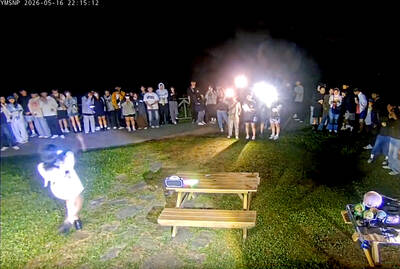
Yangmingshan National Park’s Qingtiangang (擎天崗) nature area has gone viral after a park livestream camera observed a couple in the throes of intimate congress, which was broadcast live on YouTube, drawing large late-night crowds and sparking a backlash over noise, bright lights and disruption to wildlife habitat. The area’s livestream footage appeared to show a couple engaging in sexual activity on a picnic table in the park on Friday last week, with the uncensored footage streamed publicly online. The footage quickly spread across social media, prompting a tide of visitors to travel to the site to “check in” and recreate the

A former soldier and an active-duty army officer were yesterday indicted for allegedly selling classified military training materials to a Chinese intelligence operative for a total of NT$79,440. The Taipei District Prosecutors’ Office indicted Chen Tai-yin (陳泰尹) and Lee Chun-ta (李俊達) for contravening the National Security Act (國家安全法) and the Anti-Corruption Act (貪污治罪條例). Chen left the military in September 2013 after serving alongside then-staff sergeant Lee, now an army lieutenant, at the 21st Artillery Command of the army’s Sixth Corps from 2011 to 2013, according to the indictment. Chen met a Chinese intelligence operative identified as “Wang” (王) through a friend in November

Minister of Digital Affairs Lin Yi-ching (林宜敬) yesterday cited regulatory issues and national security concerns as an expert said that Taiwan is among the few Asian regions without Starlink. Lin made the remarks on Facebook after funP Innovation Group chief executive officer Nathan Chiu (邱繼弘) on Friday said Taiwan and four other countries in Asia — China, North Korea, Afghanistan and Syria — have no access to Starlink. Starlink has become available in 166 countries worldwide, including Ukraine, Malaysia, the Philippines and Vietnam, in the six years since it became commercial, he said. While China and North Korea block Starlink, Syria is not


 RSS
RSS