


The Fourth Nuclear Power Plant “cannot be and must not be” made operational, Premier Su Tseng-chang (蘇貞昌) said on Thursday, despite a looming national referendum on the issue.
Su categorically ruled out the possibility of using the mothballed plant in New Taipei City’s Gongliao District (貢寮), Executive Yuan spokesman Lo Ping-cheng (羅秉成) quoted him as saying at a weekly Cabinet meeting.
Su was briefed on the facility by Hsu Yung-hui (許永輝), head of Taiwan Power Co’s (Taipower) Nuclear Power Division.
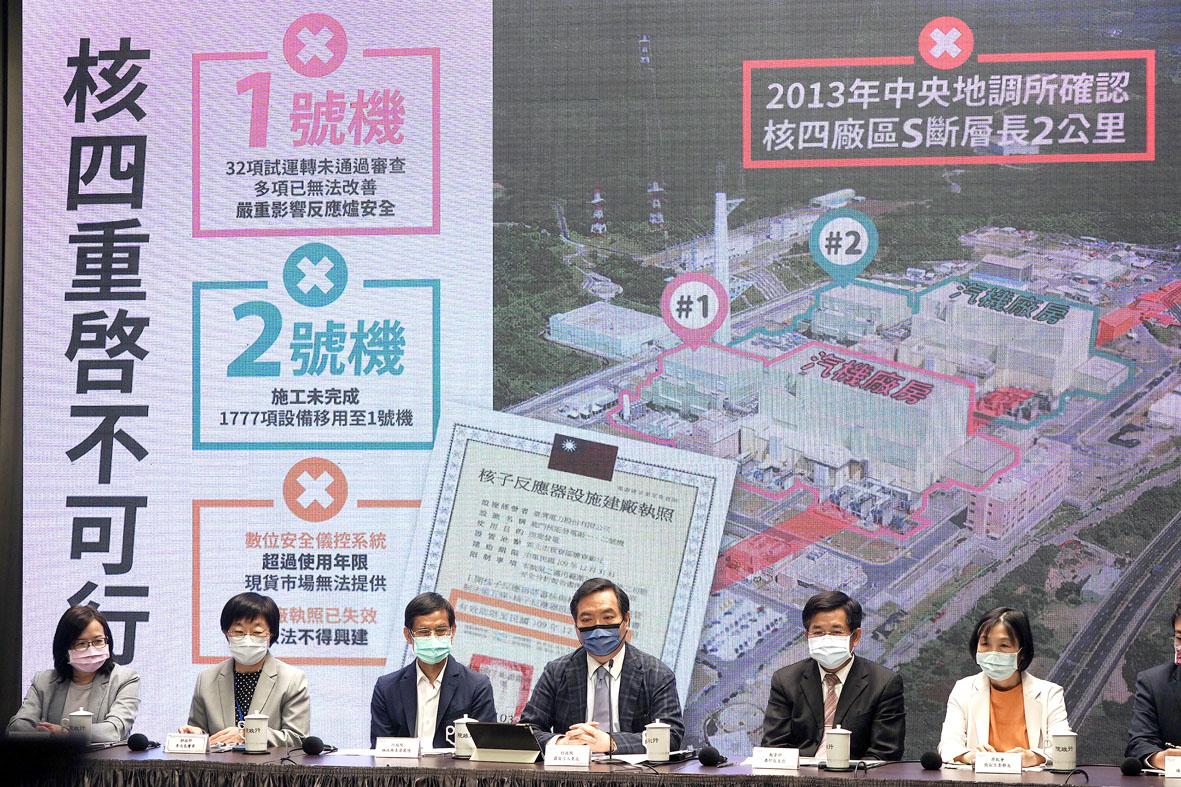
Photo: CNA
The plant was last sealed in 2014 by then-president Ma Ying-jeou’s (馬英九) administration amid rising public concern over the use of nuclear power, prompted by the 2011 Fukushima Dai-ichi nuclear power plant disaster in Japan, which was triggered by a devastating tsunami following an earthquake.
“Based on the report and figures provided by Hsu, there is no way the Fourth Nuclear Power Plant can be restored to its previous condition,” Lo said, citing comments by Su at the meeting.
One of the two generators at the plant is a mixture of components, while the other is incomplete, Su said.
A total of 1,777 items that are part of the No. 1 generator were taken from the No. 2 generator, and many failed safety tests, including rescue systems and reactors, Su said, adding that this was why the government agencies involved were censured by the Control Yuan in 2003.
At the same time, a construction license for the plant expired late last year, with the team in charge of building the facility being dismissed.
The warranties for a lot of equipment have expired and some equipment is no longer being produced, he said.
On top of that, Taipower on Sunday last week shipped 120 unused fuel rods, the last batch of 1,744 at the mothballed plant, back to the supplier in the US, he said.
That was carried out in compliance with a legislative resolution passed in January 2018 that required their return to General Electric Co to obtain some return on the assets, he said.
An investigation by the Central Geological Survey in 2013 confirmed that the Fourth Nuclear Power Plant is built on several fault lines, including a 2km-long fault directly underneath the facility, which poses a huge safety risk, Su said.
“Under such circumstances, it is impossible to resume construction of the plant,” he said.
The premier also focused on the issue of handling radioactive waste.
“I asked local government heads and they all opposed the operation of the plant, and no city or county is willing to store the nuclear waste,” he said.
Regardless of party affiliation, cities and counties across the country prioritize safety as their sole concern when addressing the Fourth Nuclear Power Plant, which reflects the consensus reached by the public, Su said.
Su asked the Ministry of Economic Affairs and the Atomic Energy Council to provide the public with more detailed information on the current condition of the facility and the thorny issues facing nuclear power.
A national referendum on activating the plant is to be held on Aug. 28. It was launched by nuclear power advocate Huang Shih-hsiu (黃士修).

LOUD AND PROUD Taiwan might have taken a drubbing against Australia and Japan, but you might not know it from the enthusiasm and numbers of the fans Taiwan might not be expected to win the World Baseball Classic (WBC) but their fans are making their presence felt in Tokyo, with tens of thousands decked out in the team’s blue, blowing horns and singing songs. Taiwanese fans have packed out the Tokyo Dome for all three of their games so far and even threatened to drown out home team supporters when their team played Japan on Friday. They blew trumpets, chanted for their favorite players and had their own cheerleading squad who dance on a stage during the game. The team struggled to match that exuberance on the field, with
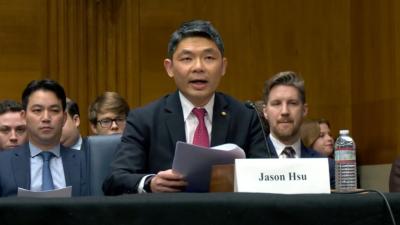
If China chose to invade Taiwan tomorrow, it would only have to sever three undersea fiber-optic cable clusters to cause a data blackout, Jason Hsu (許毓仁), a senior fellow at the Hudson Institute and former Chinese Nationalist Party (KMT) legislator, told a US security panel yesterday. In a Taiwan contingency, cable disruption would be one of the earliest preinvasion actions and the signal that escalation had begun, he said, adding that Taiwan’s current cable repair capabilities are insufficient. The US-China Economic and Security Review Commission (USCC) yesterday held a hearing on US-China Competition Under the Sea, with Hsu speaking on
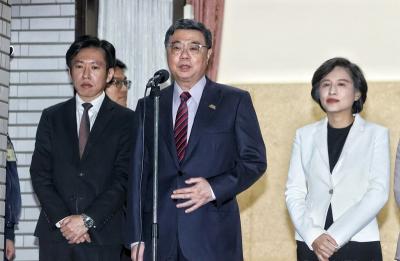
Taiwan is awaiting official notification from the US regarding the status of the Agreement on Reciprocal Trade (ART) after the US Supreme Court ruled US President Donald Trump's global tariffs unconstitutional. Speaking to reporters before a legislative hearing today, Premier Cho Jung-tai (卓榮泰) said that Taiwan's negotiation team remains focused on ensuring that the bilateral trade deal remains intact despite the legal challenge to Trump's tariff policy. "The US has pledged to notify its trade partners once the subsequent administrative and legal processes are finalized, and that certainly includes Taiwan," Cho said when asked about opposition parties’ doubts that the ART was
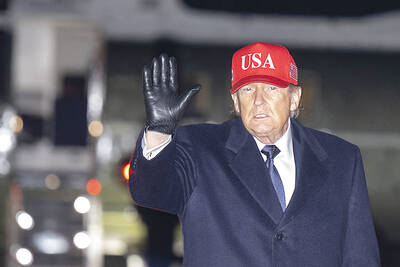
The US’ joint strikes with Israel on Iran dismantled a key pillar of China’s regional strategy, removing an important piece in Beijing’s potential Taiwan Strait scenario, said Zineb Riboua, a senior researcher at the Hudson Institute’s Center for Middle East Peace and Security. In an article titled: “The Iran Question Is All About China,” Riboua said that understanding the Iran issue in the context of China’s “grand strategy” is essential to fully grasp the complexity of the situation. Beijing has spent billions of dollars over the years turning Iran into a “structural strategic asset,” diverting US military resources in the


 RSS
RSS