


Agricultural experts yesterday urged the government to reduce reliance on China, which is the nation’s largest export destination for agricultural products, by finding other markets and seeking patent protection for some of Taiwan’s unique plants.
On Friday, China announced that it was suspending imports of pineapples from Taiwan on the grounds that it had found scale insects among the fruit.
The same day, Chinese media promoted Hsuwen pineapples produced in China’s Guangdong Province, which are actually a variety of pineapple from Taiwan.
Wu Rong-jieh (吳榮杰), an honorary professor at National Taiwan University’s Department of Agricultural Economics, said it is no secret that some people have transferred agricultural technology to China.
“Some consider personal interests above national interests and take the technology with them to China because of the short-term benefits. Others do not even consider China a hostile nation and even think of it as a motherland. Technology transfer becomes inevitable when you confuse political and economic issues,” Wu said.
For example, Taiwan was once known for its giant groupers, which would take three years to grow, he said, adding that the market price went as high as NT$1,500 per 600g at one point.
In 2008, after the technology used to raise giant groupers was given to China, many large indoor grouper facilities were built in China’s Fujian Province.
Taiwan and China signed an economic cooperation framework agreement in 2010, which listed giant groupers as one of the tax-free items, and by 2014, the number of groupers produced in Taiwan reached a record 26,000 tonnes, 80 percent of which were exported to China, Wu said.
However, groupers from China began to be sold in Taiwan in 2012, with the market price sliding to NT$500 per 600g, he said, adding that by then eight times more groupers were being produced in China than what was being produced in Taiwan.
Since 2016, China has imposed a 13 percent business tax on groupers imported from Taiwan, Wu said, adding that the market price for grouper has dropped below NT$250 per 600g.
“We should not rely on the Chinese market anymore and need to quickly find other reliable, high-end markets,” he said.
Yang Ming-hsien (楊明憲), a professor at Feng Chia University’s Department of International Business, said even if China managed to obtain fruit-growing technology from Taiwan, the fruit grown there might not be as good if farmers do not have the same management skills and the climate is different.
Some of the nation’s unique plant varieties should be patented to protect intellectual property rights, he said, adding that this could be used as a strategy to compete with other countries.

The military has spotted two Chinese warships operating in waters near Penghu County in the Taiwan Strait and sent its own naval and air forces to monitor the vessels, the Ministry of National Defense (MND) said. Beijing sends warships and warplanes into the waters and skies around Taiwan on an almost daily basis, drawing condemnation from Taipei. While the ministry offers daily updates on the locations of Chinese military aircraft, it only rarely gives details of where Chinese warships are operating, generally only when it detects aircraft carriers, as happened last week. A Chinese destroyer and a frigate entered waters to the southwest
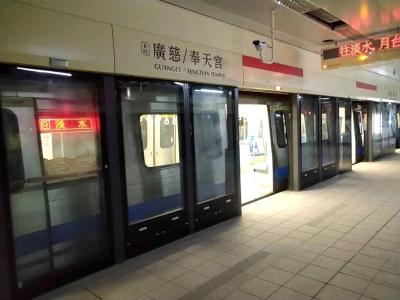
The eastern extension of the Taipei MRT Red Line could begin operations as early as late June, the Taipei Department of Rapid Transit Systems said yesterday. Taipei Rapid Transit Corp said it is considering offering one month of free rides on the new section to mark its opening. Construction progress on the 1.4km extension, which is to run from the current terminal Xiangshan Station to a new eastern terminal, Guangci/Fengtian Temple Station, was 90.6 percent complete by the end of last month, the department said in a report to the Taipei City Council's Transportation Committee. While construction began in October 2016 with an
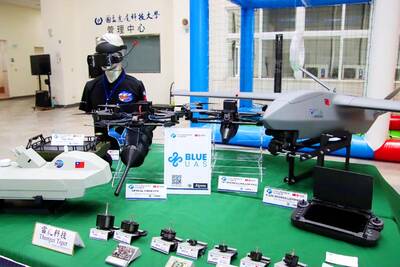
NON-RED SUPPLY: Boosting the nation’s drone industry is becoming increasingly urgent as China’s UAV dominance could become an issue in a crisis, an analyst said Taiwan’s drone exports to Europe grew 41.7-fold from 2024 to last year, with demand from Ukraine’s fight against Russian aggression the most likely driver of growth, a study showed. The Institute for Democracy, Society and Emerging Technology (DSET) in a statement on Wednesday said it found that many of Taiwan’s uncrewed aerial vehicle (UAV) sales were from Poland and the Czech Republic. These countries likely transferred the drones to Ukraine to aid it in its fight against the Russian invasion that started in 2022, it said. Despite the gains, Taiwan is not the dominant drone exporter to these markets, ranking second and fourth

Japanese Prime Minister Sanae Takaichi’s comment last year on Tokyo’s potential reaction to a Taiwan-China conflict has forced Beijing to rewrite its invasion plans, a retired Japanese general said. Takaichi told the Diet on Nov. 7 last year that a Chinese naval blockade or military attack on Taiwan could constitute a “survival-threatening situation” for Japan, potentially allowing Tokyo to exercise its right to collective self-defense. Former Japan Ground Self-Defense Force general Kiyofumi Ogawa said in a recent speech that the remark has been interpreted as meaning Japan could intervene in the early stages of a Taiwan Strait conflict, undermining China’s previous assumptions


 RSS
RSS