


The government cannot legally require pork importers to mark pork products that contain ractopamine residue with particular labels, or Taiwan might face trade retaliations from other countries, Premier Su Tseng-chang (蘇貞昌) said yesterday.
Su’s remarks came in response to calls by New Taipei City Mayor Hou You-yi (侯友宜) and other mayors to require that pork products which contain traces of the feed additive be labeled.
A ban on imports of pork products from the US, where the feed additive is allowed, is set to be lifted on Jan. 1.
Su said that a total of 101 countries allow imports of pork containing traces of ractopamine without label requirements.
If the government were to legally require labels on particular pork products to inform Taiwanese customers, these 101 countries might impose retaliatory measures on the the nation, Su said.
Su on Friday said that soon after he assumed office in January last year, President Tsai Ing-wen (蔡英文) approached him about the issue of US pork imports.
The Presidential Office as of yesterday did not comment on the remark.
Reacting to media queries saying that details about the policy remain confusing, despite more than a year of deliberation, Su said that the government was pursuing a step-by-step approach.
Following Tsai’s announcement on Aug. 28 that the import ban would be lifted, several government agencies have been working out the details, he said.
The government aims to boost the nation’s international standing and promote domestic products overseas, Su said, adding that lifting import barriers was a necessary part of that approach.
However, this requires concerted efforts by the central and local governments, and the legislature, Su said.
Food safety for Taiwanese remains a priority, he added.
Local pork importers earlier this month said that they are not planning to import pork that might contain ractopamine residues, Su said.
The government welcomes importers’ plans to mark products that do not contain ractopamine residue, Su said, adding that businesses were free to choose measures to ensure the competitiveness of their products.
Despite the importers’ initiative, the government would stick to the five regulatory measures announced by the Legislative Yuan, Su said.
According to the Executive Yuan, the measures entail inspections of pork factories in the US before greenlighting their products; requirements for country-of-origin labels; customs inspections of all batches of pork imports; requirements for tracking codes on products; and ensuring that only domestic pork is served to students at schools throughout the nation.
Additional reporting by Lee Hsin-fang

Taiwan has received more than US$70 million in royalties as of the end of last year from developing the F-16V jet as countries worldwide purchase or upgrade to this popular model, government and military officials said on Saturday. Taiwan funded the development of the F-16V jet and ended up the sole investor as other countries withdrew from the program. Now the F-16V is increasingly popular and countries must pay Taiwan a percentage in royalties when they purchase new F-16V aircraft or upgrade older F-16 models. The next five years are expected to be the peak for these royalties, with Taiwan potentially earning
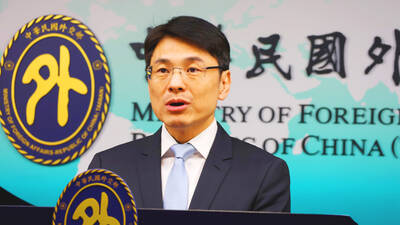
STAY IN YOUR LANE: As the US and Israel attack Iran, the ministry has warned China not to overstep by including Taiwanese citizens in its evacuation orders The Ministry of Foreign Affairs (MOFA) yesterday rebuked a statement by China’s embassy in Israel that it would evacuate Taiwanese holders of Chinese travel documents from Israel amid the latter’s escalating conflict with Iran. Tensions have risen across the Middle East in the wake of US and Israeli airstrikes on Iran beginning Saturday. China subsequently issued an evacuation notice for its citizens. In a news release, the Chinese embassy in Israel said holders of “Taiwan compatriot permits (台胞證)” issued to Taiwanese nationals by Chinese authorities for travel to China — could register for evacuation to Egypt. In Taipei, the ministry yesterday said Taiwan
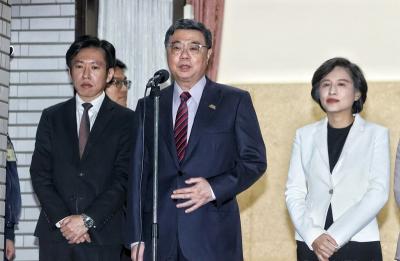
Taiwan is awaiting official notification from the US regarding the status of the Agreement on Reciprocal Trade (ART) after the US Supreme Court ruled US President Donald Trump's global tariffs unconstitutional. Speaking to reporters before a legislative hearing today, Premier Cho Jung-tai (卓榮泰) said that Taiwan's negotiation team remains focused on ensuring that the bilateral trade deal remains intact despite the legal challenge to Trump's tariff policy. "The US has pledged to notify its trade partners once the subsequent administrative and legal processes are finalized, and that certainly includes Taiwan," Cho said when asked about opposition parties’ doubts that the ART was
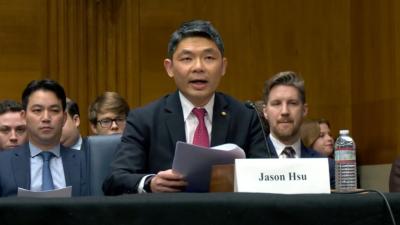
If China chose to invade Taiwan tomorrow, it would only have to sever three undersea fiber-optic cable clusters to cause a data blackout, Jason Hsu (許毓仁), a senior fellow at the Hudson Institute and former Chinese Nationalist Party (KMT) legislator, told a US security panel yesterday. In a Taiwan contingency, cable disruption would be one of the earliest preinvasion actions and the signal that escalation had begun, he said, adding that Taiwan’s current cable repair capabilities are insufficient. The US-China Economic and Security Review Commission (USCC) yesterday held a hearing on US-China Competition Under the Sea, with Hsu speaking on


 RSS
RSS