


People First Party (PFP) Chairman James Soong (宋楚瑜) last night conceded defeat in the presidential election, saying that the party respected the decision of voters.
Apart from thanking the party’s candidates, staff and supporters, Soong warned that the nation’s future leader would soon face many challenges.
“The nation will face a major change in the global political situation this year,” Soong said.
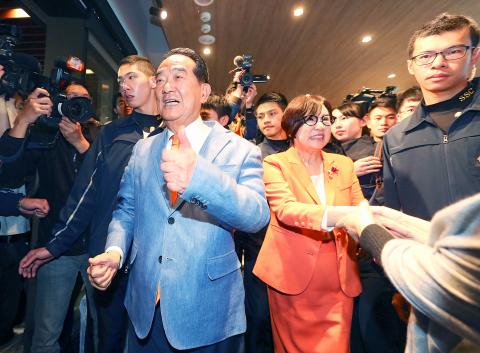
Photo: CNA
“If cross-strait relations remain unstable and Taiwan takes the wrong side in dealings with Japan, the US and China, all these factors will affect Taiwan,” he said.
“This government should stop pitting one party against another, stop destroying the civil service by offering lucrative jobs only to those who agree with it and stop using drastic measures to carry out social reforms,” he added.
Asked if he would run for president again in 2024, Soong said that the question is whether the nation will survive the next four years, given the trials it will face.
Securities analyst Wu Kuan-lung (吳官隆), a supporter of Hon Hai Precision Industry Co founder Terry Gou (郭台銘), watched the election results at the PFP’s campaign headquarters.
The loss by Kaohsiung Mayor Han Kuo-yu (韓國瑜), the Chinese Nationalist Party’s (KMT) presidential candidate, proved that Han should not have run for president just a few months after taking office, Wu said, calling that decision Han’s “original sin,” for which he has no excuse.
Although they secured some legislator-at-large seats, the PFP and the Taiwan People’s Party lost their legislative elections, meaning there would be no “third force” party in the Legislative Yuan large enough to serve as a counterweight to either the Democratic Progressive Party (DPP) or the KMT, Wu said.
PFP legislator-at-large nominee Amanda Liu (劉宥彤), a former aide to Gou, said that these elections were not won by the DPP, but rather lost by the KMT.
Not many party votes go to third parties when the competition between the DPP and KMT is intense, she said.
PFP spokeswoman Belle Yu (于美人) said that the party fought the good fight, but added that voters made the final decision.
“What the PFP cares about is not the victories of political parties, but rather what people have gained through the process,” Yu said.
“What consensus have people reached through the elections? Do we now have a common goal for the future?” she said. “This is what we care about.”
As her role as spokesperson ended yesterday, Yu said that she was honored to be part of a historic moment working for Soong’s presidential campaign, his “last battle.”
“We will miss Chairman Soong. We thank him for his contribution to Taiwan’s democracy and for giving 44 years of his life to the nation,” Yu said.
Prior to last night’s election, Soong had also been the PFP’s presidential candidate in the 2012 and 2016 elections, losing by a significant margin.
In 2012, Soong secured only 2.77 percent of overall votes.
In 2016, Soong and his running mate, former Republican Party chairwoman Hsu Hsin-ying (徐欣瑩), garnered 1,576,861 votes, or 12.83 percent of total ballots.
Soong first ran for the presidency in 2000 as an independent candidate and narrowly lost to former president Chen Shui-bian (陳水扁) by 2.46 percentage points.
In 2004, Soong was the running mate of former vice president Lien Chan (連戰) in a KMT-PFP alliance. They lost to Chen and former vice president Annette Lu (呂秀蓮) by 0.2 percentage points.

FUKUOKA SITUATION: Japanese media reported that the pathogen is expected to be identified by the summer, while the CDC downplayed the idea that it was hMPV A “mysterious cold-like illness” reported in Japan’s Fukuoka Prefecture does not seem to be a new disease, but Japanese authorities have been asked about the situation, the Centers for Disease Control (CDC) said yesterday. The Fukuoka Prefectural Medical Association on Wednesday told a news conference that a “mystery cold” that has become a hot topic on social media is “highly likely to be caused by some kind of viral infection,” Japan’s KBC News reported. “Many people are experiencing symptoms starting with a sore throat, followed by a runny nose, phlegm and a severe cough,” KBC News reported, citing association officials. Health authorities are

Nvidia Corp CEO Jensen Huang (黃仁勳) arrived in Taiwan yesterday ahead of upcoming AI and technology events, saying he plans to meet with clients and Taiwan Semiconductor Manufacturing Co Chairman C.C. Wei (魏哲家) during his visit. After landing at Taipei Songshan Airport, Huang posed for photos with fans and handed out Yakult drinks to reporters and supporters waiting at the scene, saying he has “a lot to do” during the trip. Asked about reports that Nvidia’s planned headquarters site in Taipei’s Beitou Shilin Technology Park could break ground on May 27, Huang said that if the company holds an event, he would

The Ministry of Finance this afternoon announced the winning numbers for the March-April uniform invoice lottery. The winning number for the NT$10 million (US$318,060) special prize is 19531471, and the winning number for the NT$2 million grand prize is 85941329. Three numbers were drawn for the NT$200,000 first prize: 07225810, 20231230 and 83518781. Those with receipts matching the last seven digits of any of the first-prize numbers will win the NT$40,000 second prize, while those matching the last six digits will win the NT$10,000 third prize. Those whose receipts match the last five digits of the first-prize numbers can claim the NT$4,000 fourth prize,
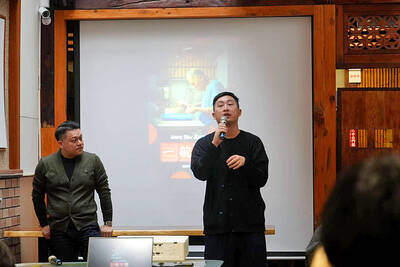
Taiwan Travelogue (臺灣漫遊錄), which earlier this week became the first Taiwanese novel to win the International Booker Prize, is to be adapted into a television series through a Taiwan-Japan coproduction, producer Chang Chen-yu (張辰漁) said yesterday. Chang, a producer at World Softest Production Film Co, wrote on Facebook that the company had been searching for projects with international appeal that retain a strong Taiwanese identity after colleagues and Japanese partners strongly recommended the novel. After reading the book, Chang said he immediately decided to pursue the screen rights. “A great story has the power to transcend time and borders, and connect countless people,”


 RSS
RSS