


Anybody visiting Albert Muhlbock has no need for detailed directions. Just follow the music in his quiet neighborhood in Taichung and they will find him.
“The neighbors were complaining at first, but then they got used to it and would ask me where I had gone if they didn’t hear music for days,” said the pianist, who has lived in Taichung for three years.
The Austrian said that he cherishes the flexibility to teach in schools and offer private lessons instead of being tied to one employer, which would have been impossible without the Employment Gold Card he obtained last year.
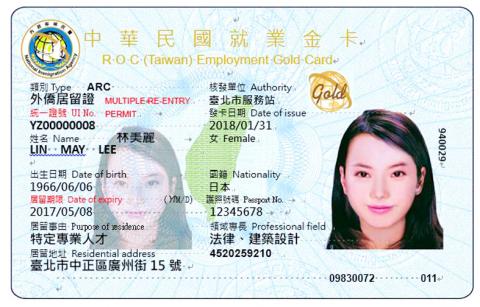
Screen grab from the Internet
A four-in-one document comprising a work permit, resident’s visa, Alien Resident Certificate and re-entry permit, the card came into being under the Act for the Recruitment and Employment of Foreign Professional Professionals (外國專業人才延攬及僱用法).
Drawn up by the National Development Council and passed by the Legislative Yuan on Oct. 31, 2017, the regulations were conceived to help recruit foreign talent by providing a friendlier environment for foreign professionals, such as Muhlbock, with expertise and a record of achievement in a specific field.
The law sought in part to accommodate the changing definition of work in the era of the knowledge economy, with professionals with specific skills more likely to work for themselves rather than be bound to a single employer.
Since the law took effect on Feb. 8 last year, there have been about 420 applicants, with 260 approved, the council said.
That means people like Muhlbock have the freedom to pursue careers in Taiwan without visa and residency concerns, as long as they meet professional requirements in their specialized fields, such as architecture, law, science and technology, culture or education.
Previously, foreign professionals could only apply for a fixed work permit tied to a specific employer, and the permit was terminated when the employment ended.
Their ability to stay in Taiwan after that depended on their residency status. If they received a visa for employment purposes, they would have to leave.
Muhlbock obtained his Gold Card based on expertise in education, while Tom Fifield got his for science and technology.
The Australian, who last year started working for himself teaching companies how to build cloud systems as part of a global, open-source project, said the new program came at the perfect time, because he had been in Taiwan for four years and needed to renew his work permit.
“If I wanted to take up a side job or have a second engagement, I could do that with the Gold Card, and that was a big benefit for me,” he said.
For others, the card provides a sense of stability as they look for work or was an incentive to work in Taiwan.
Gabriele de Seta, an Italian media anthropologist — a job that focuses on understanding producers, audiences and other cultural and social aspects of mass media — applied for the Gold Card while in his home nation in the summer of last year. Visa restrictions had forced him to leave Taiwan after working for Academia Sinica and doing freelance work.
“As a freelancer, someone who is kind of in between jobs, starting his career, I think the Gold Card helps me in having stability and a bit of safety, knowing that I can work legally in Taiwan,” said De Seta, whose expertise is education.
Applying for a Gold Card costs between NT$3,000 and NT$8,000 depending on the applicant’s nationality and the length of stay they request — from one to three years.
Most applicants find the online process convenient, but some have said that there are still drawbacks.
John Chen, a financial specialist who moved back to Taiwan to help start-ups go global, said the process was challenging for people wanting to bring their families with them.
The program required his young children to come to Taiwan in person to process the permit, a major inconvenience, he said.
De Seta said that a big problem was that too few people actually know about the program, and that Taiwan’s many recruitment programs and their requirements can be confusing.
Still, Gold Card holders generally praised the process and said that it made Taiwan more appealing for foreign professionals.
Colum Brolly, an Irish software engineer who applied for the card in the science and technology field, said it offers younger professionals more opportunities.
“You can just come to Taiwan and enter the country as a resident with an open work permit, [which allows] you to network and take opportunities, or walk into them as you see them come up, which makes Taiwan more competitive and definitely more competitive,” he said.
Taiwan’s living environment has given these professionals reason to stay.
Tomas Rizek, a Czech illustrator who published his first book in Taiwan 15 years ago, found himself spending more time in Taiwan than in Europe as he worked with Taiwanese partners. He eventually set up a branch of his Czech publishing house here.
The foreign professionals said they were keen to help Taiwan become more competitive.
Taiwan is still stuck in a mindset of making hardware, where profit margins are being squeezed, while falling behind in developing software, which generates value, Chen said.
“One of my intermediate goals is to find a company in Taiwan that I can help take on to the global stage and then create a role model for younger kids to look up to and then they’ll start believing and then try to do their own stuff,” he said.
For Muhlbock, who has spent decades studying the clavichord — regarded as the predecessor of the piano — one of his goals is to introduce the early-European keyboard instrument to Taiwan, as local research on it is almost nonexistent.
Muhlbock said he wants to contribute as much as possible to the development of music in the nation, having anchored himself here since his first visit 20 years ago.
“Taiwan has become my second home on the other side of the Earth,” he said.

A magnitude 6.1 earthquake struck off the coast of Yilan County at 8:39pm tonight, the Central Weather Administration (CWA) said, with no immediate reports of damage or injuries. The epicenter was 38.7km east-northeast of Yilan County Hall at a focal depth of 98.3km, the CWA’s Seismological Center said. The quake’s maximum intensity, which gauges the actual physical effect of a seismic event, was a level 4 on Taiwan’s 7-tier intensity scale, the center said. That intensity level was recorded in Yilan County’s Nanao Township (南澳), Hsinchu County’s Guansi Township (關西), Nantou County’s Hehuanshan (合歡山) and Hualien County’s Yanliao (鹽寮). An intensity of 3 was

Instead of focusing solely on the threat of a full-scale military invasion, the US and its allies must prepare for a potential Chinese “quarantine” of Taiwan enforced through customs inspections, Stanford University Hoover fellow Eyck Freymann said in a Foreign Affairs article published on Wednesday. China could use various “gray zone” tactics in “reconfiguring the regional and ultimately the global economic order without a war,” said Freymann, who is also a nonresident research fellow at the US Naval War College. China might seize control of Taiwan’s links to the outside world by requiring all flights and ships entering or leaving Taiwan
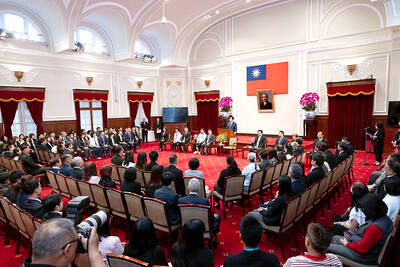
The next minimum wage hike is expected to exceed NT$30,000, President William Lai (賴清德) said yesterday during an award ceremony honoring “model workers,” including migrant workers, at the Presidential Office ahead of Workers’ Day today. Lai said he wished to thank the awardees on behalf of the nation and extend his most sincere respect for their hard work, on which Taiwan’s prosperity has been built. Lai specifically thanked 10 migrant workers selected for the award, saying that although they left their home countries to further their own goals, their efforts have benefited Taiwan as well. The nation’s industrial sector and small businesses lay
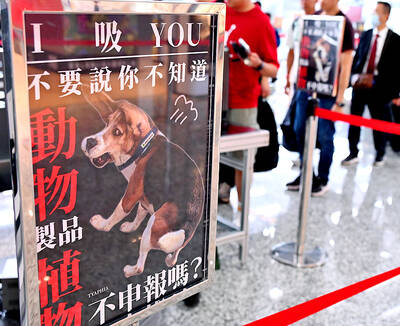
Quarantine awareness posters at Taiwan Taoyuan International Airport have gone viral for their use of wordplay. Issued by the airport branch of the Animal and Plant Health Inspection Agency, the posters feature sniffer dogs making a range of facial expressions, paired with advisory messages built around homophones. “We update the messages for holidays and campaign needs, periodically refreshing materials to attract people’s attention,” quarantine officials said. “The aim is to use the dogs’ appeal to draw focus to quarantine regulations.” A Japanese traveler visiting Taiwan has posted a photo on X of a poster showing a quarantine dog with a


 RSS
RSS