


Hsinchu County-based seashell inlay worker Chen Fu-chiang (陳甫強), who immigrated from Hong Kong with his father in 1954, said he witnessed the glory days of Taiwan’s inlay export industry, which he now fears might vanish.
Known as luodian (螺鈿), the traditional art of inlaying shells in wood or lacquer is estimated to be 3,000 years old and its etymology is unclear, Chen said.
While luo clearly refers to the shells, dian could mean either golden-and-silver honeysuckle or the act of inlaying.
Modern inlayers in Japan and South Korea use laser cutters to shape the shells before reassembling them into a design, while the traditional technique used in Taiwan relies on handwork for cutting, grinding and polishing the material, he said.
The traditional technique is called “thick” shell inlay after the thickness of the resulting pieces and it is typically used to decorate high-end furniture, Chen said.
He was inducted into the trade in 1967 so that he could help his father, a master carver, with a contract to create several objects for Taipei’s Sun Yat-sen Memorial Hall, he said, adding that he developed a fondness for shell inlays at the time.
His father’s technique, exemplified by the mother-of-pearl inlays on the screens of the hall’s Round Chamber, utilized the gradients of white in the material to achieve an effect similar to “broken ink” brush paintings, he said.
His own style, which he developed after returning from military service, makes use of power tools and colorful seashells to create designs that evoke “meticulous” brush paintings, Chen said.
Hsinchu County is the last place in Taiwan where shell inlay workers use traditional methods and he has been running a tuition-free school to pass on the skill, he said.
About 100 students have attended the school, but most have only been curious and not become professionals, Chen said, adding that mastering the trade requires many years of apprenticeship.
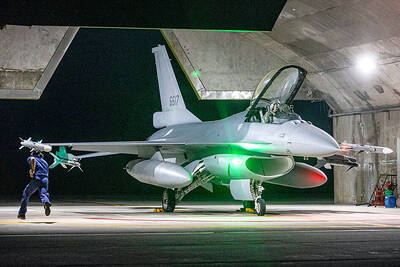
Taiwan has received more than US$70 million in royalties as of the end of last year from developing the F-16V jet as countries worldwide purchase or upgrade to this popular model, government and military officials said on Saturday. Taiwan funded the development of the F-16V jet and ended up the sole investor as other countries withdrew from the program. Now the F-16V is increasingly popular and countries must pay Taiwan a percentage in royalties when they purchase new F-16V aircraft or upgrade older F-16 models. The next five years are expected to be the peak for these royalties, with Taiwan potentially earning
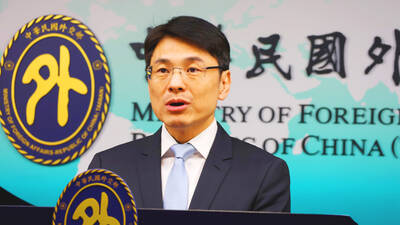
STAY IN YOUR LANE: As the US and Israel attack Iran, the ministry has warned China not to overstep by including Taiwanese citizens in its evacuation orders The Ministry of Foreign Affairs (MOFA) yesterday rebuked a statement by China’s embassy in Israel that it would evacuate Taiwanese holders of Chinese travel documents from Israel amid the latter’s escalating conflict with Iran. Tensions have risen across the Middle East in the wake of US and Israeli airstrikes on Iran beginning Saturday. China subsequently issued an evacuation notice for its citizens. In a news release, the Chinese embassy in Israel said holders of “Taiwan compatriot permits (台胞證)” issued to Taiwanese nationals by Chinese authorities for travel to China — could register for evacuation to Egypt. In Taipei, the ministry yesterday said Taiwan
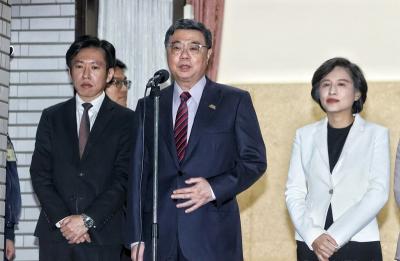
Taiwan is awaiting official notification from the US regarding the status of the Agreement on Reciprocal Trade (ART) after the US Supreme Court ruled US President Donald Trump's global tariffs unconstitutional. Speaking to reporters before a legislative hearing today, Premier Cho Jung-tai (卓榮泰) said that Taiwan's negotiation team remains focused on ensuring that the bilateral trade deal remains intact despite the legal challenge to Trump's tariff policy. "The US has pledged to notify its trade partners once the subsequent administrative and legal processes are finalized, and that certainly includes Taiwan," Cho said when asked about opposition parties’ doubts that the ART was
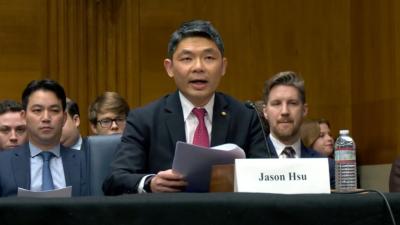
If China chose to invade Taiwan tomorrow, it would only have to sever three undersea fiber-optic cable clusters to cause a data blackout, Jason Hsu (許毓仁), a senior fellow at the Hudson Institute and former Chinese Nationalist Party (KMT) legislator, told a US security panel yesterday. In a Taiwan contingency, cable disruption would be one of the earliest preinvasion actions and the signal that escalation had begun, he said, adding that Taiwan’s current cable repair capabilities are insufficient. The US-China Economic and Security Review Commission (USCC) yesterday held a hearing on US-China Competition Under the Sea, with Hsu speaking on


 RSS
RSS