


Civil servants should immediately stop “liking” or commenting on social media posts by candidates running for local office, as such actions are in breach of the Civil Service Administrative Neutrality Act (公務人員行政中立法), the Examination Yuan said yesterday.
The Ministry of Civil Service has repeatedly warned government agencies at all levels that the act should be observed, Examination Yuan Secretary-General Lee Chi-hsuan (李繼玄) said.
Even clicking the “like” button on Facebook might be in contravention of the act, Lee said.
Government agencies must process any complaints about such actions if they are filed, Lee added.
Common infractions by civil servants include confidential staff doubling as deputy party chairperson or serving as the managing director of a local party chapter, or the head of a government division “mobilizing” the entire unit to attend a rally for a candidate, the Examination Yuan said.
Civil servants should not attend events or rallies hosted by political parties or candidates when leaving the office on official business, and should not circulate election pamphlets in their office, regardless of whether they pass them to colleagues or visitors, the Executive Yuan said.
Civil servants should not wear election-themed apparel to the office and confidential staff may not attend or host candidates’ fundraisers, it said.
Finally, deans of public schools must not write endorsements for candidates in mass media advertisements, it said.
Any breach of the act by civil servants is punishable under the Public Functionary Discipline Act (公務員懲戒法), the Civil Servants Evaluation Act (公務人員考績法) or other regulations, depending on the severity of the infraction, it said.

Yangmingshan National Park authorities yesterday urged visitors to respect public spaces and obey the law after a couple was caught on a camera livestream having sex at the park’s Qingtiangang (擎天崗) earlier in the day. The Shilin Police Precinct in Taipei said it has identified a suspect and his vehicle registration number, and would summon him for questioning. The case would be handled in accordance with public indecency charges, it added. The couple entered the park at about 11pm on Thursday and began fooling around by 1am yesterday, the police said, adding that the two were unaware of the park’s all-day live
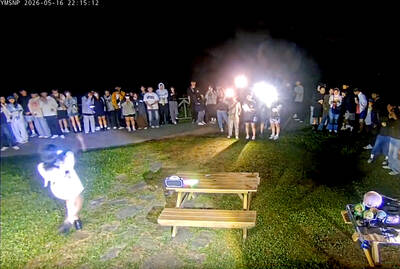
Yangmingshan National Park’s Qingtiangang (擎天崗) nature area has gone viral after a park livestream camera observed a couple in the throes of intimate congress, which was broadcast live on YouTube, drawing large late-night crowds and sparking a backlash over noise, bright lights and disruption to wildlife habitat. The area’s livestream footage appeared to show a couple engaging in sexual activity on a picnic table in the park on Friday last week, with the uncensored footage streamed publicly online. The footage quickly spread across social media, prompting a tide of visitors to travel to the site to “check in” and recreate the

A former soldier and an active-duty army officer were yesterday indicted for allegedly selling classified military training materials to a Chinese intelligence operative for a total of NT$79,440. The Taipei District Prosecutors’ Office indicted Chen Tai-yin (陳泰尹) and Lee Chun-ta (李俊達) for contravening the National Security Act (國家安全法) and the Anti-Corruption Act (貪污治罪條例). Chen left the military in September 2013 after serving alongside then-staff sergeant Lee, now an army lieutenant, at the 21st Artillery Command of the army’s Sixth Corps from 2011 to 2013, according to the indictment. Chen met a Chinese intelligence operative identified as “Wang” (王) through a friend in November

Minister of Digital Affairs Lin Yi-ching (林宜敬) yesterday cited regulatory issues and national security concerns as an expert said that Taiwan is among the few Asian regions without Starlink. Lin made the remarks on Facebook after funP Innovation Group chief executive officer Nathan Chiu (邱繼弘) on Friday said Taiwan and four other countries in Asia — China, North Korea, Afghanistan and Syria — have no access to Starlink. Starlink has become available in 166 countries worldwide, including Ukraine, Malaysia, the Philippines and Vietnam, in the six years since it became commercial, he said. While China and North Korea block Starlink, Syria is not


 RSS
RSS