


Government efforts to promote start-ups and innovative technology is seeing some success, with AP Plasma Corp applying plasma technology to shoe manufacturing, and PicSee becoming a must-have tool for uploading one’s daily life onto social networking platforms.
The traditional shoe industry has long used a highly toxic chemical to glue the sole to the shoe, a practice that is very damaging to the environment, AP Plasma manager Wang Hung-yi (王弘壹) said on Thursday.
By using plasma to treat the original materials, their base characteristics are changed, altering the chemical bonds, Wang said, adding that applying non-toxic resin to shoes removes the need for highly toxic chemical glues.
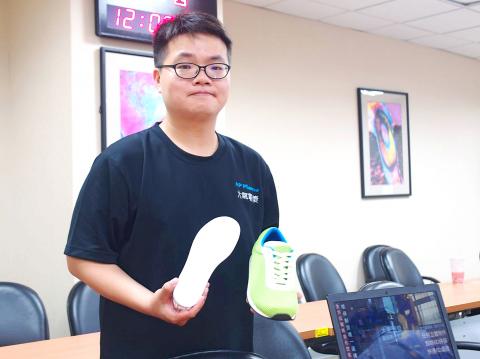
Photo: Chien Hui-ju, Taipei Times
The company is collaborating with Pou Chen Industry and hopes to apply the same technology to all macromolecule rubber products, Wang said.
The introduction of the technology could make the traditional shoemaking industry cleaner and more eco-friendly, as well as more competitive, Wang said.
PicSee cofounder Ray Wei (方選) said there is great market potential in Southeast Asia for his firm.
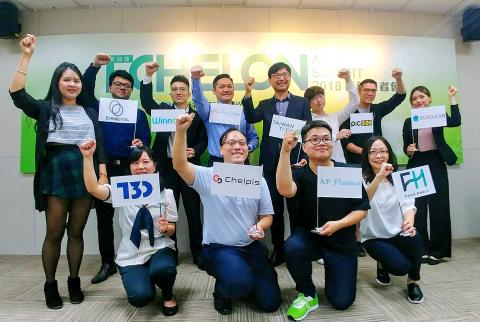
Photo: Chien Hui-ju, Taipei Times
PicSee’s services shorten the length of Web addresses for easier sharing on social Web sites and can help increase the amount of “likes” on social networking services, Ray said.
Vietnam has 45 million Internet users, 2.6 times that of Taiwan at 17 million, Ray said, adding that Taiwanese YouTube channel This Group of People has about 2 million subscribers, while the most popular YouTube channel in Thailand has more than 10 million subscribers.
Meanwhile, the Ministry of Science and Technology is scheduled to take nine leading start-ups to the Echelon Asia Summit at the Singapore Expo on Thursday and Friday.
Both AP Plasma and PicSee are to attend.
The ministry is to have a Taiwan pavilion at the expo for the first time this year and hopes to break into Southeast Asia’s innovative technology industry, ministry official Chiu Chiu-hui (邱求慧) said.
The nine companies would include start-ups in the fields of smart technology in medicine, artificial intelligence, smart manufacturing and statistical analysis, Chiu said.

Yangmingshan National Park authorities yesterday urged visitors to respect public spaces and obey the law after a couple was caught on a camera livestream having sex at the park’s Qingtiangang (擎天崗) earlier in the day. The Shilin Police Precinct in Taipei said it has identified a suspect and his vehicle registration number, and would summon him for questioning. The case would be handled in accordance with public indecency charges, it added. The couple entered the park at about 11pm on Thursday and began fooling around by 1am yesterday, the police said, adding that the two were unaware of the park’s all-day live

Yangmingshan National Park’s Qingtiangang (擎天崗) nature area has gone viral after a park livestream camera observed a couple in the throes of intimate congress, which was broadcast live on YouTube, drawing large late-night crowds and sparking a backlash over noise, bright lights and disruption to wildlife habitat. The area’s livestream footage appeared to show a couple engaging in sexual activity on a picnic table in the park on Friday last week, with the uncensored footage streamed publicly online. The footage quickly spread across social media, prompting a tide of visitors to travel to the site to “check in” and recreate the

A former soldier and an active-duty army officer were yesterday indicted for allegedly selling classified military training materials to a Chinese intelligence operative for a total of NT$79,440. The Taipei District Prosecutors’ Office indicted Chen Tai-yin (陳泰尹) and Lee Chun-ta (李俊達) for contravening the National Security Act (國家安全法) and the Anti-Corruption Act (貪污治罪條例). Chen left the military in September 2013 after serving alongside then-staff sergeant Lee, now an army lieutenant, at the 21st Artillery Command of the army’s Sixth Corps from 2011 to 2013, according to the indictment. Chen met a Chinese intelligence operative identified as “Wang” (王) through a friend in November

Minister of Digital Affairs Lin Yi-ching (林宜敬) yesterday cited regulatory issues and national security concerns as an expert said that Taiwan is among the few Asian regions without Starlink. Lin made the remarks on Facebook after funP Innovation Group chief executive officer Nathan Chiu (邱繼弘) on Friday said Taiwan and four other countries in Asia — China, North Korea, Afghanistan and Syria — have no access to Starlink. Starlink has become available in 166 countries worldwide, including Ukraine, Malaysia, the Philippines and Vietnam, in the six years since it became commercial, he said. While China and North Korea block Starlink, Syria is not


 RSS
RSS