


A special task force has been created to help promote President Tsai Ing-wen’s (蔡英文) “new southbound policy,” with an emphasis on using existing city-to-city relations to encourage bilateral visits and economic cooperation agreements, the Ministry of Foreign Affairs said.
China’s efforts to marginalize Taiwan in the international community remain the nation’s greatest challenge, but non-traditional solutions, such as the “new southbound policy,” might provide alternative opportunities to enhance cooperation with other nations, Minister of Foreign Affairs David Lee (李大維) said.
Regional missions have been asked to submit plans to establish city-based channels of communication between Taiwan and Southeast Asian nations on issues such as mutual visits, multilateral diplomatic visits involving the legislatures of each nation, setting the groundwork for economic cooperation agreements, stepping up medical interaction and expanding mutual training programs, the ministry said.
Taiwan’s advantage lies in its emphasis on democracy, freedom and human rights, Lee said, adding that since his appointment he had met with officials from nations that share the same values as Taiwan and found that they were sincerely interested in pursuing further cooperation.
Lee said he is “more optimistic than ever” about the policy and he has revised his views toward several nations with which Taiwan might pursue further ties.
In response to Chinese Nationalist Party (KMT) Legislator Johnny Chiang’s (江啟臣) concerns that the policy is vacuous, Department of East Asian and Pacific Affairs Director-General Winston Chen (陳文儀) said the ministry plans to enhance existing sister-city ties.
Many local governments have sister-city relationships with Southeast Asian cities, but lack the motivation for further interactions, Chen said, adding that the ministry’s missions in the region could help bridge the gap between city governments.
On the ministry’s plans to shutter some of its missions, Lee said the ministry has decided to consolidate the nation’s diplomatic resources, adding that it would reallocate any freed-up resources to Southeast Asian nations.
In related news, Sports Administration Secretary-General Wang Han-chung (王漢忠) said the government has allocated NT$72.7 million (US$2.2 million) to encourage sports as a medium for international exchanges, particularly in Southeast Asia.
The agency is increasing its funding to local sports organizations for training and applying to join international competitions, while looking to invite Southeast Asian nations to Taiwan to participate in international friendlies, Wang said.
The agency plans to invite both private and government representatives from Southeast Asian nations to participate in meetings on sports policies in the hope of increasing bilateral talks between sports organizations, Wang said.
Additional reporting by Lin Tsung-wei
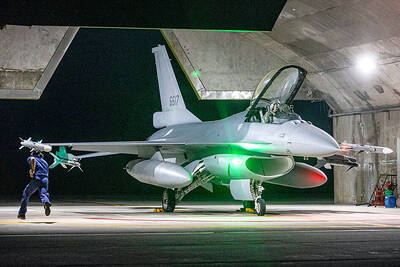
Taiwan has received more than US$70 million in royalties as of the end of last year from developing the F-16V jet as countries worldwide purchase or upgrade to this popular model, government and military officials said on Saturday. Taiwan funded the development of the F-16V jet and ended up the sole investor as other countries withdrew from the program. Now the F-16V is increasingly popular and countries must pay Taiwan a percentage in royalties when they purchase new F-16V aircraft or upgrade older F-16 models. The next five years are expected to be the peak for these royalties, with Taiwan potentially earning
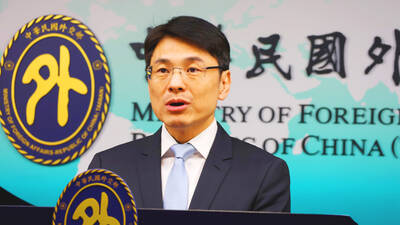
STAY IN YOUR LANE: As the US and Israel attack Iran, the ministry has warned China not to overstep by including Taiwanese citizens in its evacuation orders The Ministry of Foreign Affairs (MOFA) yesterday rebuked a statement by China’s embassy in Israel that it would evacuate Taiwanese holders of Chinese travel documents from Israel amid the latter’s escalating conflict with Iran. Tensions have risen across the Middle East in the wake of US and Israeli airstrikes on Iran beginning Saturday. China subsequently issued an evacuation notice for its citizens. In a news release, the Chinese embassy in Israel said holders of “Taiwan compatriot permits (台胞證)” issued to Taiwanese nationals by Chinese authorities for travel to China — could register for evacuation to Egypt. In Taipei, the ministry yesterday said Taiwan
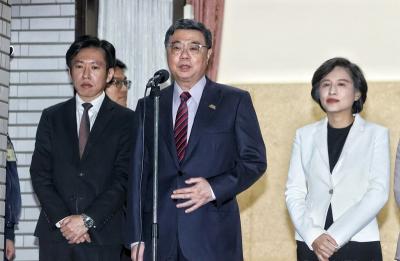
Taiwan is awaiting official notification from the US regarding the status of the Agreement on Reciprocal Trade (ART) after the US Supreme Court ruled US President Donald Trump's global tariffs unconstitutional. Speaking to reporters before a legislative hearing today, Premier Cho Jung-tai (卓榮泰) said that Taiwan's negotiation team remains focused on ensuring that the bilateral trade deal remains intact despite the legal challenge to Trump's tariff policy. "The US has pledged to notify its trade partners once the subsequent administrative and legal processes are finalized, and that certainly includes Taiwan," Cho said when asked about opposition parties’ doubts that the ART was
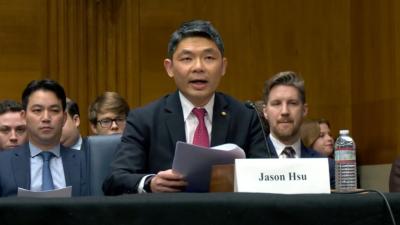
If China chose to invade Taiwan tomorrow, it would only have to sever three undersea fiber-optic cable clusters to cause a data blackout, Jason Hsu (許毓仁), a senior fellow at the Hudson Institute and former Chinese Nationalist Party (KMT) legislator, told a US security panel yesterday. In a Taiwan contingency, cable disruption would be one of the earliest preinvasion actions and the signal that escalation had begun, he said, adding that Taiwan’s current cable repair capabilities are insufficient. The US-China Economic and Security Review Commission (USCC) yesterday held a hearing on US-China Competition Under the Sea, with Hsu speaking on


 RSS
RSS