


The Mainland Affairs Council (MAC) yesterday said it welcomes local-level interaction across the Taiwan Strait, pledging to facilitate exchanges of views between the council and local government heads to promote amicable ties.
In a press release yesterday, the council said that improving interactions with local governments to forge consensuses has been a significant part of its effort to promote relations across the Taiwan Strait.
“In a bid to gain a better understanding of local governments’ views regarding cross-strait ties, MAC Minister Katharine Chang (張小月) and officials have visited the leaders of local governments, including Tainan and Taoyuan cities, as well as Nantou, Hualien and Hsinchu counties, since July,” the council said.
The purpose of the visits was to exchange opinions with local heads on the issue of cross-strait interactions and explain the central government’s policies, the council said, adding that more such visits would be conducted.
The council made the remarks amid speculation that recent visits by high-level council officials were meant to target the eight pan-blue local government heads who went to Beijing last month offering their acceptance of the so-called “1992 consensus” in exchange for preferential tourism treatment by China.
The delegation, consisting of six Chinese Nationalist Party (KMT) and two independent local government heads, met with Chinese People’s Political Consultative Conference Chairman Yu Zhengsheng (俞正聲) and China’s Taiwan Affairs Office Minister Zhang Zhijun (張志軍) during the visit to discuss tourism and trade-related issues.
The “1992 consensus” — a term former MAC chairman Su Chi (蘇起) admitted that he made up in 2000 — refers to a tacit understanding between the KMT and Beijing that both sides of the Taiwan Strait acknowledge that there is “one China,” with each side having its own interpretation of what “China” means.
President Tsai Ing-wen’s (蔡英文) refusal to recognize the “1992 consensus” has been met with several punitive measures from Beijing, including the suspension of official cross-strait communications and a reduction in the number of Chinese tourists allowed to visit Taiwan.
Stressing that the government has a positive attitude toward cross-strait interactions at the local government level, the council said it values suggestions made by local governments and that it has paid attention to the problems they face promoting cross-strait exchanges.
“Based on the existing foundation, we intend to bolster interactions and cooperation with various local governments, while joining hands with them to facilitate stable and peaceful development of cross-strait relations and improving the welfare of the people,” the council said.

Taiwanese can file complaints with the Tourism Administration to report travel agencies if their activities caused termination of a person’s citizenship, Mainland Affairs Council Minister Chiu Chui-cheng (邱垂正) said yesterday, after a podcaster highlighted a case in which a person’s citizenship was canceled for receiving a single-use Chinese passport to enter Russia. The council is aware of incidents in which people who signed up through Chinese travel agencies for tours of Russia were told they could obtain Russian visas and fast-track border clearance, Chiu told reporters on the sidelines of an event in Taipei. However, the travel agencies actually applied
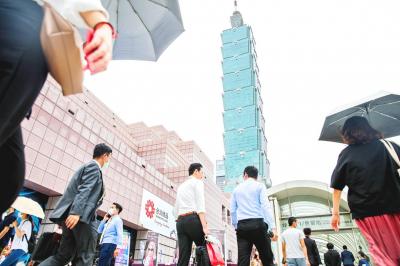
Japanese footwear brand Onitsuka Tiger today issued a public apology and said it has suspended an employee amid allegations that the staff member discriminated against a Vietnamese customer at its Taipei 101 store. Posting on the social media platform Threads yesterday, a user said that an employee at the store said that “those shoes are very expensive” when her friend, who is a migrant worker from Vietnam, asked for assistance. The employee then ignored her until she asked again, to which she replied: "We don't have a size 37." The post had amassed nearly 26,000 likes and 916 comments as of this
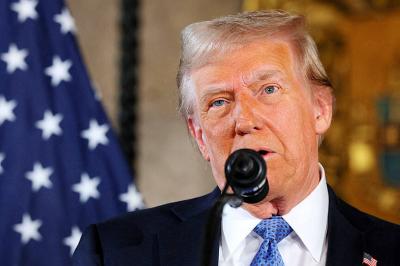
US President Donald Trump said "it’s up to" Chinese President Xi Jinping (習近平) what China does on Taiwan, but that he would be "very unhappy" with a change in the "status quo," the New York Times said in an interview published yesterday. Xi "considers it to be a part of China, and that’s up to him what he’s going to be doing," Trump told the newspaper on Wednesday. "But I’ve expressed to him that I would be very unhappy if he did that, and I don’t think he’ll do that," he added. "I hope he doesn’t do that." Trump made the comments in
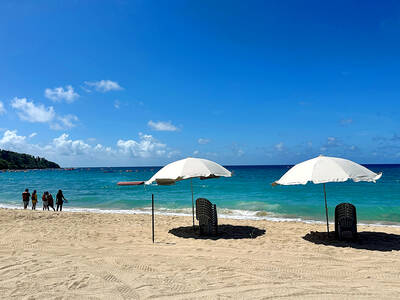
Tourism in Kenting fell to a historic low for the second consecutive year last year, impacting hotels and other local businesses that rely on a steady stream of domestic tourists, the latest data showed. A total of 2.139 million tourists visited Kenting last year, down slightly from 2.14 million in 2024, the data showed. The number of tourists who visited the national park on the Hengchun Peninsula peaked in 2015 at 8.37 million people. That number has been below 2.2 million for two years, although there was a spike in October last year due to multiple long weekends. The occupancy rate for hotels


 RSS
RSS