


Premier Lin Chuan (林全) yesterday said he does not see why Minister of Finance Sheu Yu-jer (許虞哲) should resign, amid media reports that Sheu would follow Financial Supervisory Commission chairman Ding Kung-wha (丁克華) in stepping down over the Mega International Commercial Bank (兆豐銀行) scandal.
Ding resigned on Monday to take responsibility for Mega Bank’s breaches of US money-laundering regulations.
Lin said that Ding had on several occasions informed him of his intention to resign over the Mega Bank incident, and Lin on Sunday finally approved his resignation.
When asked whether Ding’s resignation was a political move by the Cabinet in response to recent criticism of it being too “old, blue and male,” Lin said that political appointees have their own “considerations, as they come and go for different reasons.”
“As the commission has [since the Mega Bank scandal] been the subject of continued criticism, Ding felt that his resignation might be a good way [to settle the controversy],” Lin said.
An Executive Yuan supervisory task force formed to investigate the Mega Bank breach decided on Monday to have the Control Yuan assess the accountability in the incident of former commission chairs Chen Yuh-chang (陳裕璋), Jennifer Wang (王儷玲), William Tseng (曾銘宗) and Ding, as well as former minister of finance Chang Sheng-ford (張盛和) and Sheu, after the task force completes its investigation.
Chinese Nationalist Party (KMT) Legislator Lin Wei-chou (林為洲) questioned the premier about the decision during a legislative question-and-answer session yesterday.
Lin Chuan said the task force aims to clarify the accountability of the executives for failing to correct Mega Bank’s misconduct and therefore listed all of those working during that period, but added that the investigation is ongoing.
Lin Wei-chou pointed out that Sheu has two roles in the investigation, as he is assisting the probe, but also being investigated.
The premier said that Sheu was not involved in the appointment of Mega Bank board directors and supervisors, who were all appointed before May 20, but added that he would respect the task force’s decision.
“I do not think there is any reason for Sheu to resign,” Lin Chuan said in response to the lawmaker’s question of whether Sheu would be the next to resign.

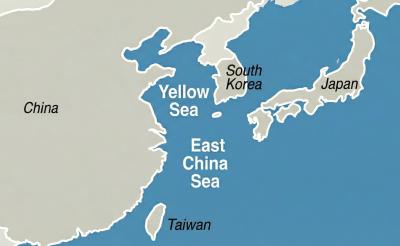
China has reserved offshore airspace in the Yellow Sea and East China Sea from March 27 to May 6, issuing alerts usually used to warn of military exercises, although no such exercises have been announced, the Wall Street Journal (WSJ) reported yesterday. Reserving such a large area for 40 days without explanation is an “unusual step,” as military exercises normally only last a few days, the paper said. These alerts, known as Notice to Air Missions (Notams), “are intended to inform pilots and aviation authorities of temporary airspace hazards or restrictions,” the article said. The airspace reserved in the alert is

South Korea is planning to revise its controversial electronic arrival card, a step Taiwanese officials said prompted them to hold off on planned retaliatory measures, a South Korean media report said yesterday. A Yonhap News Agency report said that the South Korean Ministry of Foreign Affairs is planning to remove the “previous departure place” and “next destination” fields from its e-arrival card system. The plan, reached after interagency consultations, is under review and aims to simplify entry procedures and align the electronic form with the paper version, a South Korean ministry official said. The fields — which appeared only on the electronic form

A bipartisan group of US senators has introduced a bill to enhance cooperation with Taiwan on drone development and to reduce reliance on supply chains linked to China. The proposed Blue Skies for Taiwan Act of 2026 was introduced by Republican US senators Ted Cruz and John Curtis, and Democratic US senators Jeff Merkley and Andy Kim. The legislation seeks to ease constraints on Taiwan-US cooperation in uncrewed aerial systems (UAS), including dependence on China-sourced components, limited access to capital and regulatory barriers under US export controls, a news release issued by Cruz on Wednesday said. The bill would establish a "Blue UAS
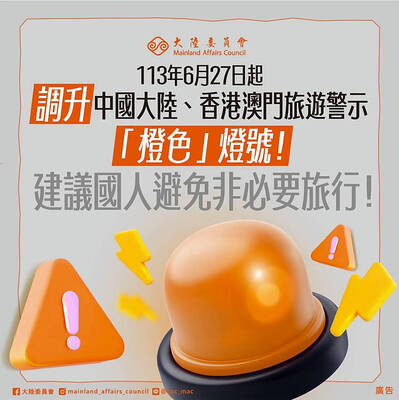
More than 6,000 Taiwanese students have participated in exchange programs in China over the past two years, despite the Mainland Affairs Council’s (MAC) “orange light” travel advisory, government records showed. The MAC’s publicly available registry showed that Taiwanese college and university students who went on exchange programs across the Strait numbered 3,592 and 2,966 people respectively. The National Immigration Agency data revealed that 2,296 and 2,551 Chinese students visited Taiwan for study in the same two years. A review of the Web sites of publicly-run universities and colleges showed that Taiwanese higher education institutions continued to recruit students for Chinese educational programs without


 RSS
RSS